COSTAdapta

Categories
News

LIFE COSTAdapta holds its second Consortium Meeting with the participation of ELMEN

A Coastal Climate Adaptation Day will take place on Tuesday as part of the EU Region Week

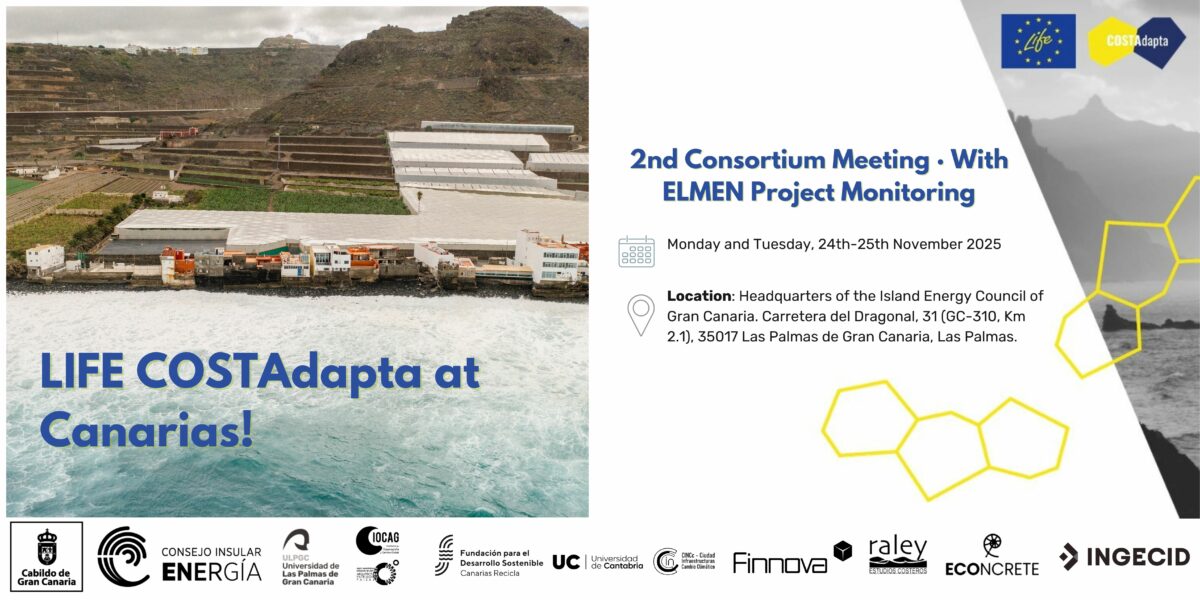
Brussels, 20 November 2025. The European project LIFE COSTAdapta will hold its second in-person consortium meeting on Monday, 24 November, at the headquarters of the Island Energy Council of Gran Canaria (CIEGC). The session will bring together all partner organisations to review technical progress and coordinate the next steps in the development of innovative solutions for coastal climate adaptation.

The meeting will open with a welcome speech by Alexis Lozano, Director of Energy and Climate at CIEGC. This will be followed by an intervention from Sara Barceló, representative of ELMEN and monitor appointed by the LIFE Programme, who will present an expert assessment of the project’s status from the perspective of the European supervisory body.

Throughout the day, partners will present updates on each component of the project. Patricia Caro, from the University of Las Palmas de Gran Canaria (ULPGC), will report on overall coordination and management. Rakel Ramos Pereda, from Raley Estudios Costeros, and Cecilia Ribalaygua, from the University of Cantabria, will explain the preparatory actions related to coastal behaviour analysis. Development activities will be presented by Iñaki Pérez (ULPGC) and Leire Fernández Prieto (Raley Estudios Costeros).

Implementation progress will be outlined by Nuria Pérez, from INGECID, while validation and monitoring tasks will again be presented by Patricia Caro. Communication, replication and sustainability activities will be presented by Yolanda Durán and Adrián Noheda from the Finnova Foundation.

The consortium also announces the celebration of the 1st Coastal Climate Adaptation Day for Island Regions, which will take place on Tuesday, 25 November, within the official programme of the European Week of Regions and Cities (EU Region Week). The event will gather experts, public authorities, research institutions and organisations working on coastal adaptation challenges.

Registrations remain open, although they are close to closing. Interested participants may still register via the following link:

https://www.eventbrite.es/e/i-jornada-de-adaptacion-costera-el-proyecto-life-costadapta-tickets-1360524187469

LIFE COSTAdapta has a total budget of 3,337,563 euros, of which 2,002,538 euros are financed by the European Union through the LIFE Programme. The project runs for 84 months and is coordinated by the Island Energy Council of Gran Canaria, together with ULPGC, the University of Cantabria, INGECID, Raley Estudios Costeros, ECOncrete AQUA, the Canary Foundation for Recycling and Sustainable Development and the Finnova Foundation.

More information: https://costadapta.energiagrancanaria.com

Categories
News

The tidal pool-reefs proposed by LIFE COSTAdapta to adapt the coast to rising seas will play a crucial role in the environment.

  • The project joins the celebration of World Environment Day today, June 5th.
  • LIFE COSTAdapta demonstrates a commitment to protecting the environment and promoting sustainable solutions.

Today we celebrate World Environment Day, which reminds us of the importance of caring for and protecting this source of life. It is a day that encourages us to reflect on the need to unite and contribute to a better world for us and future generations.

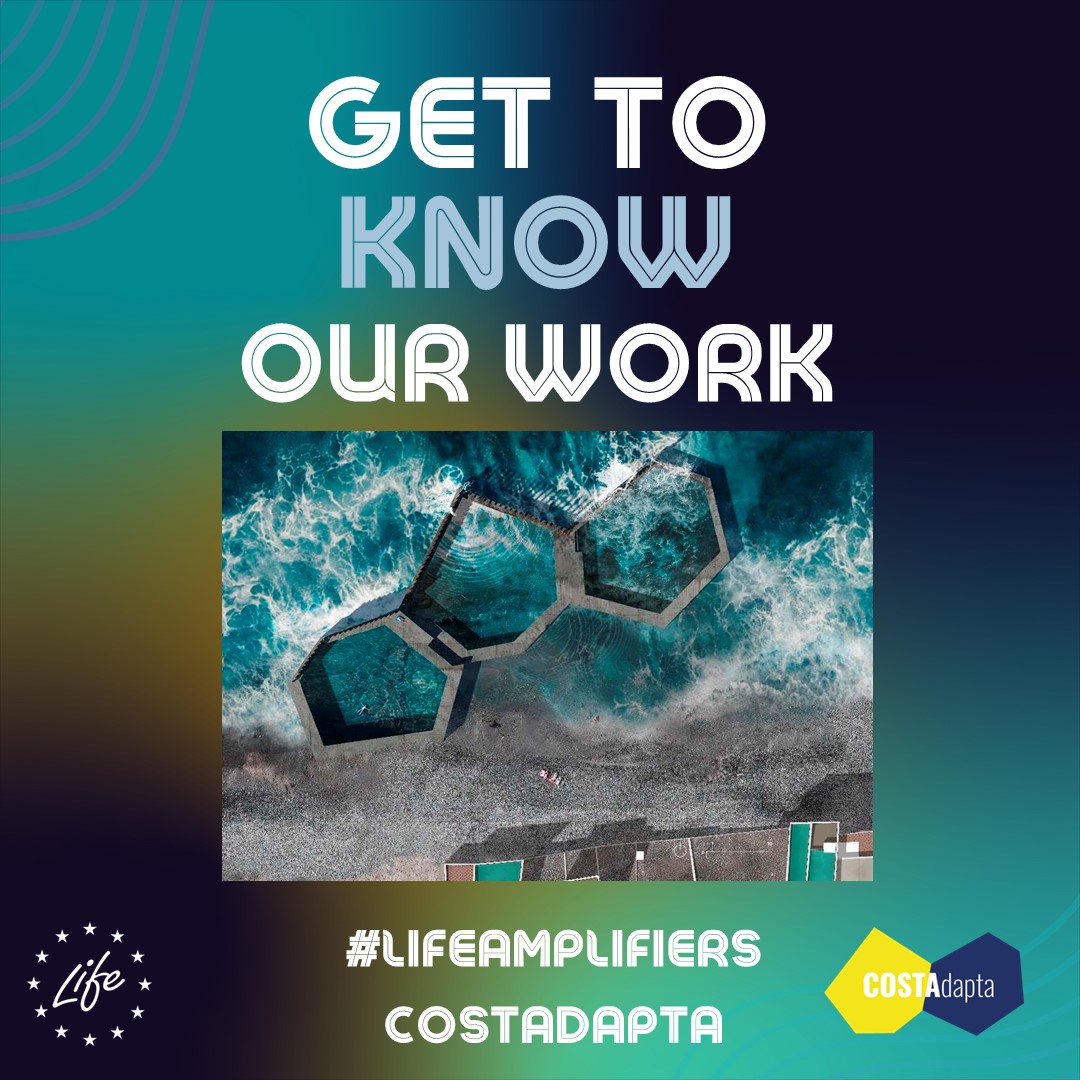
At LIFECOSTAdapta, we prioritize environmental care. Our goal is to adapt the coast to rising sea levels by constructing tidal reefs made of ecological materials, promoting the preservation of marine ecosystems and biodiversity. This prototype is an important coastal ecosystem that provides shelter for diverse marine life, opportunities for education and research, and recreational benefits.

Environmentally, it will play a crucial role for several reasons:

  • Biodiversity: Tide pools serve as temporary habitats for a diverse array of organisms, including algae, molluscs, crustaceans, anemones, small fish, and various invertebrate species. They offer an opportunity to study biodiversity and ecological interactions in a confined space.
  • Natural Laboratories: Due to their changing conditions and small size, tide pools are excellent for scientific research. Scientists can observe directly how these organisms respond to environmental factors such as temperature, salinity, and oxygen availability.
  • Education and Recreation: Tide pools are accessible and attractive for environmental education and recreation. They can inspire people to learn more about marine life and the importance of conserving coastal ecosystems.
  • Food Sources: Many organisms rely on tide pools as a temporary source of food and shelter. Seabirds, for example, often forage in these pools at low tide.

These reefs will not only mitigate coastal erosion by attenuating waves and currents but also foster ecotourism by attracting visitors interested in sustainability, coastal ecosystems, and the unique biodiversity characteristic of Gran Canaria. In addition, the project aims to raise community and visitor awareness of the importance of conservation, adding value to local ecological understanding. The project represents a step forward in coastal adaptation to climate change and demonstrates a commitment to protecting the environment and promoting sustainable solutions. Ultimately, it seeks to maintain the compatibility of residential use and the environment.

Today, more than ever, let’s celebrate World Environment Day!

About LIFE COSTAdapta

The main objective of the LIFE COSTAdapta project is to address the adaptation of the coast of Gran Canaria to sea level rise through an innovative methodology. To achieve this, we will develop and test a progressive tidal pool-reef system, integrating traditional tidal pool construction techniques and advanced solutions.

This approach will contribute to the gradual adaptation of the Gran Canaria coast to climate change, which is crucial given the region’s high vulnerability to climate impacts, including sea level rise. In addition to strengthening the resilience of coastal areas, LIFE COSTAdapta aims to conserve habitats characteristic of these areas and protect the local tourism economy. Furthermore, the project will ensure economic sustainability by offering flood mitigation solutions and preserving the region’s appeal to tourists, thus reinforcing coastal stability.

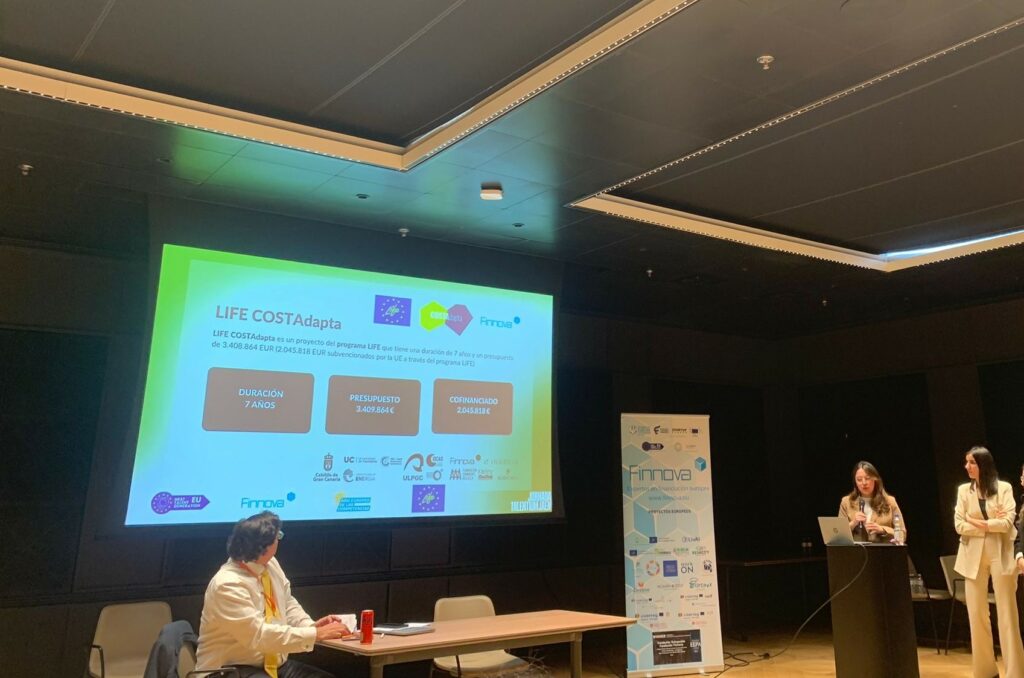
The project, with a duration of 7 years and a total budget of 3,409,864 EUR (2,045,818 EUR subsidized by the European Union through the LIFE Programme), is coordinated by the Gran Canaria Island Energy Council (CIEGC) of the Cabildo de Gran Canaria, with the support of 7 partners: University of Las Palmas de Gran Canaria (ULPGC); University of Cantabria (UC); INGECID, Research and Project Development; Raley Estudios Costeros S. C.P.; ECOncrete AQUA; Fundación Canaria para el Reciclaje y Desarrollo Sostenible (FCR) and Fundación Finnova.

Categories
News

LIFE COSTAdapta celebrates the 32nd anniversary of the LIFE programme

The LIFE Programme is the only financial instrument of the European Union dedicated exclusively to the environment and climate action. Since 1992, more than 900 LIFE projects have been approved in Spain (5,400 in the EU as a whole), with a total budget of 1,555 million euros and an EU contribution of 781 million euros (9,000 million in the EU as a whole, with a total EU contribution of more than 6,500 million euros). Today, we celebrate the 32nd anniversary of this important programme for the preservation of the environment.

LIFE Costadapta is a project funded by the LIFE programme, which aims to adapt coasts to rising seas. This is a very important objective considering that climate change is causing many coasts to deteriorate due to strong waves and rising seas. Thanks to LIFE funding, the project will be able to design and test an innovative system of proximity reefs that partially use the traditional technique of building ‘tidal pool-reefs’ common in the Canary Islands and the rest of Macaronesia.  

With a duration of 7 years and a total budget of 3,409,864 EUR (2,045,818 EUR subsidised by the EU through the LIFE Programme), COSTAdapta is a project coordinated by the Gran Canaria Island Energy Council (CIEGC) of the Cabildo de Gran Canaria with the support of 7 partners: University of Las Palmas de Gran Canaria (ULPGC); University of Cantabria (UC); INGECID, Research and Project Development; Raley Estudios Costeros S. C.P.; ECOncrete AQUA; Fundación Canaria para el Reciclaje y Desarrollo Sostenible (FCR) and Fundación Finnova.

Happy Anniversary! Here’s to many more years of innovative achievements and environmental stewardship with the LIFE Programme.

Categories
News

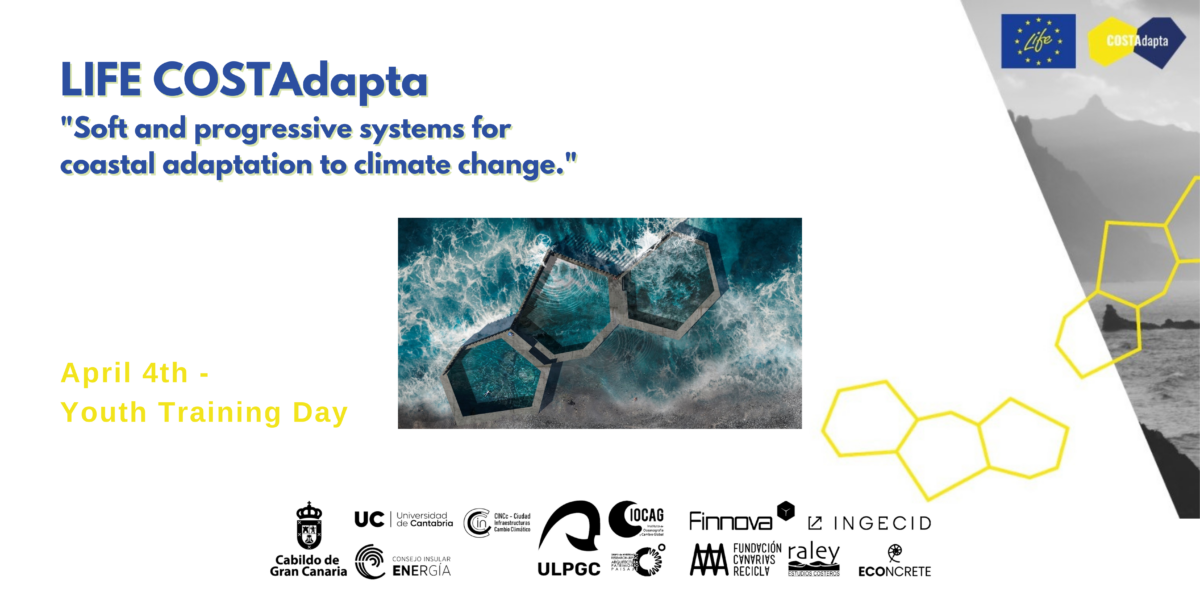
LIFE COSTAdapta present at the youth training day in Brussels

  • The training meeting for young talents was held on 4 April in the European capital.
  • Finnova presented the main objectives and activities of the project.

Brussels, 5 April 2024. LIFE COSTAdapta has been present last 4th April at the training day for young people held in Brussels by the Finnova Foundation, partner of the project. During the event, attendees were able to learn about the main aspects of the European project and the activities that are being developed.

The presentation of LIFE COSTAdapta was very well received by the young people, who were able to see the importance of this project to alleviate the consequences of rising sea levels on the coasts. The day also served to raise awareness of a project that can be scaled up to other European territories and that will undoubtedly have enormous benefits for the coast of Gran Canaria.

About LIFECOSTAdapta

The main objective of the LIFE COSTAdapta project is to address the adaptation of the coast of Gran Canaria to sea level rise through an innovative methodology. To this end, a progressive tidal pool-reef system will be designed and tested, combining traditional tidal pool construction techniques with advanced solutions.

This will contribute to the progressive adaptation of the Gran Canaria coast to climate change, crucial given the high vulnerability of the Canary Islands to climate impacts, including sea level rise. In addition to strengthening the resilience of coastal areas, LIFE COSTAdapta aims to conserve habitats characteristic of these areas and protect the local tourism economy. The project will ensure economic sustainability by providing solutions to flooding and maintaining the region’s tourist attraction, which in turn will support coastal stability.

The project, with a duration of 7 years and a total budget of 3,409,864 EUR (2,045. 818 EUR subsidised by the European Union through the LIFE Programme), is coordinated by the Consejo Insular de Energía de Gran Canaria (CIEGC) of the Cabildo de Gran Canaria, with the support of its seven partners, among which are public entities, universities, foundations and private companies, such as the University of Las Palmas de Gran Canaria (ULPC), universities, foundations and private companies, such as the University of Las Palmas de Gran Canaria (ULPGC), the University of Cantabria (UC), INGECID, Raley Estudios Costeros, ECONCRETE, the Canary Islands Foundation for Recycling and Sustainable Development and the Finnova Foundation.