COSTAdapta

Categories
News

The European project LIFE COSTAdapta plays a crucial role in introducing new climate change adaptation measures

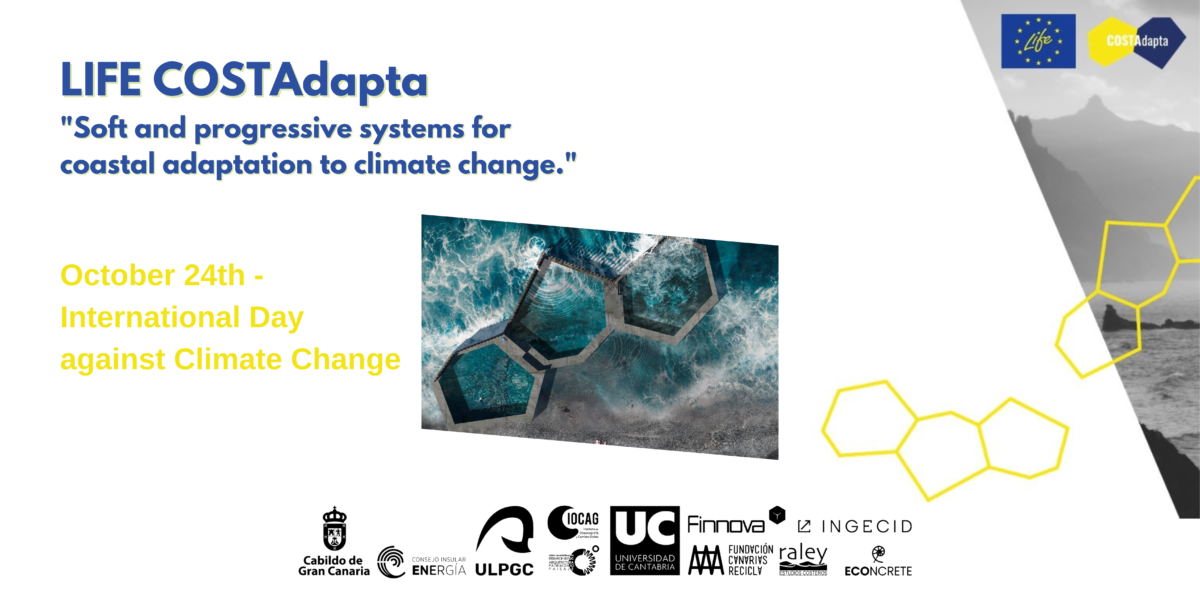
24/10/2023, Brussels. Today, Tuesday, October 24th, we celebrate International Day against Climate Change to raise awareness about the harmful and devastating effects of climate change on the planet. This commemoration is driven by the United Nations (UN) as an initiative advocating for the generation of actions to counteract climate change.

Climate change involves the global variation of the Earth’s climate and temperature, primarily caused by natural factors over the long term. Over the past century, pollution generated by human activity has accelerated this process at an alarming rate due to the emission of greenhouse gases produced by factors such as the burning of fossil fuels, land use, energy consumption, and industrial activities.

These gases lead to an increase in temperatures, giving rise to the phenomenon of global warming, which is the main driver of climate change. Some of the global effects include rising average temperatures, sea level rise, Arctic ice melting, and an increase in extreme weather events such as droughts, wildfires, water shortages, and floods, among others.

LIFE COSTAdapta addresses the adaptation of the coast of Gran Canaria to sea level rise through an innovative methodology. To this end, the objective is to design and test an innovative and progressive Tidal pool-reef system, which uses, partially, the traditional technique of tidal pool construction, common elements in the Canary Islands and the rest of Macaronesia, for the coastal adaptation of Gran Canaria to climate change. The project, which has a duration of 7 years and a total budget of 3,409,864 EUR, is coordinated by the Consejo Insular de Energía de Gran Canaria (CIEGC) of the Cabildo de Gran Canaria with the support of 7 partners: Universidad de Las Palmas de Gran Canaria (ULPGC); Universidad de Cantabria (UC); INGECID S.L.; Raley Estudios Costeros S.C.P.; ECOncrete AQUA; Fundación Canar.  
Categories
News

LIFE COSTAdapta aims to reduce the risk of coastal floods and erosion

Brussels, October 13, 2023. Today, International Day for Disaster Risk Reduction, we recall that the rising sea level, caused by global warming, is one of the most serious threats posed by climate change in coastal areas.

According to a recent study by the Spanish Institute of Oceanography (IEO-CSIC), in collaboration with the Mediterranean Institute for Advanced Studies (IMEDEA), the rate at which the sea level is rising in Spain, with its 8,000 kilometers of coastline, has doubled in the past 20 years. Since 1993, the sea level has been increasing at an average rate of 2.8 millimeters per year. This phenomenon is impacting the risk of beach erosion and, consequently, poses a threat to the country’s primary economic resource: tourism. But it’s not just that; it also presents a looming risk to the safety of coastal communities.

The climate change report presented by the Spanish government in 2021 projects a worrisome scenario in which it is estimated that the flooding levels in some coastal areas of the country could increase by 8% by the year 2040. This increase would be 6% in the Canary Islands and range between 2% and 3% along the rest of the Mediterranean coast. The study warns of the risk of suffering million-euros damages from flooding in the most exposed coastal cities.


LIFE COSTAdapta’s proposal for adapting and strengthening the coastlines of Gran Canaria against climate change

LIFE COSTAdapta project aims to address the adaptation of the coast of Gran Canaria to sea-level rise through an innovative methodology. To achieve this, a progressive system of tidal pool-reefs will be designed and tested, combining traditional tidal pool construction techniques with advanced solutions.

This will contribute to the gradual adaptation of the Gran Canaria coast to climate change, which is crucial given the high vulnerability of the Canary Islands to climate impacts, including sea-level rise. In addition to strengthening the resilience of coastal areas, LIFE COSTAdapta seeks to preserve the characteristic habitats of these areas and protect the local tourist economy. The project will ensure economic sustainability by providing solutions against flooding and maintaining the region’s tourist appeal, which in turn will favor coastal stability.

The project, with a duration of 7 years and a total budget of 3,409,864 EUR (2,045,818 EUR subsidized by the European Union through the LIFE Program), is coordinated by Consejo Insular de Energía de Gran Canaria (CIEGC) by the Cabildo de Gran Canaria, with the support of its seven partners.

Categories
News

Three ways in which LIFE COSTAdapta will contribute to strengthening coastal geodiversity

Brussels, October 6, 2023. On International Geodiversity Day, from LIFE COSTAdapta, we share three ways in which our European project, specifically designed to address the challenges associated with climate change and adapt the coastlines of Gran Canaria to its effects, can promote the strengthening of coastal geodiversity with its innovative method of Tidal pool-reefs.

Coastal habitats benefit from the innovative system of LIFE COSTAdapta

The sustainable solution of LIFE COSTAdapta will contribute to coastal resilience against climate change by creating Tidal pool-reefs with the potential to provide shelter and food for various marine species, thus strengthening coastal geodiversity. But that’s not all; this European project aims to introduce a multi-channel methodology that, collectively, will support the ecological transition of the area in various ways:

  1. Mitigating coastal erosion

Tidal pool-reefs will help mitigate coastal erosion by calming the force of waves and currents. This will protect the coastline and the health of nearby natural habitats, enhancing the resilience of coastal geodiversity against the effects of climate change and human activity.

  • Promoting ecotourism

These artificial structures will offer a unique coastal environment, attracting visitors interested in the characteristic biodiversity of these areas. Moreover, it aims to position itself as an effective tool for engaging the local community and visitors in awareness and conservation activities, thereby adding value to social awareness regarding local sustainability and environmental care.

  • Encouraging innovation and research

As a project within the European LIFE program, one of the main priorities of the consortium comprising 8 partners will be to establish synergies and collaborations to ensure the continuity and possible transfer of this approach for the benefit of other coastal regions facing similar challenges. This consortium, supported by experts and allied with public-private initiatives, will promote research and innovation with the constant aim of improving this approach.

About LIFE COSTAdapta

LIFE COSTAdapta project aims to address the adaptation of the coast of Gran Canaria to sea-level rise through an innovative methodology. To achieve this, a progressive system of Tidal pool-reefs will be designed and tested, combining traditional tidal pool construction techniques with advanced solutions.

This will contribute to the gradual adaptation of the Gran Canaria coast to climate change, which is crucial given the high vulnerability of the Canary Islands to climate impacts, including sea-level rise. In addition to strengthening the resilience of coastal areas, LIFE COSTAdapta seeks to preserve the characteristic habitats of these areas and protect the local tourist economy. The project will ensure economic sustainability by providing solutions against flooding and maintaining the region’s tourist appeal, which in turn will favor coastal stability.

The project, with a duration of 7 years and a total budget of 3,409,864 EUR (2,045,818 EUR subsidized by the European Union through the LIFE Program), is coordinated by Consejo Insular de Energía de Gran Canaria (CIEGC) by the Cabildo de Gran Canaria, with the support of its seven partners.

Categories
News

The design of an innovative and progressive tidal pool-reef system proposed by LIFE COSTAdapta will enhance biodiversity

  • World Habitat Day is celebrated today to promote awareness of urban habitat issues and the importance of a liveable and sustainable environment.

Today, 2 October, coinciding with the first Monday of this month, is World Habitat Day 2023, the perfect occasion to highlight the state of many habitats on the planet. The day was established by the United Nations to promote awareness of urban habitat issues and the importance of a liveable and sustainable environment. World Habitat Day focuses on highlighting the need to address issues such as adequate urban planning, access to decent housing, sustainable transport, natural resource management in urban areas and the promotion of more inclusive and equitable communities.

The loss of natural habitats often leads to the extinction of species that depend on those ecosystems for their survival. Natural habitats are home to a unique variety of flora and fauna, and when they disappear, the species that once inhabited them may be threatened with extinction. The degradation or disappearance of a habitat forces species to seek new places to live and feed. This can lead to forced migration of animals, which can result in conflicts with other species and competition for limited resources. Many human communities depend on natural habitats for resources such as food, medicines and building materials. The disappearance of these ecosystems can lead to shortages of essential resources, negatively affecting people’s livelihoods. The loss of natural habitats can also have a significant economic impact. Ecosystem degradation can affect industries related to tourism, fisheries and agriculture, which in turn can affect the economic stability of a region.

The main objective of the LIFE COSTAdapta project is to adapt island and outermost territories to climate change, enhance biodiversity and maintain the compatibility of residential use and the environment. LIFE COSTAdapta will develop adaptation measures through natural and mixed actions, focused on integration and improvement, both with the natural environment and with the enhancement of cultural elements. To this end, it plans actions to adapt to rising sea levels through the design and testing of an innovative and progressive tidal pool-reef system, which partially uses the traditional technique of building tidal pools, common elements in the Canary Islands and the rest of Macaronesia, for the coastal adaptation of Gran Canaria to climate change.

The development and design of these prototypes with a holistic vision of adaptation to sea level rise, increases its benefits and promotes a solution (blue infrastructure) that encompasses crucial factors in the resilience and quality of life of coastal areas: reduction of the flooding surface, reduction in the height of the sheet of water, adaptability to changing circumstances (modular measures of progressive increase), systems for the creation of marine habitats, creation of places of social enjoyment with easy accessibility, increase of economic activities, improvement of degraded areas, among others.