COSTAdapta

Categories
News

2023 closes with record-breaking temperatures that are affecting sea level rise

  • 2023 looks set to be the hottest year in recorded history
  • Sea level rise is a direct consequence of global temperature increase
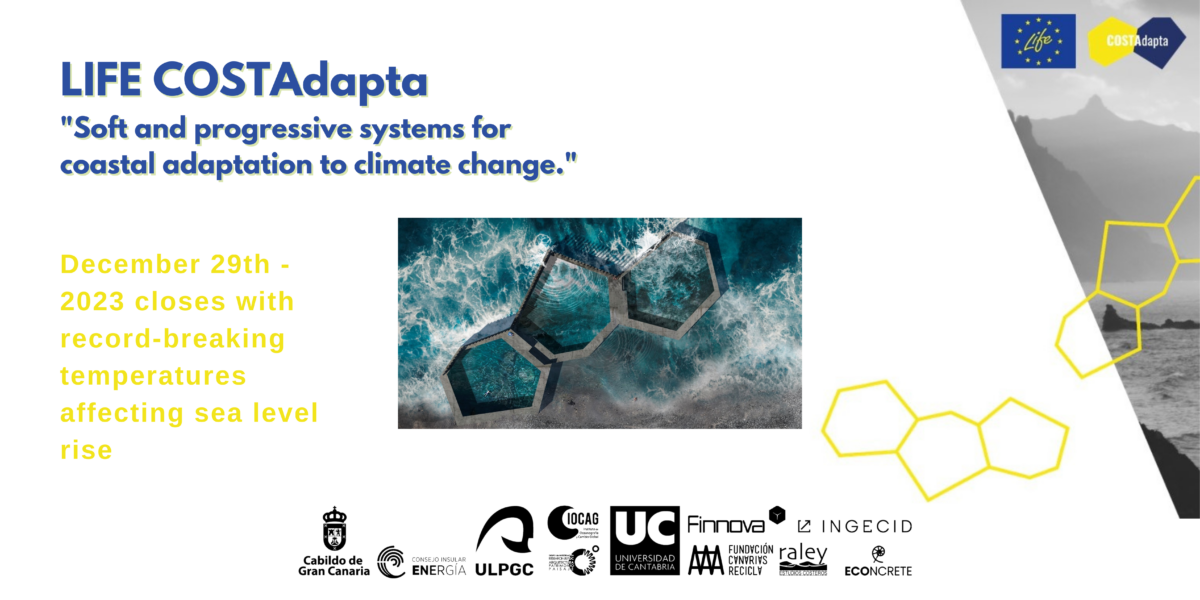
  • The European LIFE COSTAdapta project aims to adapt the coast of Gran Canaria to climate change by building a progressive system of tidal reefs-tide shelves

In just one week’s time, 2023 will come to a close, a year in which several temperature records have been broken as a result of climate change. This rise in global temperature is causing sea levels to rise, threatening seabed biodiversity, erosion and coastal encroachment, among other adverse effects. The European LIFE COSTAdapta project aims to address the problems caused by rising sea levels on the coast of Gran Canaria by building a progressive system of tidal reefs-tidal pools.

This year has seen sustained record-breaking temperatures. Up to October, the global average temperature in 2023 was the highest since measurements began, approaching the planetary safety limit of 1.5 degrees above pre-industrial levels set as a target by the international community in the historic Paris Agreement. The perfect storm unleashed by the combination of climate change and the “El Niño” phenomenon, which is often the cause of rising temperatures in recent years, is behind data that already places this year as the warmest, pending confirmation by the end of 2023.

Moreover, once the hottest months in the northern hemisphere, July and August, were over, the lull in the thermometers was relatively short-lived and the counter-attack of the heat was violent. Global temperatures in September and October were more anomalous than in any other year, according to Copernicus data. In fact, in Europe, this September was the hottest September by far: 1.1°C behind the previous top-ranked September, which was in 2020.

Multiple records have also been broken with respect to sea temperature. During this summer, both the Mediterranean and the Atlantic have broken their maximum temperature records, reaching average values of 28.71ºC and 24.9ºC, respectively. Both seas are living, on average, with water temperatures well above the historical average and the highest range ever detected.

When sea levels are rising as fast as they are, even the smallest rise can have terrible consequences for people living on the coast. As seawater moves inland, it can lead to soil erosion, flooding of wetlands, contamination of agricultural land and aquifers, and thus loss of habitat for fish, birds and plants. On the other hand, sea level rise coincides with the occurrence of more extreme weather conditions and more dangerous weather phenomena.

About LIFE COSTAdapta

The main objective of the LIFE COSTAdapta project is to address the adaptation of the coast of Gran Canaria to sea level rise by means of an innovative methodology. To this end, a progressive tidal pool-reef system will be designed and tested, combining traditional tidal pool construction techniques with advanced solutions.

This will contribute to the progressive adaptation of the Gran Canaria coast to climate change, crucial given the high vulnerability of the Canary Islands to climate impacts, including sea level rise. In addition to strengthening the resilience of coastal areas, LIFE COSTAdapta aims to conserve habitats characteristic of these areas and protect the local tourism economy. The project will ensure economic sustainability by providing solutions to flooding and maintaining the region’s tourist attraction, which in turn will support coastal stability.

The project, with a duration of 7 years and a total budget of 3,409,864 EUR (2,045. 818 EUR subsidised by the European Union through the LIFE Programme), is coordinated by the Consejo Insular de Energía de Gran Canaria (CIEGC) of the Cabildo de Gran Canaria, with the support of its seven partners, among which are public entities, universities, foundations and private companies, such as the University of Las Palmas de Gran Canaria (ULPC), universities, foundations and private companies, such as the University of Las Palmas de Gran Canaria (ULPGC), the University of Cantabria (UC), INGECID, Raley Estudios Costeros, ECONCRETE, the Canary Islands Foundation for Recycling and Sustainable Development and the Finnova Foundation.
Categories
News

Rising sea levels at the heart of the COP 28 debate

  • The most vulnerable territories have insisted on the need to keep global temperature rise below 1.5 degrees Celsius
  • LIFE COSTAdapta is a project that aims to protect coasts from rising sea levels

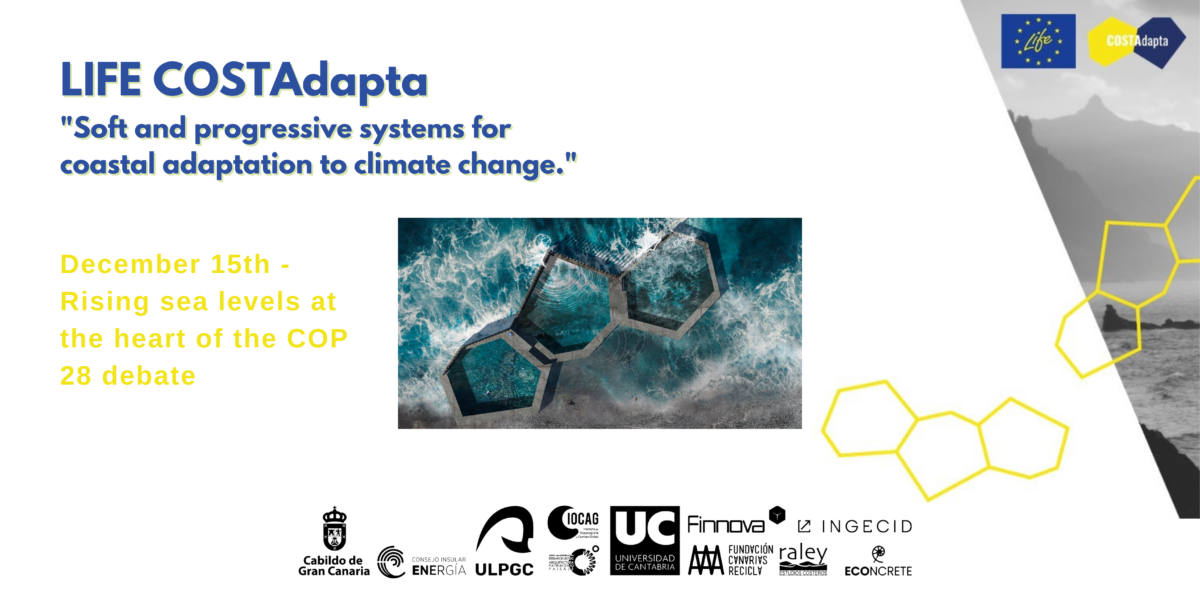
Brussels, 15 December 2023. The United Nations Conference on Climate Change held in Dubai (also known as COP 28), closed last Tuesday, December 12, with a warning message from the countries most vulnerable to climate change about its eventual disappearance. The constant rise in sea level is the main threat to island territories such as Tuvalu, Kiribati or the Fiji Islands, states that have hardly any altitude and for which the fight against climate change is at the top of the agenda. A problem that the European project LIFE COSTAdapta aims to tackle by addressing the adaptation of the coast of Gran Canaria to sea level rise.

The Alliance of Small Island States (AOSIS) has exposed once again at this last COP the imperative need to keep the rise in global average temperature below 1.5 degrees. This body, which brings together 39 territories particularly vulnerable to climate change, warns that they are already suffering with the current level of warming, and that losses and damages will increase with each increase in temperature.  “For our islands, there can be no alternative. This is our red line,” they point out.

In addition, AOSIS also issued a statement criticizing some aspects of the final agreement of this COP 28. The organization regrets that no commitment was made to reach peak emissions in 2025. AOSIS refers to the lack of attention being given to scientific rigor in this aspect, by not taking the relevant measures in order to act in line with what science says should be done.

The LIFE COSTAdapta project, which was present at COP 28, aims to show the problems that sea level rise can cause if we do not act in time in this regard. Precisely, it is in line with the main objective of the LIFE COSTAdapta project, to address the adaptation of the coast of Gran Canaria to sea level rise. 

About LIFE COSTAdapta

The main objective of the LIFE COSTAdapta project is to address the adaptation of the coast of Gran Canaria to sea level rise through an innovative methodology. To this end, a progressive tidal pool-reef system will be designed and tested, combining traditional tidal pool construction techniques with advanced solutions.

This will contribute to the progressive adaptation of the coast of Gran Canaria to climate change, which is crucial given the high vulnerability of the Canary Islands to climate impacts, including sea level rise. In addition to strengthening the resilience of coastal areas, LIFE COSTAdapta seeks to conserve habitats characteristic of these areas and protect the local tourism economy. The project will ensure economic sustainability by providing solutions to flooding and maintaining the region’s tourist attraction, which in turn will support coastal stability.

The project, with a duration of 7 years and a total budget of EUR 3,409,864 (EUR 2,045,818 subsidized by the European Union through the LIFE Program), is coordinated by the Gran Canaria Island Energy Council (CIEGC) of the Cabildo de Gran Canaria, with the support of its seven partners.

Categories
News

The LIFE COSTAdapta project, led by the Cabildo de Gran Canaria, at COP 28 in Dubai

  • E-Concrete, one of the partners, has been in charge of taking the project to the largest UN climate summit.
  • LIFE COSTAdapta, which deals with the adaptation of the coast of Gran Canaria to sea level rise, could become a reference and be replicated in those coastal areas that suffer the consequences of strong waves.

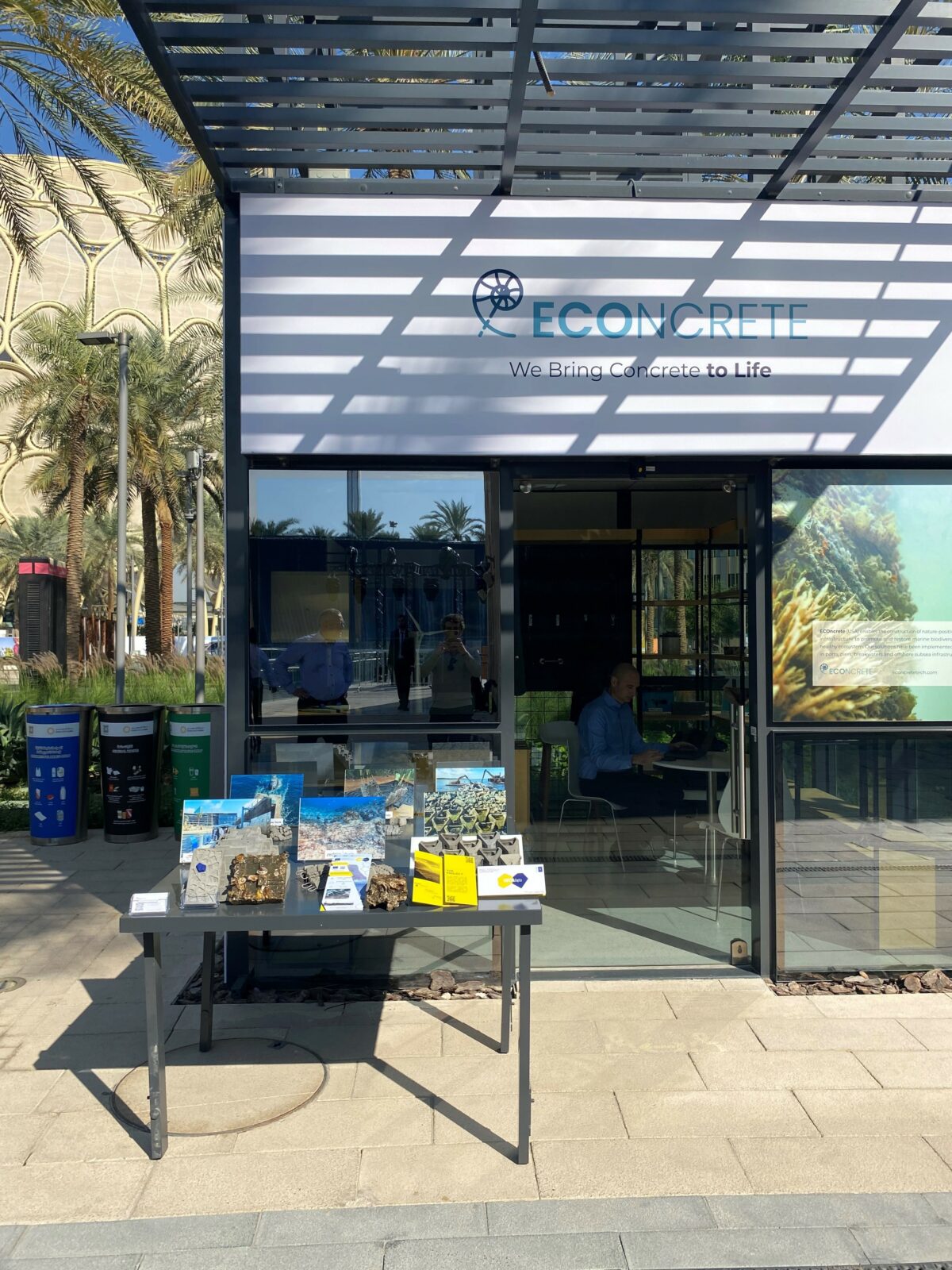
The European LIFE Costadapta project, which aims to address the adaptation of the coast of Gran Canaria to sea level rise, is currently present at COP 28, with the support of one of the project partners, E-Concrete. Led by the Council of Gran Canaria, the European project aims to become a benchmark and be replicated in those coastal areas that suffer the consequences of strong waves.

The Canary Islands are in a position of high vulnerability to the impacts of climate change, as pointed out by the Intergovernmental Panel on Climate Change (IPCC), showing a significant increase in sea levels affecting its coasts. The main objective of the LIFE COSTAdapta project is to address the adaptation of the coast of Gran Canaria to rising sea levels through an innovative methodology. To this end, a progressive tidal pool-reef system will be designed and tested, combining traditional tidal pool construction techniques with advanced solutions. This will contribute to the progressive adaptation of the coast of Gran Canaria to climate change, crucial given the high vulnerability of the Canary Islands to climate impacts, including sea level rise.

In addition to strengthening the resilience of coastal zones, LIFE COSTAdapta aims to conserve habitats characteristic of these areas and protect the local tourism economy. The project will ensure economic sustainability by providing solutions to flooding and maintaining the region’s tourist attraction, which in turn will support coastal stability.

This project that we are presenting these days in Dubai is particularly important to strengthen the resilience of coastal areas in the face of rising sea levels, and to promote the preservation of the biodiversity characteristic of these areas”, says Àlvar Trabazos Clavería, Project Manager of E-Concret. “In a forum as important as this one, in which climate change is the main protagonist, we are receiving many visits from organisations and individuals who have expressed their interest in this practice that respects the habitat and helps to prevent further erosion on the coast. LIFE COSTAdapta is committed to protecting the environment and promoting sustainable solutions” he adds.

With a duration of 7 years and a total budget of 3,409,864 EUR (2,045,818 EUR subsidised by the EU through the LIFE Programme), COSTAdapta is a project coordinated by the Gran Canaria Island Energy Council (CIEGC) of the Cabildo de Gran Canaria with the support of 7 partners: University of Las Palmas de Gran Canaria (ULPGC); University of Cantabria (UC); INGECID, Research and Project Development; Raley Estudios Costeros S. C.P.; ECOncrete AQUA; Fundación Canaria para el Reciclaje y Desarrollo Sostenible (FCR) and Fundación Finnova.

About the Gran Canaria Island Energy Council (CIEGC)

The Consejo Insular de la Energía de Gran Canaria (CIEGC) is a public business entity of the Cabildo de Gran Canaria whose mission is to implement an alternative energy model based on renewable energies and energy efficiency. The CIEGC manages subsidies, promotes electric mobility, trains professionals and citizens, and promotes research and innovation in the energy sector.

About ECOncrete (www.econcretetech.com)

ECOncrete is an initiative focused on innovation in sustainable marine and coastal infrastructures. Through the application of advanced technologies and materials, ECOncrete seeks to mitigate the negative impacts of human constructions on aquatic and marine ecosystems. The initiative is based on ecological design principles and collaborates with experts in marine biology and other disciplines to achieve solutions that promote biodiversity and coastal resilience. In LIFE COSTAdapta, it is responsible for the design, implementation and monitoring of the project.

About the University of Las Palmas de Gran Canaria (ULPGC)

The University of Las Palmas de Gran Canaria (ULPGC) is a higher education institution located on the island of Gran Canaria, Spain. Founded in 1989, the ULPGC has established itself as a centre of academic excellence especially in disciplines such as natural sciences and technology. The university strives to promote research, innovation and international collaboration to contribute to the development of society and the region.

About the University of Cantabria (UC)

The University of Cantabria (UC) is an academic institution of higher education located in Cantabria, Spain. Founded in 1972, the UC stands out for its commitment to quality education and cutting-edge research. Research plays a fundamental role at UC, with approaches in various disciplines and interdisciplinary collaborations. The university aims to contribute to the advancement of knowledge and sustainable development in the region and globally.

 About INGECID, Research and Project Development (www.ingecid.es)

INGECID is a company dedicated to research and project development. Its focus encompasses areas such as engineering, architecture and sustainability. Through its expertise in innovative projects, INGECID seeks to generate creative and efficient solutions to technical and environmental challenges. Its commitment to research and development contributes to the improvement of processes and technologies in the project.

About Raley Estudios Costeros S.C.P. (www.raleyestudioscosteros.com)

Raley Estudios Costeros S.C.P. is a company specialised in providing studies and analysis related to coastal areas. Through detailed research, it seeks to understand and identify coastal dynamics, environmental impacts and possible solutions for the sustainable management of coastal areas. Its expertise contributes to informed decision-making for coastal projects and development.

About the Canarian Foundation for Recycling and Sustainable Development (FCR)

The Canary Islands Foundation for Recycling and Sustainable Development (FCR) is an organisation committed to the promotion of recycling and the adoption of sustainable practices in the Canary Islands. Through education, awareness-raising and collaboration with different sectors, the FCR seeks to promote waste reduction and the conservation of the natural environment. Its work contributes to the protection of the environment and the promotion of a more responsible mentality in the Canarian community. In the project, it provides the socio-economic vision for the implementation of LIFE COSTAdapta.

About the Finnova Foundation (www.finnova.eu)

Finnova is the Spanish-Belgian non-profit foundation based in Brussels and Spain, working for the promotion and development of innovation and entrepreneurship in the EU. Finnova’s experience in leading communication and dissemination activities of European projects, being the lead entity of Interreg projects, is combined with a solid proven track record in business creation and entrepreneurship support programmes, such as accelerators, incubators and events, as well as its commitment to training and employability of young people. It role in LIFE COSTAdapta is to support the management of the project and to lead the communication and dissemination of its results.

Further information:

Patricia Cavanillas

patricia.cavanillas@finnova.eu

+34 667 466 384