Categories
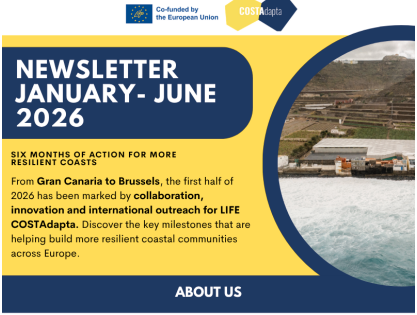
Newletter Costadapta January-June 2026
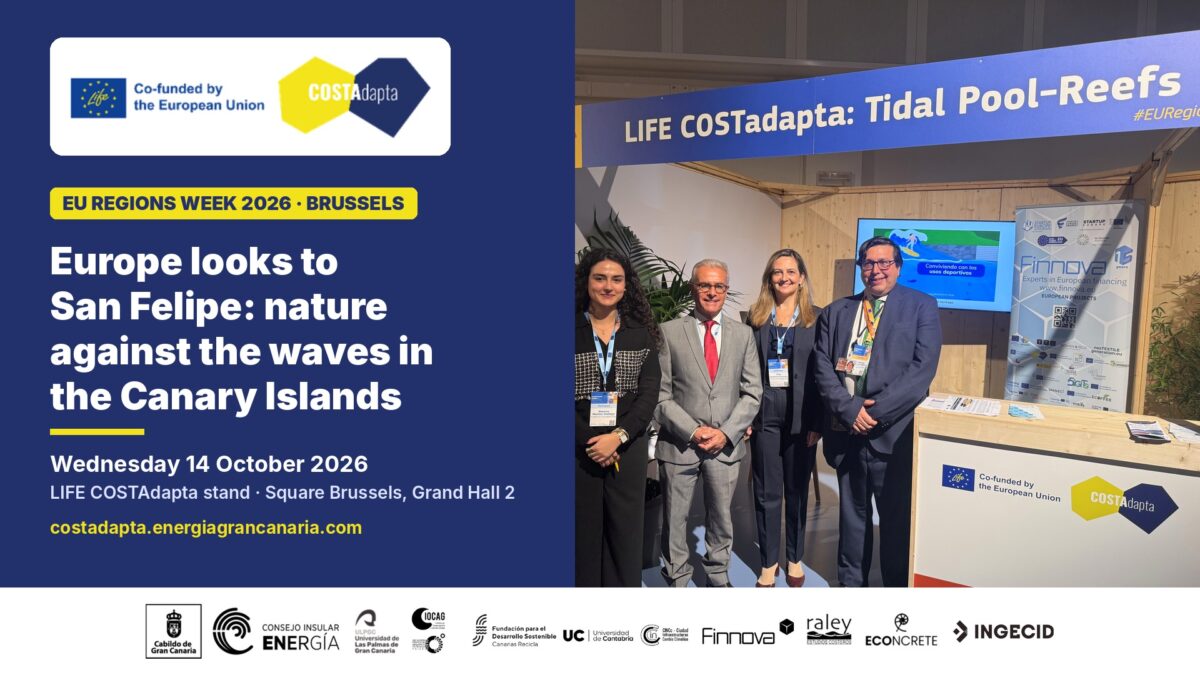
The Canarian project LIFE COSTAdapta had its own stand at the European Week of Regions and Cities, where 27 visitors from 10 countries and European institutions learned how to protect San Felipe’s homes from the waves.
By Yolanda Durán.
Brussels, Thursday 15 October 2026. The LIFE COSTAdapta project, co-funded by the European Union’s LIFE Programme, presented its coastal adaptation solution on Wednesday 14 October 2026 at the EU Regions Week 2026. Throughout the day, from 8:00 to 18:30, the project occupied a stand in the exhibition area of Grand Hall 2 at the Square Brussels convention centre.
Attendance at the event was possible thanks to Fundación Finnova, a project partner, which secured an exhibition space and dedicated it to LIFE COSTAdapta. Gaining access as an exhibitor to this event is highly competitive, and the stand allowed policymakers, technicians, and experts from all over Europe to see how Gran Canaria is preparing for sea-level rise.
A tide pool-reef to break the waves LIFE COSTAdapta is developing a tide pool-reef in San Felipe (Gran Canaria), a hybrid model that combines tide pools with living breakwaters. Its goal is to reduce wave impact on homes and the urban front, protect the coastline, and create new marine habitats. The solution uses nature as infrastructure, moving away from traditional concrete walls.
At the stand, the Finnova team explained the project using audiovisual materials and brochures. Juan Manuel Revuelta, CEO of Fundación Finnova; Pilar Santamaría, Communication Director; and Nekane Martín-Vallejo, EU Project Assistant, attended to the visitors.
International presence at the stand According to the stand’s registration sheet, 27 people from 10 countries showed interest in the project. Among them were representatives from the European Commission (DG REGIO and DG ENV), the European Parliament, and the Permanent Representation of Italy to the EU. Regions such as Tuscany and the Azores, municipalities from Ukraine, Belgium, and the Netherlands, and research centres like Fondazione Bruno Kessler and KU Leuven also visited the stand. Furthermore, Manuela Gómez Villalonga, Director of the European and International Projects Office at the Universitat Jaume I-Empresa Foundation, also stopped by.
The team also established contact with Atlantic Cities, the cooperation platform for cities in the Atlantic Arc, which includes the Canary Islands. The network defends the interests of these cities in European policies and funding programmes.
The major event for European regional policy The 24th edition of the EU Regions Week 2026 took place in Brussels from Monday 12 to Wednesday 14 October 2026 under the motto “Strong regions, strong Europe”. It is organised by the European Commission’s Directorate-General for Regional and Urban Policy (DG REGIO) and the European Committee of the Regions. Every year, the programme brings together policymakers, regional and local representatives, experts, and journalists to debate the future of cohesion policy.
About LIFE COSTAdapta LIFE COSTAdapta (“Adapting our coasts to climate change”) has a total budget of €3.34 million and runs from July 2023 to June 2030. It is coordinated by the Gran Canaria Island Energy Council (CIEGC), with partners including the University of Las Palmas de Gran Canaria (ULPGC), the University of Cantabria (UC), INGECID, Raley Estudios Costeros, ECOncrete AQUA, the Canary Islands Foundation for Recycling and Sustainable Development (FCR), and Fundación Finnova. The project is funded under LIFE grant agreement 101113851. More information at costadapta.energiagrancanaria.com.
Project co-funded by the European Union. Views and opinions expressed are however those of the author(s) only and do not necessarily reflect those of the European Union or CINEA. Neither the European Union nor the granting authority can be held responsible for them.
Event sources: EU Regions Week, 2026 edition guide, stand profile in the programme.
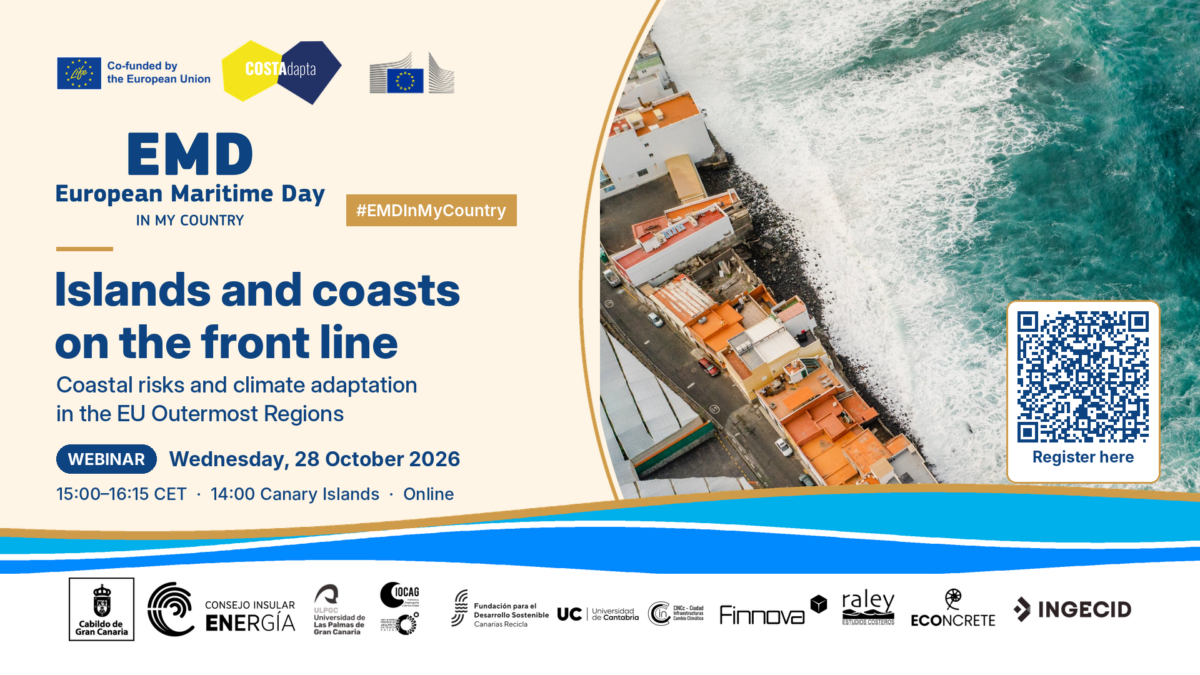
The LIFE COSTAdapta project will have its own stand at Europe’s leading event on regional development, showcasing its work on coastal adaptation to representatives from across Europe
Brussels, Monday, 21 September 2026. How can we protect a changing coastline without building new barriers against the sea? This is one of the questions that LIFE COSTAdapta, a European project developed in Gran Canaria, is seeking to answer. On Wednesday, 14 October, the project will be present at the European Week of Regions and Cities 2026 (EURegionsWeek) with its own stand in Brussels.
Visitors will be able to discover the project in the exhibition area at SQUARE Brussels, where LIFE COSTAdapta will share the space with other European projects and organisations. Throughout the day, from 8:00 a.m. to 6:30 p.m., the stand will provide an opportunity to learn more about the project’s work and, above all, about a different approach to coastal protection: using nature itself as part of coastal protection infrastructure.
At the heart of the project is the tidal pool-reef, a hybrid system that combines natural tidal pools and living breakwaters to reduce wave impact, protect beaches and promote the creation of new marine habitats. The approach also incorporates local knowledge and adaptive design, with the aim of developing a model that can be replicated along other vulnerable European coastlines.
LIFE COSTAdapta’s presence at EURegionsWeek will connect an experience developed in Gran Canaria with an event that this year focuses on the theme “Strong regions, strong Europe” and brings together regions, institutions, projects and other stakeholders involved in territorial development in Brussels. The 2026 edition will feature sessions, networking activities and exhibition spaces designed to share experiences, build partnerships and showcase initiatives developed across European territories.
For LIFE COSTAdapta, the stand will also be a gateway to exchange and collaboration. Learning from other experiences, sharing how the project is being developed in Gran Canaria and exploring connections with territories facing similar challenges will all form part of a day in which the project will take its island-based experience to one of the key meeting points for European regional policy.
LIFE COSTAdapta will be represented by the Finnova team, including Juanma Revuelta, CEO of Finnova; Pilar Santamaría, Communications Director; and Nekane Martín, Project Assistant. The team will be available throughout the day to welcome visitors interested in learning more about the project and its progress.
The stand, officially registered in the EURegionsWeek programme under the name “LIFE COSTAdapta: Adapting Our Coasts to Climate Change”, will be located in the Exhibition Area, Grand Hall 2, SQUARE Brussels. The participation is classified by the organisers under the areas of climate and environment, European dimension, and maritime, coastal and island territories.
The Brussels event will ultimately provide an opportunity to bring an experience developed in an island territory into the wider European conversation. As climate change transforms our coastlines, responses will also need to adapt to the specific characteristics of each territory, combining knowledge, innovation and solutions capable of working alongside the ecosystems they are designed to protect.
About LIFE COSTAdapta
LIFE COSTAdapta is coordinated by the Gran Canaria Island Energy Council (CIEGC) and brings together the University of Las Palmas de Gran Canaria (ULPGC), University of Cantabria, INGECID, Raley Estudios Costeros, ECOncrete AQUA, Fundación Canaria para el Reciclaje y Desarrollo Sostenible (Canarias Recicla), and Finnova Foundation.
The project has a total budget of €3,337,563.47, co-financed by the European Union through the LIFE Programme.
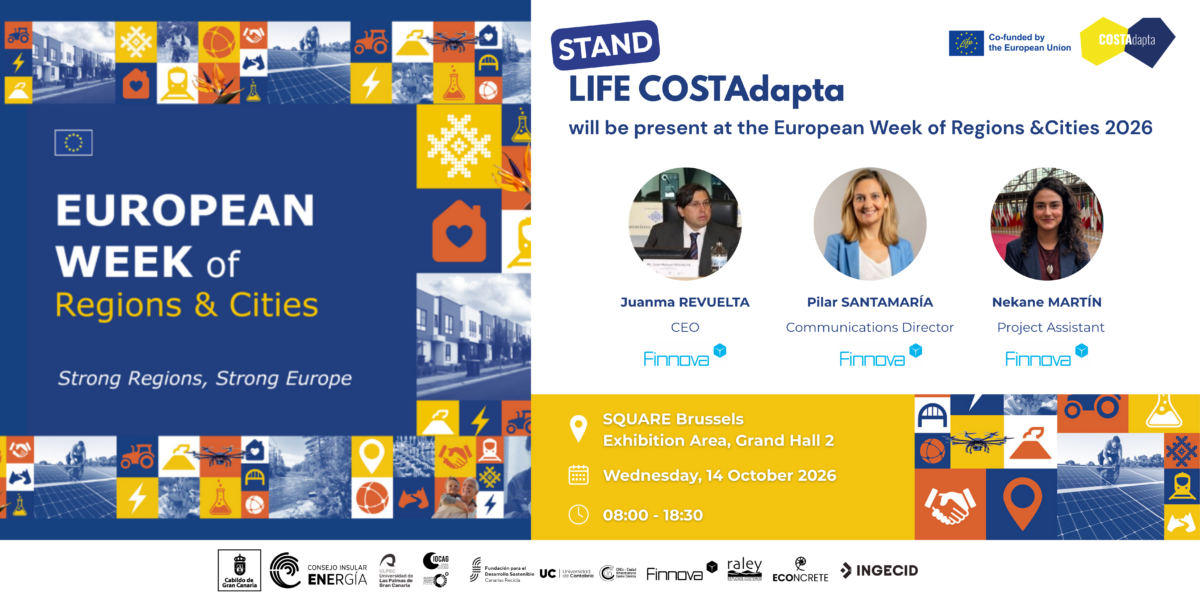
The LIFE COSTAdapta project will have its own stand at Europe’s leading event on regional development, showcasing its work on coastal adaptation to representatives from across Europe
Brussels, Monday, 21 September 2026. How can we protect a changing coastline without building new barriers against the sea? This is one of the questions that LIFE COSTAdapta, a European project developed in Gran Canaria, is seeking to answer. On Wednesday, 14 October, the project will be present at the European Week of Regions and Cities 2026 (EURegionsWeek) with its own stand in Brussels.
Visitors will be able to discover the project in the exhibition area at SQUARE Brussels, where LIFE COSTAdapta will share the space with other European projects and organisations. Throughout the day, from 8:00 a.m. to 6:30 p.m., the stand will provide an opportunity to learn more about the project’s work and, above all, about a different approach to coastal protection: using nature itself as part of coastal protection infrastructure.
At the heart of the project is the tidal pool-reef, a hybrid system that combines natural tidal pools and living breakwaters to reduce wave impact, protect beaches and promote the creation of new marine habitats. The approach also incorporates local knowledge and adaptive design, with the aim of developing a model that can be replicated along other vulnerable European coastlines.
LIFE COSTAdapta’s presence at EURegionsWeek will connect an experience developed in Gran Canaria with an event that this year focuses on the theme “Strong regions, strong Europe” and brings together regions, institutions, projects and other stakeholders involved in territorial development in Brussels. The 2026 edition will feature sessions, networking activities and exhibition spaces designed to share experiences, build partnerships and showcase initiatives developed across European territories.
For LIFE COSTAdapta, the stand will also be a gateway to exchange and collaboration. Learning from other experiences, sharing how the project is being developed in Gran Canaria and exploring connections with territories facing similar challenges will all form part of a day in which the project will take its island-based experience to one of the key meeting points for European regional policy.
LIFE COSTAdapta will be represented by the Finnova team, including Juanma Revuelta, CEO of Finnova; Pilar Santamaría, Communications Director; and Nekane Martín, Project Assistant. The team will be available throughout the day to welcome visitors interested in learning more about the project and its progress.
The stand, officially registered in the EURegionsWeek programme under the name “LIFE COSTAdapta: Adapting Our Coasts to Climate Change”, will be located in the Exhibition Area, Grand Hall 2, SQUARE Brussels. The participation is classified by the organisers under the areas of climate and environment, European dimension, and maritime, coastal and island territories.
The Brussels event will ultimately provide an opportunity to bring an experience developed in an island territory into the wider European conversation. As climate change transforms our coastlines, responses will also need to adapt to the specific characteristics of each territory, combining knowledge, innovation and solutions capable of working alongside the ecosystems they are designed to protect.
About LIFE COSTAdapta
LIFE COSTAdapta is coordinated by the Gran Canaria Island Energy Council (CIEGC) and brings together the University of Las Palmas de Gran Canaria (ULPGC), University of Cantabria, INGECID, Raley Estudios Costeros, ECOncrete AQUA, Fundación Canaria para el Reciclaje y Desarrollo Sostenible (Canarias Recicla), and Finnova Foundation.
The project has a total budget of €3,337,563.47, co-financed by the European Union through the LIFE Programme.
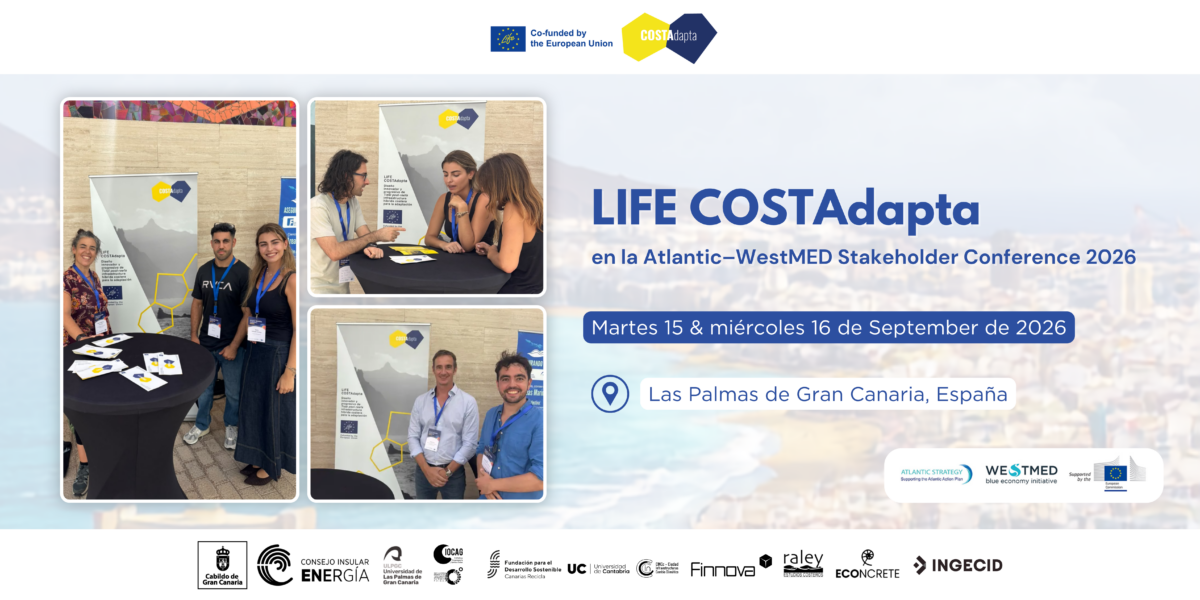
LIFE COSTAdapta presented its Tidal Pool-Reef solution in Las Palmas de Gran Canaria and explored new synergies to advance coastal resilience
Brussels, 17 September 2026. The European project LIFE COSTAdapta participated on Tuesday, 15 September, and Wednesday, 16 September, in the Atlantic–WestMED Stakeholder Conference 2026, held in Las Palmas de Gran Canaria. The event brought together representatives from public institutions, research organisations, companies, investors, organisations and European projects working in the fields of sustainability and the blue economy.
Throughout the two-day event, LIFE COSTAdapta had its own stand in the exhibition area, where it presented the project’s progress and showcased its approach to adapting coastal areas to climate change. Rocío Armada Gallego, Project Officer at Fundación Finnova, represented the project and took part in the networking activities held during the event.
The stand also featured Patricia del Mar Caro Ruiz, LIFE COSTAdapta’s Technical Coordinator and researcher at the University Institute of Oceanography and Global Change (IOCAG) of the University of Las Palmas de Gran Canaria (ULPGC), and Nareme Herrera López, researcher and geographer at the University of Cantabria. Their participation helped bring the project’s scientific and technical dimension closer to visitors and provided an opportunity to share information on the diagnostic and adaptation work being carried out in Gran Canaria.
One of the main elements presented was the Tidal Pool-Reef system, a solution inspired by the Canary Islands’ tradition of building tidal pools. The project aims to develop and test this methodology as a gradual solution to contribute to the adaptation of Gran Canaria’s coastline to sea-level rise, combining coastal protection with biodiversity conservation.
The conference also provided LIFE COSTAdapta with an opportunity to exchange experiences and explore new collaboration opportunities with stakeholders from the Atlantic and Western Mediterranean regions. In this context, the project shared exhibition space with ONE-BLUE, fostering dialogue between European initiatives focused on the protection of marine ecosystems and the development of a sustainable blue economy.
The participation also contributed to strengthening the project’s European dimension and establishing contacts with representatives of cooperation programmes and initiatives. Meetings held during the event included Vincent Ernoux, Coordinator of the Interreg NEXT MED Programme Branch Office for the Western Mediterranean, and Axel Rodríguez Garrote, Project and Programme Development Officer at the Interreg MED Programme.
About LIFE COSTAdapta
LIFE COSTAdapta is a seven-year European project coordinated by the Gran Canaria Island Energy Council (CIEGC). Its objective is to develop and test an innovative and gradual Tidal Pool-Reef system to adapt Gran Canaria’s coastline to climate change and sea-level rise. The project has a total budget of €3,337,563, of which €2,002,538 is co-financed by the European Union through the LIFE Programme. Its consortium comprises CIEGC, the University of Las Palmas de Gran Canaria (ULPGC), the University of Cantabria, INGECID, Raley Estudios Costeros, ECOncrete AQUA, Fundación Canaria para el Reciclaje y Desarrollo Sostenible (FCR), and Fundación Finnova.
In the framework of UNESCO’s Digital Learning Week, the project highlights the use of mathematical modeling and digital coastal monitoring tools as decision-making pillars
Translating complex scientific data into accessible visuals enabled San Felipe residents and El Circo surfers last July to understand how the innovative ‘Tidal Pool-Reef’ system operates
Brussels 9 September 2026. On the occasion of the Digital Learning Week promoted by UNESCO, the European project LIFE COSTAdapta highlights the strategic role of digital modeling, data simulation, and scientific pedagogy in addressing the challenge of adapting our coastlines to rising sea levels.
In modern coastal engineering, climate action and learning begin in the digital environment. The LIFE COSTAdapta consortium employs state-of-the-art technologies to mathematically model how waves interact with the northern coast of Gran Canaria and to carry out precise tracking of beach evolution in specific enclaves like San Felipe. These digital simulations allow researchers from the University of Las Palmas de Gran Canaria (ULPGC) and the University of Cantabria (UC) to predict future climate scenarios and optimize the structural design of the innovative ‘Tidal Pool-Reef’ (arrecife-charcos de marea) system.
Environmental Education for Co-design owever, digital learning is not restricted to the scientific community. One of LIFE COSTAdapta’s primary goals, in line with UNESCO’s philosophy of democratizing technological knowledge, is to transfer this complex digital data to society in an accessible and educational format.
A clear example of this was the community-listening campaign carried out last July in the neighborhood of San Felipe and the surf-break area of El Circo. Through an itinerant campaign utilizing physical, interactive wooden display boards, the project team “translated” the coastline’s digital simulations and profiles. This allowed neighbors, surfers, and visitors of all ages to understand the physics behind the tide pools. This pedagogical exercise fostered a transparent dialogue, enabling the community to provide feedback grounded in a real understanding of the project’s science.
About the Project
LIFE COSTAdapta has a duration of 7 years (84 months) and a total budget of €3,409,864, of which €2,045,818 is co-funded by the European Union’s LIFE Programme. Coordinated by the Consejo Insular de la Energía de Gran Canaria (CIEGC) of the Cabildo de Gran Canaria, the multidisciplinary consortium is composed of CIEGC, the University of Las Palmas de Gran Canaria (ULPGC), the University of Cantabria (UC), INGECID, RALEY Estudios Costeros S.C.P., ECOncrete AQUA, the Canary Foundation for Recycling and Sustainable Development (Canarias Recicla – FCR), and the Finnova Foundation.
For more information: https://costadapta.energiagrancanaria.com/
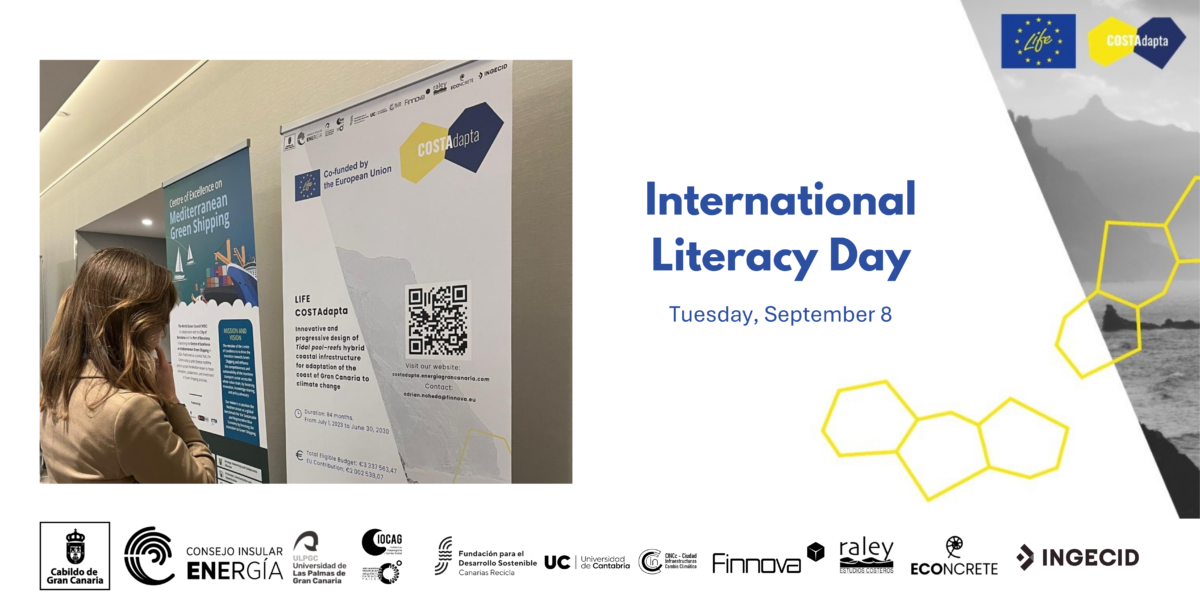
Gran Canaria, 8 September 2026. The celebration of International Literacy Day highlights the importance of access to knowledge as a tool for addressing major social and environmental challenges. In this context, the European project LIFE COSTAdapta highlights the role of environmental literacy in understanding the impacts of climate change and advancing towards a more resilient coastline in Gran Canaria.
Understanding how the coastline is changing, what consequences sea level rise may have and what adaptation options are available allows citizens to participate more actively and knowledgeably in the protection of their environment.
Environmental literacy is particularly relevant in island territories such as the Canary Islands, where coastal areas concentrate a significant part of economic, social and recreational activity. For LIFE COSTAdapta, climate change adaptation must go hand in hand with knowledge and awareness among the people who live in and enjoy these spaces.
LIFE COSTAdapta addresses the adaptation of Gran Canaria’s coastline to sea level rise through an innovative methodology based on the design and testing of a progressive Tidal pool-reef system.
The proposal combines traditional tidal pool construction techniques, characteristic of the Canary Islands and Macaronesia, with advanced solutions. The aim is to progressively strengthen natural coastal protection, support the creation and conservation of habitats and help reduce vulnerability to the effects of climate change.
The project is based on a principle of particular relevance to local communities: coastal adaptation must allow these spaces to remain part of everyday life for local communities.
LIFE COSTAdapta therefore seeks to increase coastal resilience without affecting local use. Protecting coastal areas also contributes to safeguarding economic activities linked to the coastline, including tourism, without proposing a transformation of beaches aimed at replacing their use by local residents.
Awareness is essential to ensure that adaptation solutions are understood and valued by society. Environmental literacy helps translate concepts such as sea level rise, coastal erosion and climate resilience into the everyday reality of people living close to the sea.
In this context, LIFE COSTAdapta approaches adaptation as a process that requires knowledge, innovation and collaboration between public authorities, the scientific community, businesses and citizens.
The project is coordinated by the Gran Canaria Island Energy Council (CIEGC), part of the Cabildo de Gran Canaria, and brings together seven partners: University of Las Palmas de Gran Canaria (ULPGC), University of Cantabria (UC), INGECID, Investigación y Desarrollo de Proyectos, Raley Estudios Costeros S.C.P., ECOncrete AQUA, Fundación Canaria para el Reciclaje y Desarrollo Sostenible (FCR) and Fundación Finnova.
With a duration of 84 months, LIFE COSTAdapta has a total budget of €3,337,563, of which €2,002,53 is co-financed by the European Union through the LIFE Programme.
The initiative contributes to European climate adaptation objectives and reinforces the need to prepare coastal areas for an environmental scenario undergoing significant transformation.
More information:
Press contact:
Fundación Finnova
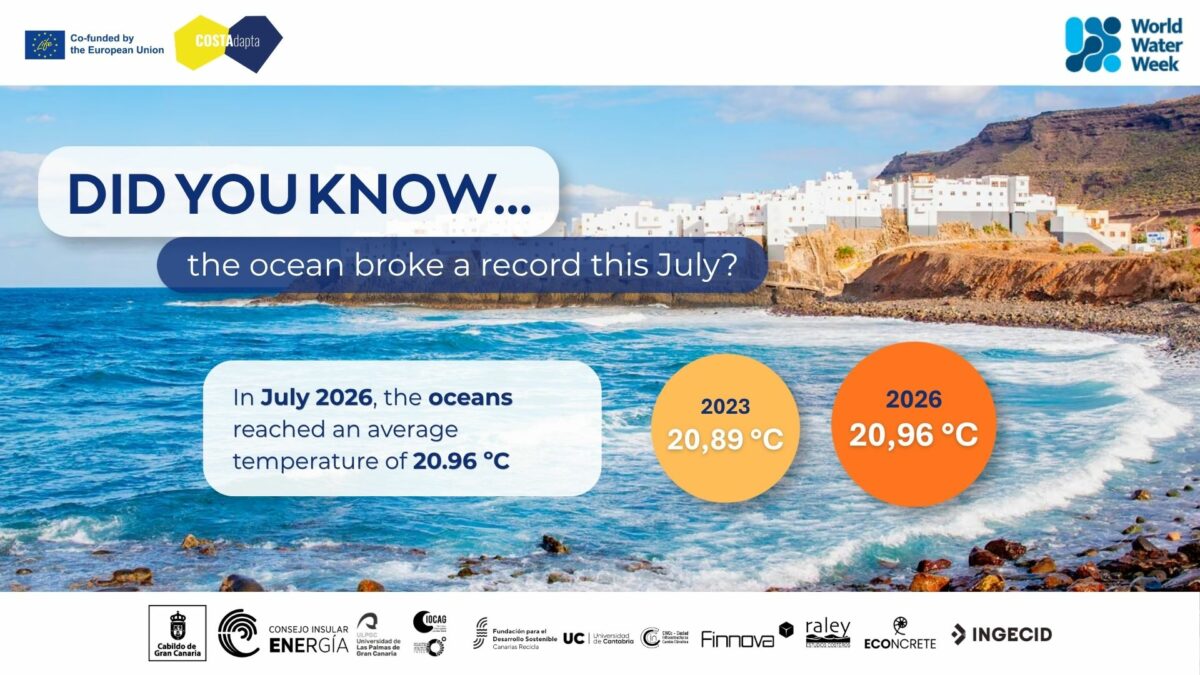
Ocean warming reinforces the need to prepare coastal areas for the impacts of climate change
Brussels, 25 August 2026. The celebration of World Water Week 2026, taking place from 23 to 27 August under the theme Water for People and Progress, once again places water at the centre of the international debate on sustainability, resilience and climate change.
The international event, held annually in Stockholm, brings together experts, institutions, organisations and other stakeholders involved in water management to address some of the main challenges related to this resource. The 2026 edition pays particular attention to water governance, climate resilience and sustainable development.
In this context, changes in ocean temperatures are one of the indicators showing the scale of the climate challenge. Copernicus data have confirmed exceptionally high sea surface temperatures throughout 2026. In June, the average temperature over the extratropical ocean reached 20.86 °C, the highest value ever recorded for this month.
These figures show how global warming is altering marine conditions and creating new challenges for coastal territories.
From ocean warming to coastal adaptation
Rising ocean temperatures are part of a changing climate scenario that also affects the dynamics of coastal areas. Sea-level rise, increased exposure to certain extreme events and pressure on marine ecosystems make it necessary to advance adaptation strategies capable of responding to these changes.
LIFE COSTAdapta works precisely in this field.
The European project is developing an innovative methodology to improve the adaptation of Gran Canaria’s coastline to climate change, with particular attention to sea-level rise and wave action.
One of the main solutions proposed is the Tidal Pool-Reef system, inspired by the traditional tidal pools found in the Canary Islands.
The proposal aims to reduce the exposure of certain coastal areas to wave action while creating favourable conditions for marine biodiversity. The approach combines climate adaptation, nature-based solutions and the restoration of coastal ecosystems.
Preparing for a scenario that is already changing
Changes in ocean temperatures highlight the need to move from observation towards adaptation.
LIFE COSTAdapta proposes a response based on knowledge of the territory and the development of solutions capable of integrating coastal protection with ecosystem conservation.
Climate change cannot be stopped by a single project, but territories can be better prepared to face its consequences.
In this regard, World Water Week provides an opportunity to highlight that talking about the future of water also means talking about the future of oceans, coastlines and the communities that depend on them.
About LIFE COSTAdapta
LIFE COSTAdapta has a total budget of €3,337,563 and is 60% co-financed by the European Union’s LIFE Programme.
The project is coordinated by the Gran Canaria Island Energy Council and involves the University of Las Palmas de Gran Canaria, University of Cantabria, INGECID, RALEY Estudios Costeros, ECOncrete, Fundación para el Desarrollo Sostenible Canarias Recicla and Fundación Finnova.
Its objective is to develop and demonstrate innovative solutions to improve the resilience of Gran Canaria’s coastal areas to the impacts of climate change, combining innovation, adaptation, environmental restoration and biodiversity conservation.
More information:
https://costadapta.energiagrancanaria.com/
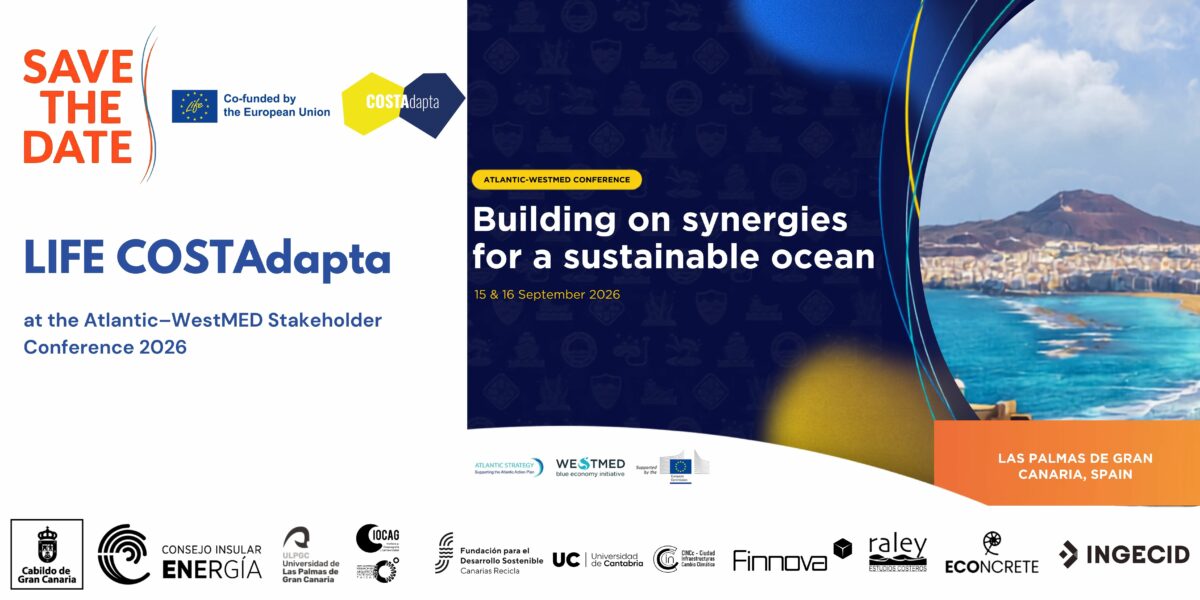
The European project will have a space in the exhibition area of the event, which will bring together stakeholders from the Atlantic and Western Mediterranean in Las Palmas de Gran Canaria
Brussels, 19 August 2026. LIFE COSTAdapta will participate in the Atlantic–WestMED Stakeholder Conference 2026, which will take place on Tuesday 15 and Wednesday 16 September in Las Palmas de Gran Canaria.
The event will bring together policymakers, public authorities, researchers, companies, entrepreneurs, investors, organizations, and European projects from the Atlantic and Western Mediterranean basins. The conference aims to strengthen cooperation, share experiences, and create new opportunities in the field of the blue economy.
LIFE COSTAdapta will have a space in the exhibition area
LIFE COSTAdapta has been invited to participate in the conference’s Exhibition Area, a space for projects and organizations to present their initiatives, solutions and results to participants.
The project will share an exhibition space with ONE-BLUE, a European initiative focused on studying emerging pollutants and their effects on aquatic ecosystems and marine biodiversity.
This participation will provide an opportunity to introduce LIFE COSTAdapta to new European stakeholders and showcase its contribution to adapting coastal areas to climate change.
Nature-inspired solutions
LIFE COSTAdapta is developing an innovative methodology to adapt the coast of Gran Canaria to rising sea levels.
The project proposes the design and testing of a progressive Tidal Pool-Reef system, inspired by the traditional tidal pools found in the Canary Islands. This solution combines traditional techniques with advanced solutions to strengthen coastal resilience and support the conservation of marine habitats.
The initiative also incorporates a participatory approach aimed at integrating the needs of the territory and coastal communities into the adaptation process.
A meeting to strengthen cooperation between basins
The Atlantic–WestMED Stakeholder Conference 2026 represents the first major joint conference of the Atlantic and WestMED maritime strategies. The program includes plenary sessions, thematic meetings, project presentations, and networking activities.
Topics addressed at the event will include coastal resilience, climate adaptation, sustainable tourism, decarbonization, and skills related to the blue economy. The conference will also feature a hackathon aimed at developing new ideas for cooperation and exploring future funding opportunities.
LIFE COSTAdapta’s presence will help strengthen the project’s European visibility and establish new contacts with initiatives and organizations working in marine ecosystem protection, climate adaptation, and the blue economy.
About LIFE COSTAdapta
LIFE COSTAdapta is coordinated by the Gran Canaria Island Energy Council (CIEGC), with the support of seven partner organizations, including the University of Las Palmas de Gran Canaria, the University of Cantabria, INGECID, Raley Estudios Costeros, ECOncrete AQUA, the Canary Foundation for Recycling and Sustainable Development, and Finnova Foundation. The project has a seven-year duration and is funded by the European Union’s LIFE Program.
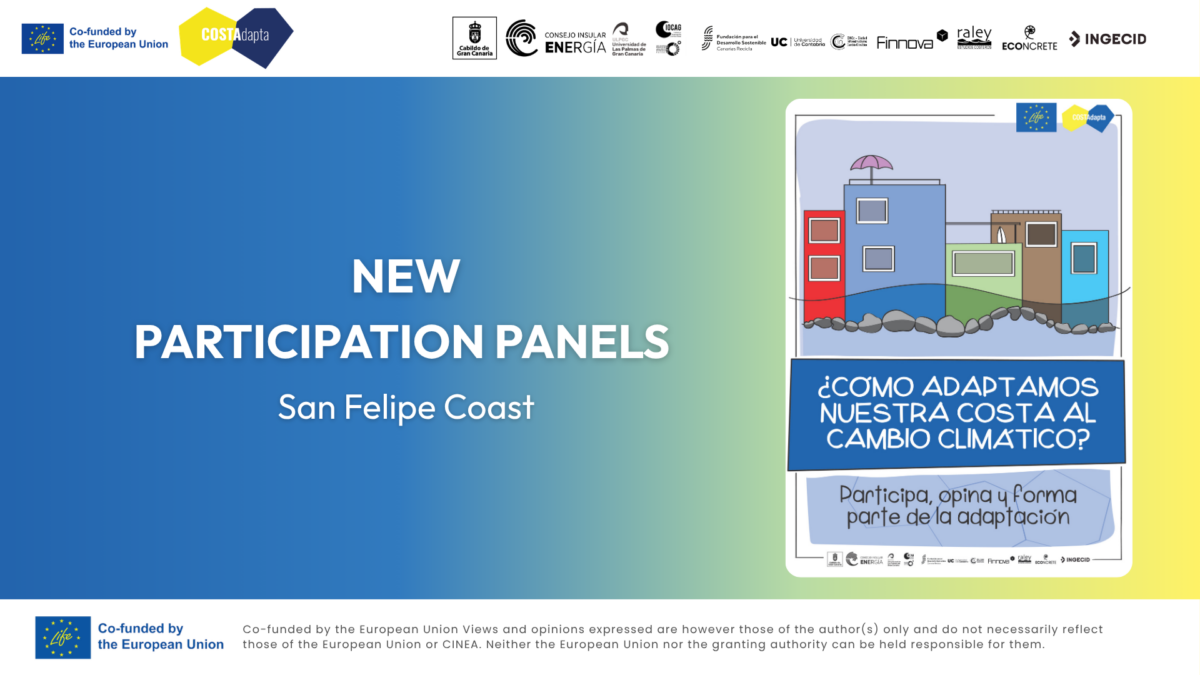
The materials present the San Felipe coastline diagnosis, its main risks and the proposed solutions to strengthen climate change adaptation
Gran Canaria, 14 August 2026. The European LIFE COSTAdapta project has made the information panels used during its participation activities in San Felipe available to the public. The materials can now be consulted on the project’s official website.
The panels provide a visual and accessible overview of the situation along the San Felipe coastline. Their content covers historical, urban, environmental, social and climate-related aspects of the area.
The materials also present the main risks facing the coastline, including coastal erosion, biodiversity loss and sea level rise.
The panels explain the different adaptation measures studied by LIFE COSTAdapta. These include the Tidal Pool-Reef system.
This solution draws inspiration from the traditional tidal pools of the Canary Islands. The project seeks to combine coastal protection with the conservation of the coastline’s biodiversity and environmental and social values.
The materials also explain the project’s working approach. This model combines coastal risk analysis, the design of adaptation solutions, collaboration with local stakeholders and the implementation of measures on the ground.
LIFE COSTAdapta has developed different activities to understand the views of residents and coastal users in San Felipe.
The participation sessions have collected concerns, suggestions and needs related to coastal adaptation. These contributions complement the technical studies carried out by the project partners.
Making the panels available online expands access to this information and keeps the content used during the participation activities available to the public.
Through this approach, LIFE COSTAdapta reinforces its commitment to a coastal adaptation process based on scientific knowledge, innovation and community participation.
LIFE COSTAdapta is coordinated by the Consejo Insular de la Energía de Gran Canaria (CIEGC) and includes the Universidad de Las Palmas de Gran Canaria, the Universidad de Cantabria, INGECID, Raley Estudios Costeros, ECOncrete AQUA, Fundación Canaria para el Reciclaje y Desarrollo Sostenible and Fundación Finnova.
The project has a total budget of €3,409,864 and receives 60% co-financing from the European Union’s LIFE Programme. Its planned duration is 84 months.
The panels are available on the official LIFE COSTAdapta website: