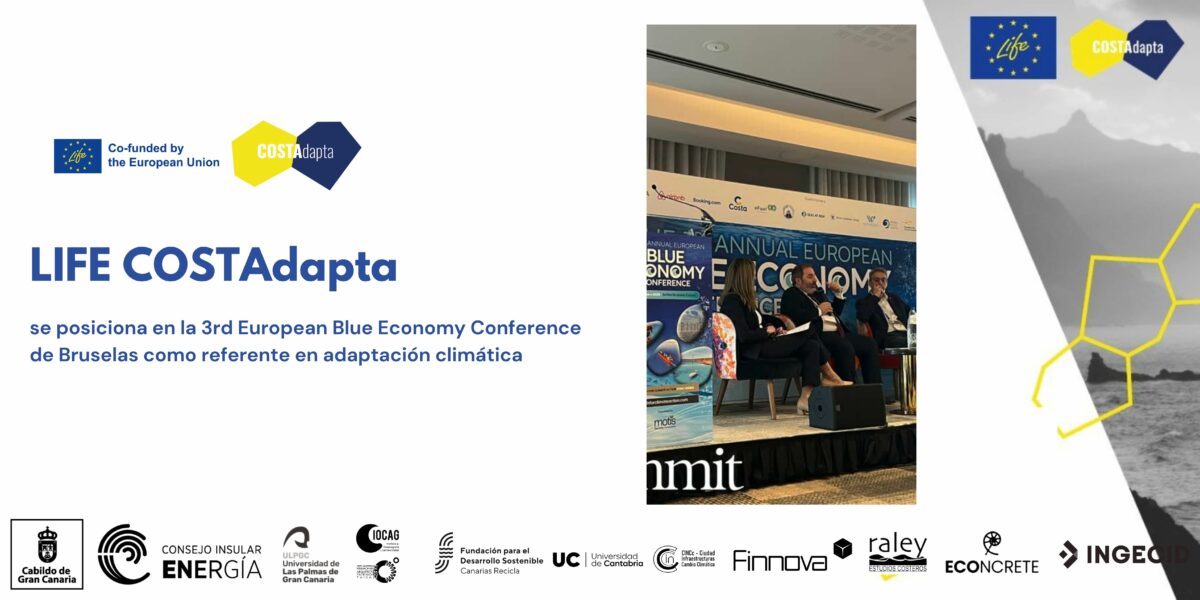
Pilar Santamaría, Communications Director of the foundation, moderated a technical session at this key international forum for maritime sustainability
Brussels, February 6, 2026. Last Tuesday, February 3rd, the Finnova Foundation, a partner of the LIFE Project #LIFECOSTAdapta, actively participated in The 3rd European Blue Economy Conference 2026 held in Brussels, Belgium. This annual summit brings together top EU policymakers, industry leaders, and innovators to shape the future of sustainability and competitiveness in our seas and coastlines.
Throughout the event, Finnova conducted intense strategic networking to provide visibility to the LIFE COSTAdapta project, which was on display for experts from across Europe. The initiative garnered significant interest from key stakeholders, most notably during a meeting with Margot Angibaud, representative of Europêche, where synergies regarding habitat protection and coastal resilience were discussed.
A major highlight of the conference was the participation of Pilar Santamaría, Director of Communication and Public Affairs at the Finnova Foundation, who served as the moderator for one of the technical sessions. Her role strengthened the Foundation’s position as a leader in the communication and management of European blue innovation projects, facilitating dialogue on the progress of the EU Ocean Pact.
About LIFE COSTAdapta The project (LIFE21-CCA-ES-LIFE COSTAdapta/101074552) has a total budget of €3,337,563, co-funded at 60% by the LIFE Programme of the European Union. It is led by the Consejo Insular de la Energía de Gran Canaria (CIEGC) and developed by a consortium including ULPGC, the University of Cantabria, INGECID, Raley Estudios Costeros, ECOncrete AQUA, the Canary Foundation for Recycling and Sustainable Development (FCR), and the Finnova Foundation
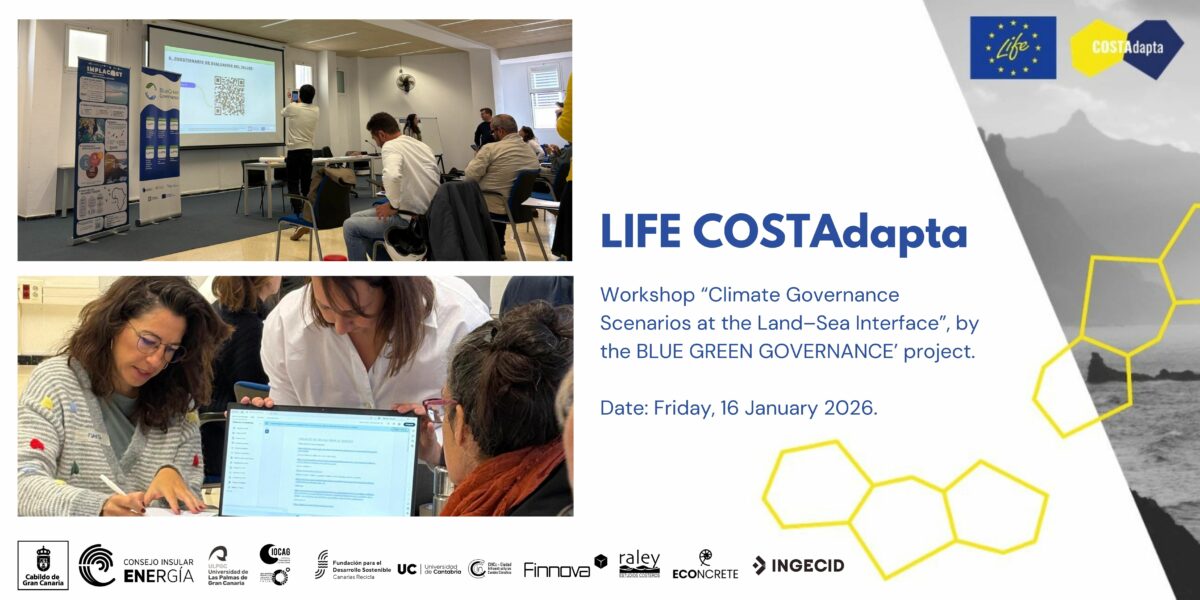
The workshop fostered collective reflection on future scenarios related to sea level rise and coastal resilience
Gran Canaria, 21st January 2026. The European project LIFE COSTAdapta took part on Friday, 16 January, in the Workshop on Climate Governance Scenarios at the Land–Sea Interface, organised within the framework of the BLUE GREEN GOVERNANCE (BGG) project and coordinated by the University of Las Palmas de Gran Canaria.
The workshop, held at the Campus del Obelisco – Aulario del Obelisco, aimed to promote collaborative work on future climate governance scenarios in the context of sea level rise and the increasing frequency of extreme events. Throughout the morning, participants engaged in participatory dynamics based on maps, narratives and collective reflection.
Representatives from LIFE COSTAdapta joined the working tables alongside public authorities, technical staff, researchers, social organisations and other European initiatives. The discussions focused on key challenges related to coastal adaptation, decision-making processes and long-term resilience in coastal areas.
One of the working groups specifically addressed an extreme climate scenario projected for the year 2100 (RCP 8.5), enabling participants to reflect on the potential impacts of sea level rise and the importance of strengthening governance models that support long-term planning and cooperation among stakeholders.
LIFE COSTAdapta’s participation in this workshop reinforces synergies with the BLUE GREEN GOVERNANCE project and with other European initiatives addressing coastal climate adaptation from complementary perspectives. These collaborative spaces contribute to knowledge exchange and to the joint development of responses to climate challenges at the land–sea interface.
About LIFE COSTAdapta
LIFE COSTAdapta is a European project aimed at addressing the adaptation of the coast of Gran Canaria to sea level rise through an innovative methodology. The project designs and tests a progressive system of tidal pool reefs, combining traditional coastal techniques with advanced nature-based solutions.
The project is coordinated by the Island Energy Council of Gran Canaria (Cabildo de Gran Canaria) and brings together the following partners: University of Las Palmas de Gran Canaria (ULPGC), University of Cantabria, INGECID, Raley Coastal Studies, ECOncrete AQUA, the Canary Foundation for Recycling and Sustainable Development, and Finnova.
LIFE COSTAdapta has a total budget of €3,337,563, of which €2,002,538 are co-funded by the European Union through the LIFE Programme.
The news item is illustrated with images from the working tables and participatory dynamics carried out during the workshop.
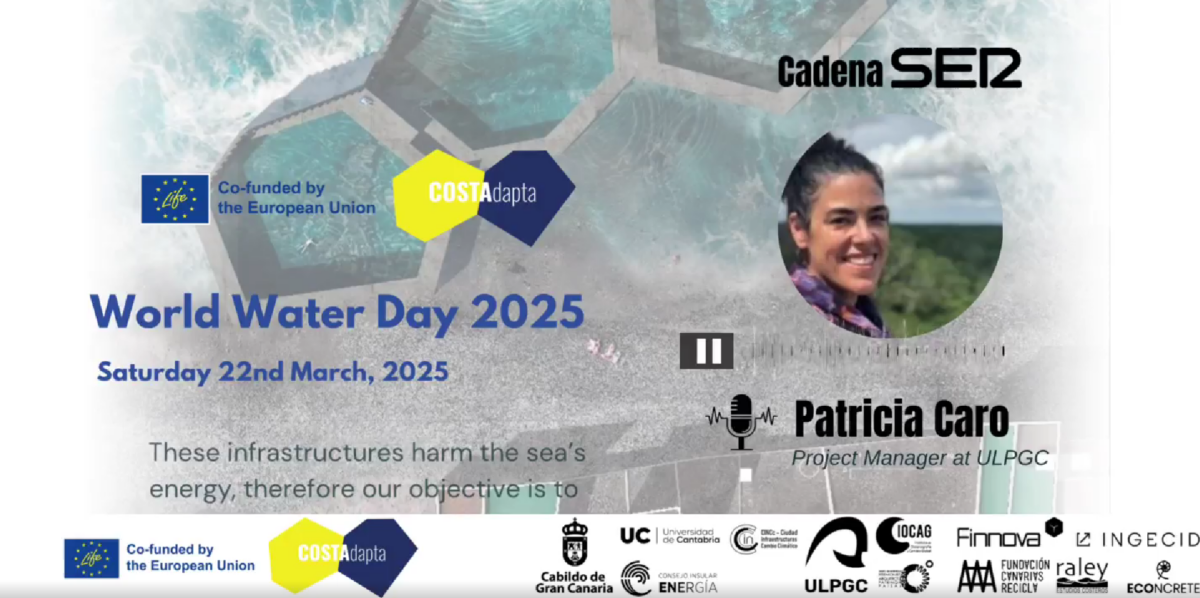
Every March 22nd, World Water Day reminds us of the essential role this resource plays in our lives and in the fight against climate change. At LIFE COSTAdapta, we work to adapt Gran Canaria’s coastline to rising sea levels through innovative and sustainable solutions.
📻 In this context, we want to share the recent interview of Patricia del Mar Caro Ruiz, researcher at Universidad de Las Palmas de Gran Canaria and partner of the LIFE COSTAdapta project, on Cadena SER . During her intervention, Patricia highlighted how the infrastructures designed within the project will help mitigate wave energy, facilitating natural coastal protection processes.
🔎 “These infrastructures help dissipate wave energy. Our goal is to design them for adaptation, supporting natural coastal protection processes. One key focus is to stabilize the shoreline and minimize erosion, another major risk associated with rising sea levels and increasing extreme weather events,” explained Patricia.
The participation strengthens synergies between European projects working on coastal adaptation and climate governance
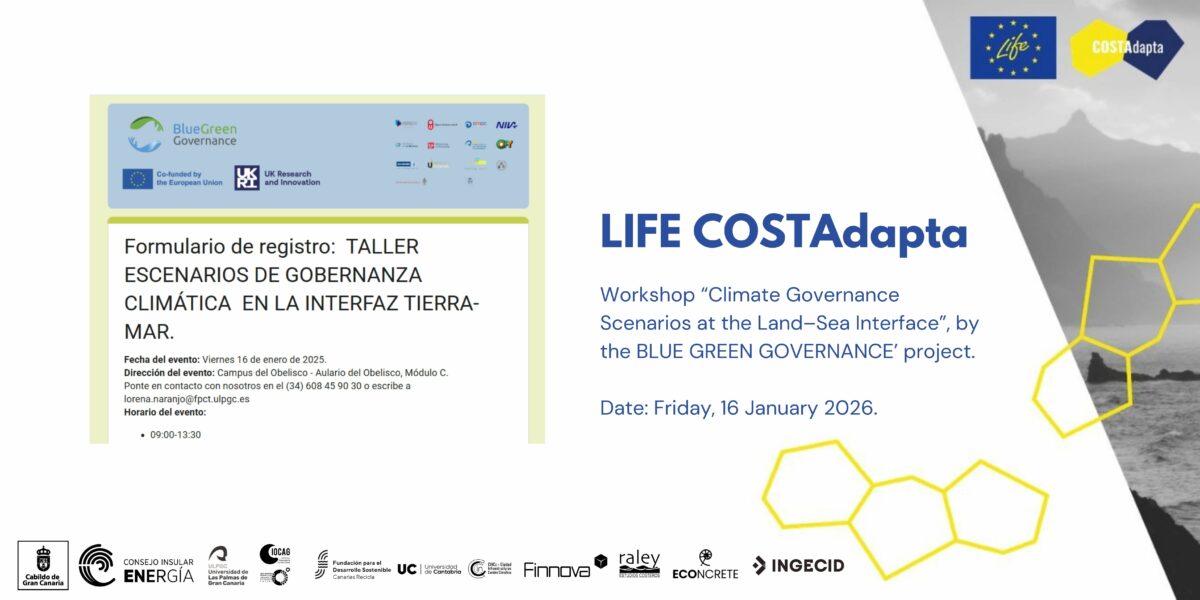
Gran Canaria, 12 January 2026. The European project LIFE COSTAdapta will attend the Workshop 2 “Climate Governance Scenarios at the Land–Sea Interface”, organised by the BLUE GREEN GOVERNANCE (BBG) project, on Friday, 16 January 2026.
This workshop follows the first session held in March 2025, where participants collectively explored future challenges at the land–sea interface in the context of climate change. The second workshop will focus on developing climate governance scenarios, integrating local narratives and institutional perspectives on climate change adaptation, with particular attention to sea level rise.
The event will take place at the Campus del Obelisco, Aulario del Obelisco, Module C, from 09:00 to 13:30, and will bring together representatives from public authorities, technical staff, the scientific community, social organisations, the private sector and local communities. The aim is to reflect on how different governance configurations can either support or hinder effective coastal resilience.
On behalf of LIFE COSTAdapta, Patricia del Mar Caro will attend the workshop to learn first-hand about the results developed by the BLUE GREEN GOVERNANCE project over the past year. LIFE COSTAdapta’s participation reinforces collaboration and knowledge exchange between European initiatives addressing coastal adaptation and climate governance from complementary perspectives.
The island hosted a consortium meeting, a field visit to San Felipe and the First Conference on Coastal Adaptation to Climate Change in Island Regions on 24 and 25 November
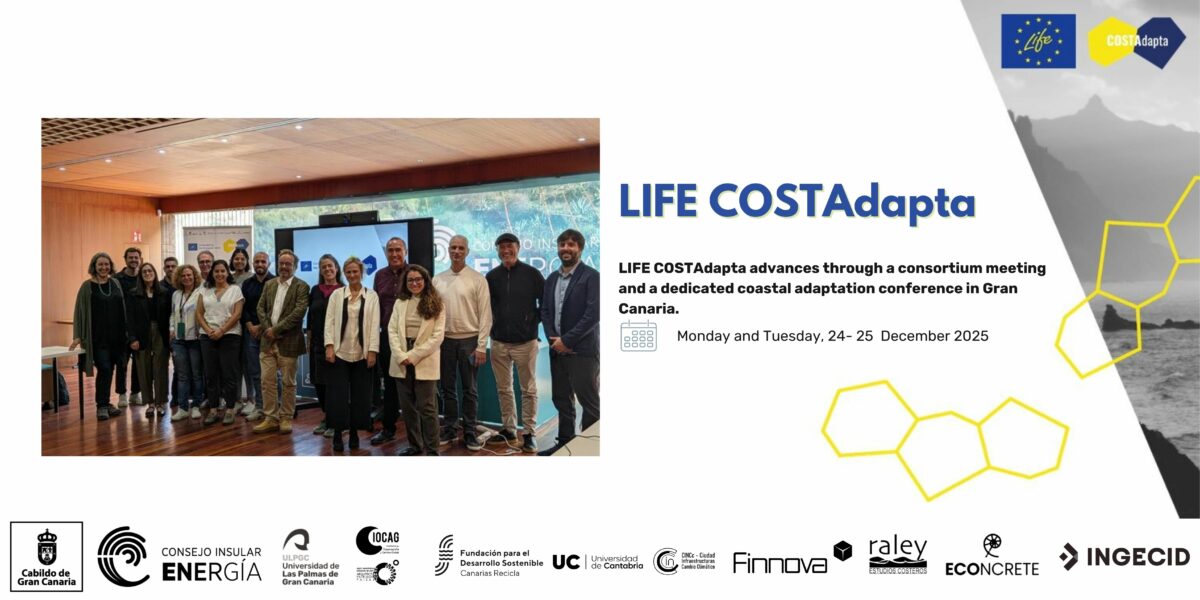
Las Palmas de Gran Canaria, 8 December 2025 — The European project LIFE COSTAdapta held two days of intensive work on 24 and 25 November in Gran Canaria, combining technical coordination, a visit to the pilot area and an institutional event included in the EURegionsWeek close to you programme. The activities brought together the project consortium, the ELMEN mechanism monitor from CINEA and institutional and academic representatives committed to coastal adaptation to climate change.
The first day took place at the headquarters of the Island Energy Council of Gran Canaria (CIEGC), where the second in-person consortium meeting was held with the participation of Sara Barceló, monitor of the ELMEN mechanism from CINEA. During the session, the consortium reviewed the status of the project, ongoing deliverables and upcoming technical and administrative milestones. The meeting strengthened internal planning for the development phase of the tidal pool–reef system, an innovative solution inspired by the traditional tidal pools of the archipelago.
In the afternoon, part of the delegation travelled to the pilot area in San Felipe to observe the location where the coastal adaptation solution will be implemented. The visit made it possible to better understand the dynamics of the shoreline and the interaction between the sea and nearby inhabited areas, including a home affected by coastal retreat. This experience highlighted the urgency of advancing solutions that combine scientific knowledge, territorial governance and respect for the traditional use of the Canary Islands’ coastline.
The second day was dedicated to the First Conference on Coastal Adaptation to Climate Change in Island Regions, organised by CIEGC and the Finnova Foundation under the EURegionsWeek close to you programme. The institutional opening featured the participation of Raúl García Brink, Councillor for Environment, Climate, Energy and Knowledge of the Island Council of Gran Canaria; the presence of Lluís Serra Majem, Rector of the University of Las Palmas de Gran Canaria; and the participation of Adrián Noheda, project manager and expert in European funding at Finnova. The conference included thematic sessions involving projects and entities working on coastal adaptation in vulnerable territories, such as NATALIE, IMPLACOST, Blue Green Governance and MasDunas, together with experts from the Government of the Canary Islands and the University of Las Palmas de Gran Canaria.
Discussions focused on multilevel climate governance, funding challenges and the need for replicable models that allow island regions to strengthen their resilience. The event generated notable media interest and was covered by outlets such as Radio Televisión Canaria, which highlighted Gran Canaria’s growing role as a reference point in coastal adaptation at the European level.
In the afternoon, the consortium held a follow-up technical session focusing on communication, replicability, sustainability and the exploitation of results. The session aimed to ensure that the methodologies and knowledge generated by the project can be transferred to other European territories affected by sea level rise.
LIFE COSTAdapta aims to design and test an innovative tidal pool–reef system that strengthens the adaptive capacity of Gran Canaria’s coastline in response to sea level rise, while preserving local coastal uses, enhancing biodiversity and contributing to the tourism economy. The project has a total budget of €3,337,563, of which €2,002,538 is co-funded by the European Union through the LIFE Programme. The initiative runs for seven years and is coordinated by CIEGC, with the participation of the University of Las Palmas de Gran Canaria, University of Cantabria, INGECID, Raley Coastal Studies, ECOncrete AQUA, the Canary Foundation for Recycling and Sustainable Development, and the Finnova Foundation.
Ocean Oasis and PLOCAN take part in a meeting focused on synergies, public participation and permitting in coastal projects
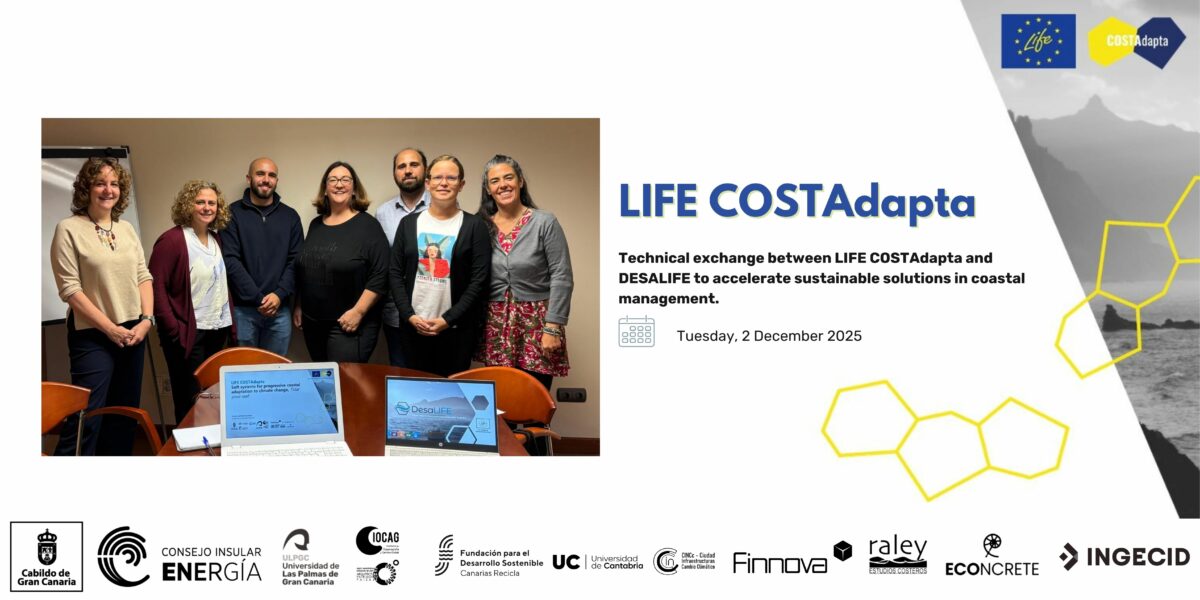
Las Palmas de Gran Canaria, 4 December 2025. The LIFE COSTAdapta project team took part this Tuesday, 2 December, in a working meeting with representatives of the DESALIFE project. The meeting aimed to exchange experiences, analyse shared approaches and explore potential synergies between both initiatives, which focus on climate change adaptation in coastal and island environments.
The session featured contributions from Susana Rodríguez and Sebastián Feimblatt, representatives of Ocean Oasis, an organisation specialised in renewable-energy-powered marine desalination solutions, as well as Silvia Hildebrandt, technician at the Oceanic Platform of the Canary Islands (PLOCAN). Both organisations bring direct expertise in ocean innovation and sustainable water management in island contexts.
During the meeting, the teams exchanged knowledge on key aspects of the LIFE approach, with particular emphasis on public participation processes, the permitting procedures for actions in the coastal zone and the technical and regulatory requirements associated with interventions in the marine environment. The discussion helped identify convergences between the two projects and potential collaboration pathways to enhance the implementation of climate solutions in vulnerable coastal areas.
The meeting also served to explore opportunities for future cooperation, including the replicability of best practices, the integration of innovative technologies and the development of sustainable coastal management models applicable to other European island territories.
With this meeting, LIFE COSTAdapta strengthens its collaboration strategy with other EU-funded initiatives, fostering knowledge transfer and coordination among key actors in the ecological transition.
The island will host, on 25 November, an in-person technical conference that will bring together experts, public authorities and citizens to address resilience solutions to climate change
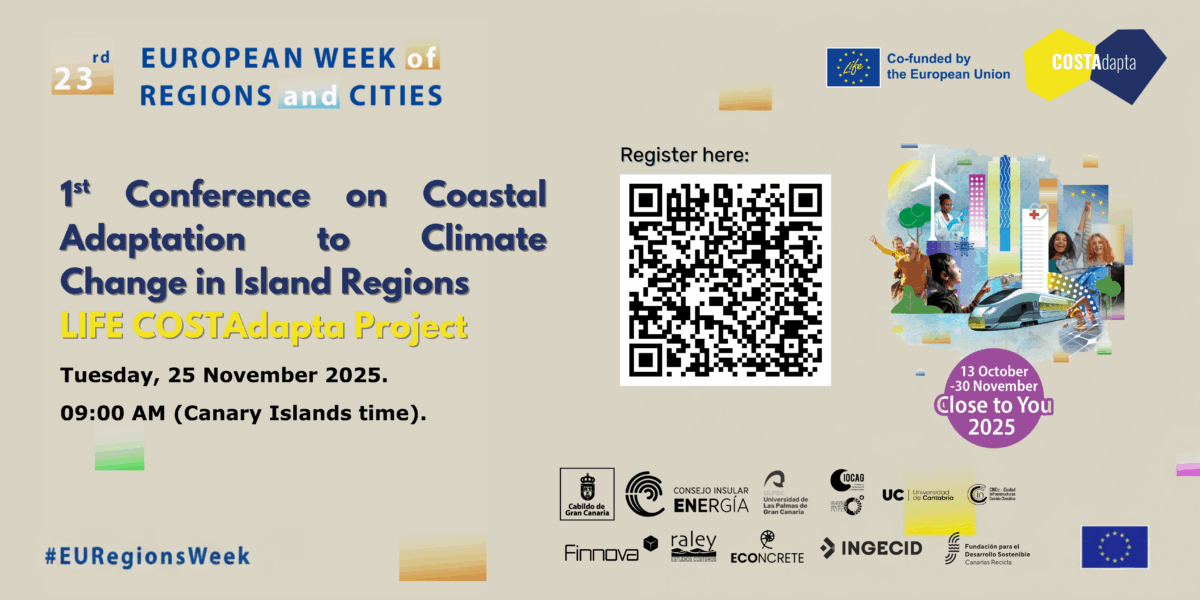
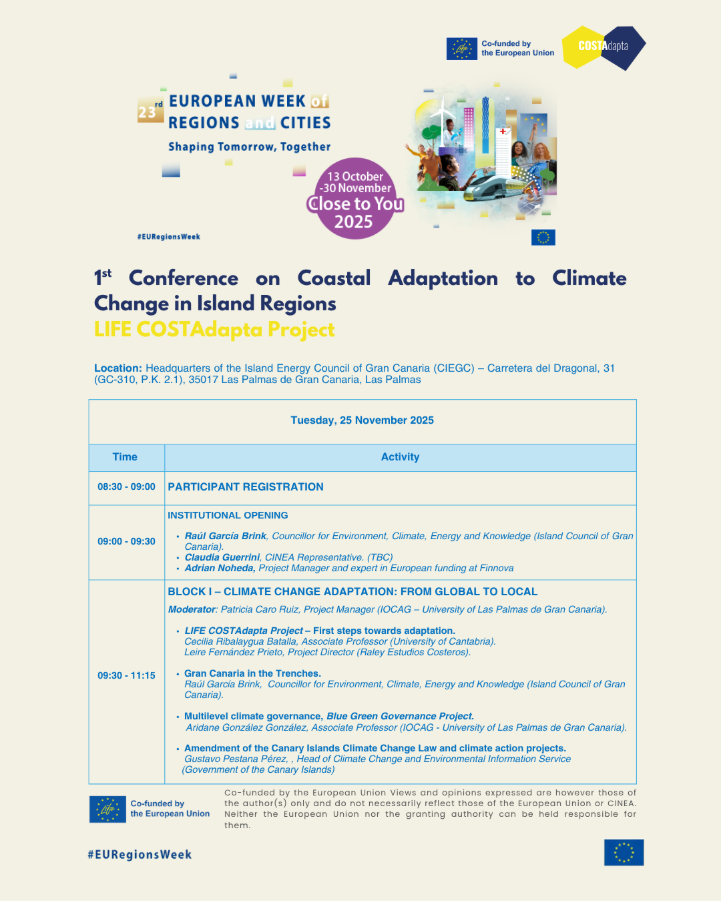
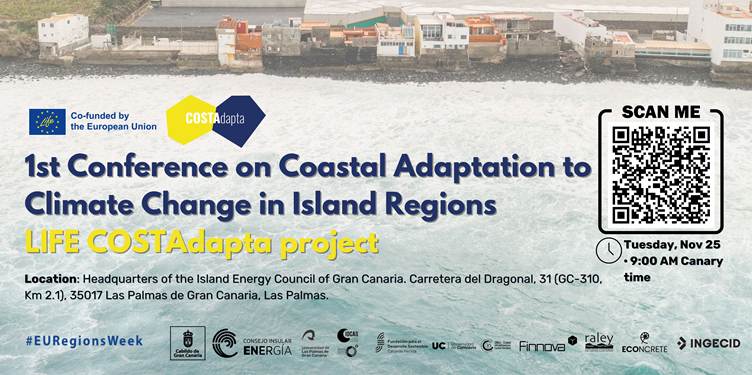
Las Palmas de Gran Canaria, 14 November 2025. The European project LIFE COSTAdapta will hold the First Conference on Coastal Adaptation to Climate Change in Island Regions next Tuesday, 25 November. The event will be in person and will bring together European institutions, local and regional authorities, universities and organisations specialised in coastal management. The conference will take place at the headquarters of the Gran Canaria Island Energy Council (CIEGC) and is part of the activities scheduled within the EU Region Week, Europe’s leading forum for territorial cooperation and innovation in public policies.
The opening session will be delivered by Raúl García Brink, Councillor for Environment, Climate, Energy and Knowledge of the Island Council of Gran Canaria, who will outline the island’s strategic commitment to coastal resilience. This introduction will be followed by Adrián Noheda, project manager and EU funding expert at the Finnova Foundation, who will provide an overview of the LIFE Programme’s opportunities and the importance of European cooperation in climate adaptation
The first block, focused on technical and scientific analysis, will be moderated by Patricia Caro Ruiz, project manager at the Institute of Oceanography and Global Change (IOCAG). Presentations will address methodological advances of the LIFE COSTAdapta project, current coastal dynamics in Gran Canaria and the challenges linked to sea-level rise. Speakers include Cecilia Ribalaygua Batalla (University of Cantabria), Leire Fernández Prieto (Raley Estudios Costeros), Aridane González González (University of Las Palmas de Gran Canaria), and Gustavo Pestana Pérez, Head of Climate Change for the Government of the Canary Islands.
The second block will take the form of a round table and will offer an overview of European coastal adaptation projects and experiences. The session will be moderated by Adrián Noheda, project manager at Finnova Foundation. Experts from the projects NATALIE, Blue Green Governance, IMPLACOST, MasDunas and Las Galletas, together with technical personnel from LIFE COSTAdapta, will take part. Among the participants are Rafael Herrera Checa, Gustavo Pestana, Aridane González, Jesús González Navarro, Marta Martínez Pérez and Patricia Caro Ruiz.
The conference aims to create a space for collective reflection on the transition towards a more resilient coastline. It also seeks to bring citizens and local stakeholders closer to the objectives of LIFE COSTAdapta and to clarify questions regarding coastal use, ensuring that adaptation measures will not interfere with the traditional enjoyment of beaches and will preserve the coastal identity of Gran Canaria.
LIFE COSTAdapta is advancing the design of an innovative system of progressive reefs and tidal pools intended to protect vulnerable coastal areas from sea-level rise. The project has a total budget of €3,337,563, of which €2,002,538 is co-funded by the European Union through the LIFE Programme. The consortium is composed of the CIEGC, the University of Las Palmas de Gran Canaria, the University of Cantabria, INGECID, Raley Estudios Costeros, ECOncrete AQUA, the Canary Islands Foundation for Recycling and Sustainable Development and the Finnova Foundation.
A participatory event to promote innovative solutions to climate change in vulnerable island territories.
Institutional representatives, European experts, and project managers will come together at the event to discuss innovative solutions to combat climate change.
Brussels, Thursday, October 30. The European LIFE COSTAdapta project, coordinated by the Island Energy Council of Gran Canaria (CIEGC), will hold the first edition of the Conference on Coastal Adaptation to Climate Change in Island Regions on Tuesday November 25th. This event is part of the “EURegionsWeek close to you” programme. The conference will take place at Foro Guiniguada, located at Carretera del Dragonal, 31, Council of Gran Canaria, Las Palmas de Gran Canaria, Spain, at 9:00 a.m. (island time). Attendees will actively participate through brief elevator pitch-style presentations and idea exchange dynamics.
During the conference, the progress of the LIFE COSTAdapta project will be presented, together with other best practices in coastal adaptation applied on islands, through a dynamic and participatory format. The meeting will bring together institutional representatives, European experts, and project managers to discuss innovative solutions to tackle climate change in vulnerable territories. Key aspects such as funding challenges, public policies, and the replicability of models in other European regions will also be addressed.
LIFE COSTAdapta promotes an innovative model of coastal adaptation that combines traditional techniques with nature-based solutions. The main goal is to strengthen the resilience of the coastline, improve residents’ quality of life, and preserve economic activity linked to tourism an action that will be implemented in the San Felipe area of Gran Canaria.
The total project budget amounts to 3.4 million euros and is co-financed by the European Union and the European Climate, Infrastructure and Environment Executive Agency (CINEA) under the LIFE Programme.
The international exhibition, open until Sunday 19 October at the Pavilhão da Oca, presents innovative coastal adaptation solutions to tackle climate change.
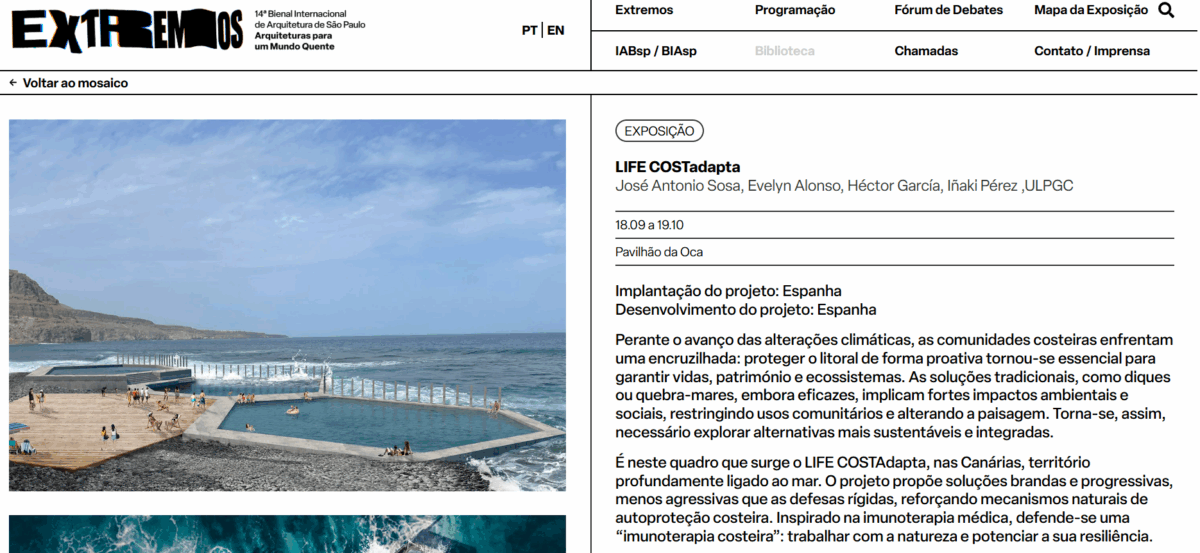
Las Palmas de Gran Canaria, 14 October 2025 – The European project LIFE COSTAdapta, coordinated by the Consejo Insular de la Energía de Gran Canaria (CIEGC), is participating in the 14th São Paulo International Architecture Biennial (BIAsp), held in Brazil until Sunday 19 October.
The Biennial, considered one of the world’s leading international events on architecture and urbanism, brings together projects addressing major contemporary challenges, including adaptation to climate change. Within this framework, LIFE COSTAdapta is showcased as an example of innovation in nature-based solutions to protect coastal areas from rising sea levels.
The proposal, presented by the Architecture, Landscape and Heritage (APP-ULPGC) research group from the University of Las Palmas de Gran Canaria, introduces the creation of artificial tidal pools or eco-concrete reefs. These structures dissipate wave energy, reduce erosion, strengthen marine biodiversity, and provide new social, educational and scientific spaces.
The project is characterised by its multidisciplinary and participatory approach, combining environmental and landscape studies with community consultation processes in areas such as San Felipe (Gran Canaria), where the construction of a full-scale prototype is planned.
The presence of LIFE COSTAdapta at the São Paulo Biennial represents international recognition of innovation and of the Canary Islands’ commitment to coastal resilience in the context of the global climate emergency.
With a budget of EUR 3.7 million, 60% co-financed by the European Union’s LIFE Programme, the project is led by the Consejo Insular de Energía de Gran Canaria (CIEGC) of the Cabildo de Gran Canaria, and brings together the following partners: University of Las Palmas de Gran Canaria (ULPGC); University of Cantabria (UC); INGECID, Investigación y Desarrollo de Proyectos; Raley Estudios Costeros S.C.P.; ECOncrete AQUA; Fundación Canaria para el Reciclaje y Desarrollo Sostenible (FCR) and Fundación Finnova.