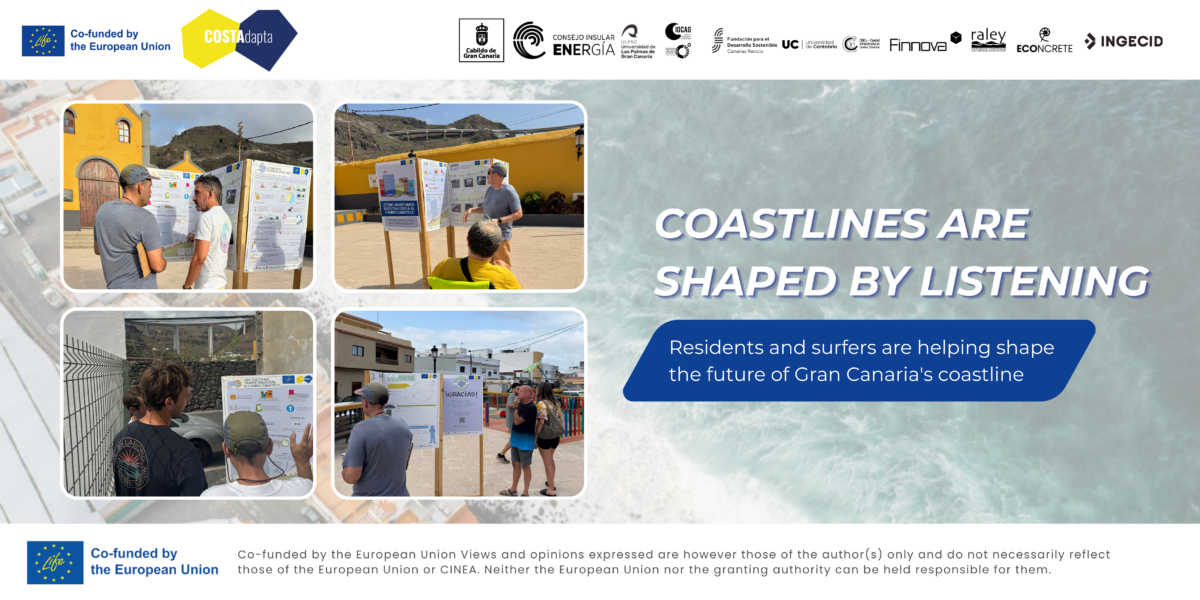
Throughout July, a mobile community engagement initiative collected first-hand proposals from local residents and coastal users on the innovative Tidal Pool-Reef system.
The contributions, questions and suggestions gathered during this active listening campaign will now be analysed to provide direct feedback to the local community.
Brussels, 3 August 2026 – The European project LIFE COSTAdapta has concluded its community engagement campaign carried out throughout July in northern Gran Canaria. Through a mobile outreach initiative, the project team met directly with residents and coastal users to explain the project’s technical progress in an accessible way and, above all, to listen to the community’s views first-hand.
The initiative focused on two key locations along the coastline of Santa María de Guía: the neighbourhood of San Felipe and the El Circo surf break, one of the main gathering points for the local surfing community. Through information panels installed on-site, visitors were able to learn about the design of the innovative Tidal Pool-Reef system. Inspired by the traditional intertidal tidal pools of the Canary Islands, this nature-based solution aims to protect the coastline against sea level rise while combining coastal defence with the ecological restoration of marine flora and fauna.
Community participation and active listening
Beyond providing information, the main objective of the mobile outreach initiative was to give the local community a voice through a fully inclusive participation process. The campaign gathered questions, suggestions and feedback from residents, surfers and visitors who regularly use this stretch of coastline.
All the information, concerns and proposals collected during the campaign are currently being analysed by the LIFE COSTAdapta technical team. The results will be used to prepare detailed responses, which will soon be shared directly with the local community. The project consortium emphasises that co-designing adaptation measures with local stakeholders is essential to ensuring that coastal adaptation solutions are both sustainable and respectful of the area’s traditional coastal uses.
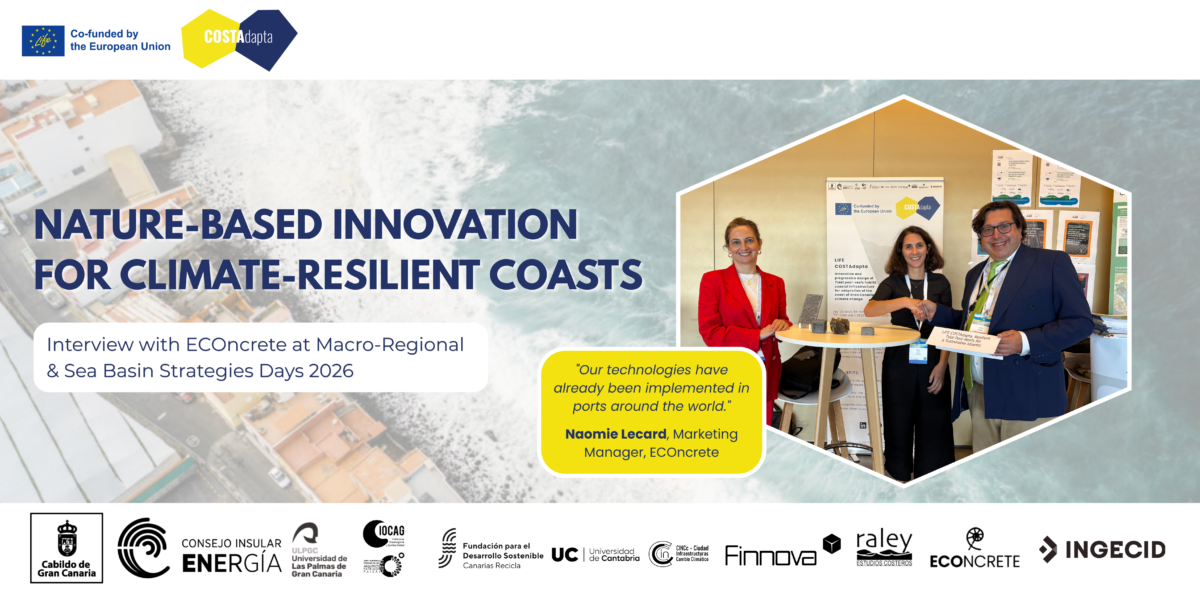
An interview with Naomie Lecard, Marketing Manager at ECOncrete, highlights the role of the project’s technology partner and the potential of nature-based solutions to strengthen coastal resilience.
Brussels, Tuesday, 28 July 2026. The European project LIFE COSTAdapta presented an interview with Naomie Lecard, Marketing Manager at ECOncrete, the consortium’s technology partner, during the Macro-Regional & Sea Basin Strategies Days 2026. The event took place on 8 and 9 July in Brussels and was organised by the European Commission’s Directorate-General for Regional and Urban Policy (DG REGIO) and Directorate-General for Maritime Affairs and Fisheries (DG MARE).
The interview was conducted at the LIFE COSTAdapta stand in the Networking Village and aimed to showcase ECOncrete’s role within the project while introducing visitors to one of the innovative technologies that will help adapt the coastline of Gran Canaria to the impacts of climate change.
During the interview, Lecard explained that ECOncrete contributes its biodiversity-enhancing concrete technology together with ecological design concepts that integrate nature into coastal infrastructure. These solutions will be incorporated into the development of the Tidal Pool-Reef system, inspired by the traditional intertidal rock pools of the Canary Islands, which LIFE COSTAdapta will implement as an innovative response to sea level rise.
“ECOncrete contributes its biodiversity-enhancing concrete technology and ecological design concepts based on nature-integrated solutions. Our technologies have already been implemented in ports around the world, from San Diego and San Francisco to Vigo,” said Naomie Lecard.
Through its participation in LIFE COSTAdapta, ECOncrete brings extensive experience gained from international projects focused on the ecological restoration of maritime infrastructure. Its contribution demonstrates how innovative engineering can combine coastal protection with the creation of new habitats for marine flora and fauna.
The interview forms part of LIFE COSTAdapta’s communication activities, which aim to bring the work of the consortium partners closer to the public while raising awareness of the innovative solutions being developed to promote sustainable coastal adaptation that can be replicated in other European regions.
About LIFE COSTAdapta
LIFE COSTAdapta has a total budget of €3,337,563, of which €2,002,538 is co-funded by the European Union’s LIFE Programme. The project is coordinated by the Gran Canaria Island Energy Council (Consejo Insular de la Energía de Gran Canaria – CIEGC) and has a duration of 84 months.
The consortium brings together the Gran Canaria Island Energy Council (CIEGC), the University of Las Palmas de Gran Canaria, the University of Cantabria, INGECID, RALEY Estudios Costeros, ECOncrete, the Canary Islands Foundation for Recycling and Sustainable Development (Canarias Recicla), and the Finnova Foundation.
The initiative, led by the Island Energy Council of Gran Canaria, was selected to have its own stand at the event organized by the European Commission
During the event, physical models of the marine infrastructure were presented by ECOncrete, the project’s technology partner
The “Tidal pool-reef” system, inspired by the traditional natural pools of the Canary Islands, drew the attention of European authorities as a replicable model to address sea level rise
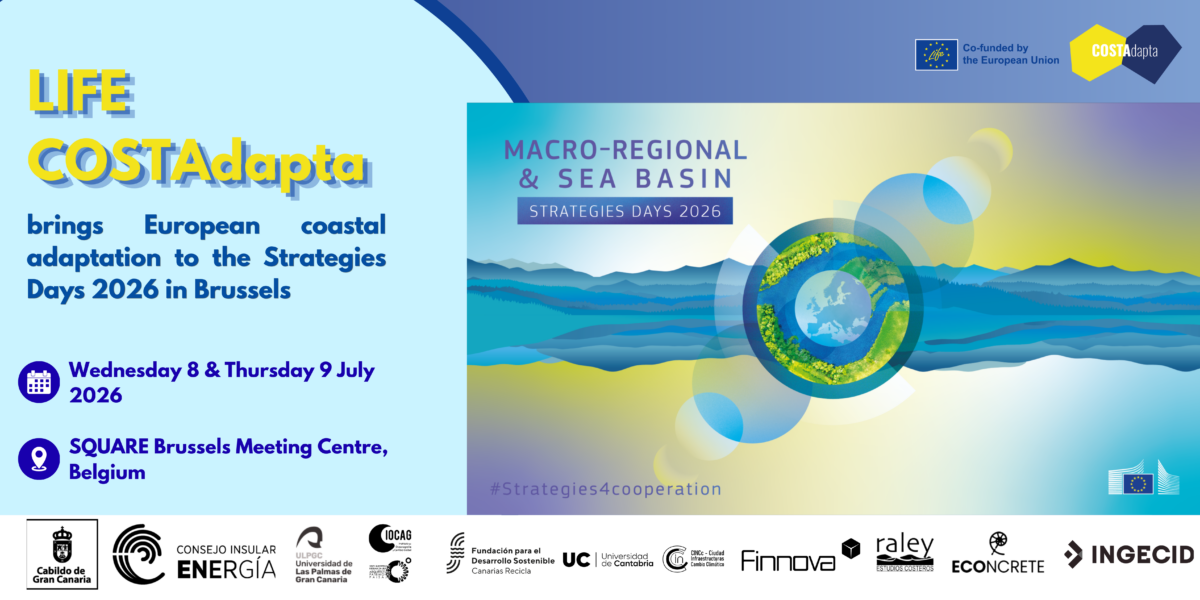
Brussels, Monday, July 13, 2026. The European project LIFE COSTAdapta successfully concluded its participation in the Macro-Regional & Sea Basin Strategies Days 2026, held on Wednesday, July 8 and Thursday, July 9 at the SQUARE conference center in Brussels. The event, co-organized by the Directorate-General for Regional and Urban Policy (DG REGIO) and the Directorate-General for Maritime Affairs and Fisheries (DG MARE) of the European Commission, brings together the leading institutional actors each year to discuss resilience, competitiveness, and territorial cooperation.
Thanks to its innovative approach, the project presented its nature-inspired coastal adaptation solutions, established new institutional contacts, and strengthened its position as a leading European initiative in addressing the challenges of climate change.
A European showcase for coastal innovation
The project was represented by Juan Manuel Revuelta Pérez, CEO of Fundación Finnova; Pilar Santamaría, Director of Communication and International Relations at Fundación Finnova; and Naomie Lecard, Marketing Manager at ECOncrete, a project partner entity.
From the exhibition space, the team presented a nature-based solution inspired by the traditional tidal pools of the Canary Islands to increase the resilience of coastal areas, protect marine biodiversity, and support adaptation to climate change.
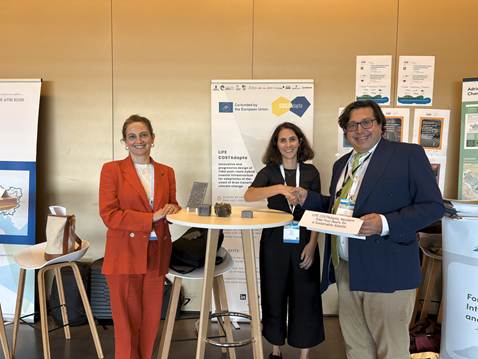
Juan Manuel Revuelta Pérez, CEO of Fundación Finnova; Pilar Santamaría, Director of Communication and International Relations at Fundación Finnova; and Naomie Lecard, Marketing Manager at ECOncrete, during the presentation of the European project.
A meeting with the leading European officials in maritime cooperation
The Macro-Regional & Sea Basin Strategies Days 2026 brought together policymakers, institutional representatives, regions, universities, and European projects to discuss the future of territorial and maritime cooperation.
The program included the plenary session “Creating further synergies among the Macro-regional and Sea Basin Strategies: cooperation potential at the thematic level,” the institutional panel “Towards an Atlantic Maritime and Macro-regional Strategy,” featuring national representatives from Ireland, France, Spain, Portugal, and the Basque Country, and the closing debate led by Hugo Sobral, Deputy Director-General of the Directorate-General for Regional and Urban Policy (DG REGIO) of the European Commission. The team also attended the workshop “Security across the EU Macro-regional Strategies – Thematic Workshop by Youth Councils,” focused on the role of youth in security and cooperation within European macro-regional strategies.
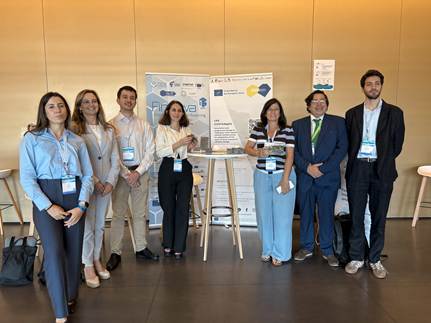
From left to right: Lucía Carletti, Junior Assistant at Finnova; Pilar Santamaría, Director of Communication and International Relations at Finnova; Tomás González Cabrera, representative of the Canary Islands Government Office in Brussels; Naomie Lecard, Marketing Manager at ECOncrete; Ana Ramos Barbosa, Director of the Galicia Europa Foundation Office in Brussels; Juan Manuel Revuelta, CEO of Finnova; Pablo Ribao, regional representative of Galicia at the Galicia Europa Foundation in Brussels.
The institutional agenda opens new opportunities for LIFE COSTAdapta
Participation in the event facilitated meetings with officials from the European Commission, public administrations, universities, and regional entities to explore future lines of collaboration in coastal adaptation, climate resilience, and the blue economy.
Notable meetings included those held with Hugo Sobral, Deputy Director-General of DG REGIO; Delilah Al Khudhairy, Director of Maritime Policy and Blue Economy at DG MARE; Christos Economou, Deputy Head of Unit at DG MARE; Tomás González Cabrera, representative of the Canary Islands Government Office in Brussels; Ana Ramos Barbosa, Director of the Galicia Europa Foundation Office in Brussels; Moisés Canle, Vice-Rector for Degree Programs and Internationalization at the University of A Coruña; and Pablo Ribao, representative of the Galician Regional Ministry of the Sea (Consellería do Mar de la Xunta de Galicia).
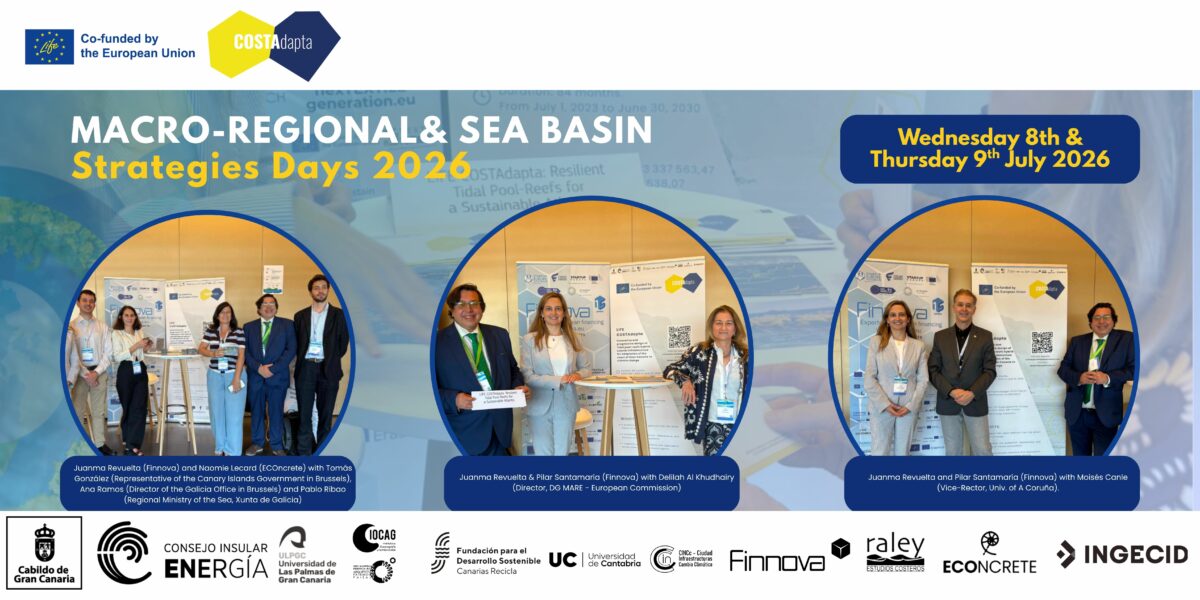
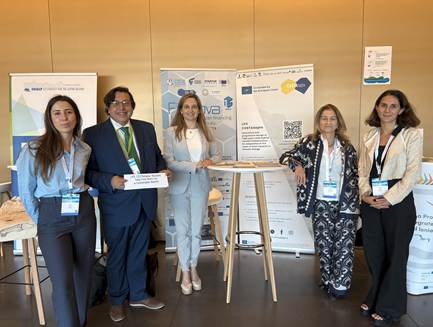
The Fundación Finnova team together with Delilah Al Khudhairy, Director of Maritime Policy and Blue Economy at the Directorate-General for Maritime Affairs and Fisheries (DG MARE) of the European Commission.
ECOncrete brings innovation closer to a European audience
The ecological infrastructure samples presented by Naomie Lecard, Marketing Manager at ECOncrete, offered a practical demonstration of how nature-based solutions support marine biodiversity and increase the resilience of coastal areas. As Naomie Lecard noted:
“ECOncrete is providing its bio-inoculating concrete technology and proven nature inclusive design concepts […]. Our solutions have been deployed globally from the ports of San Diego and San Francisco to the ports of Ashdod and the port of Vigo”.
The demonstrations attracted considerable interest among attendees and facilitated the exchange of knowledge on innovation applied to coastal adaptation.
Naomie Lecard presents the ecological infrastructure solutions developed by ECOncrete.
More than a dozen new contacts to drive future collaborations
LIFE COSTAdapta’s presence in Brussels drew the attention of representatives from institutions, public administrations, and European organizations from countries including Germany, Iran, Georgia, Ukraine, France, and Spain, all interested in learning about the project and exploring future cooperation opportunities.
This outcome strengthens LIFE COSTAdapta’s international profile and consolidates its role as a European benchmark in developing innovative solutions for coastal adaptation in the face of climate change.
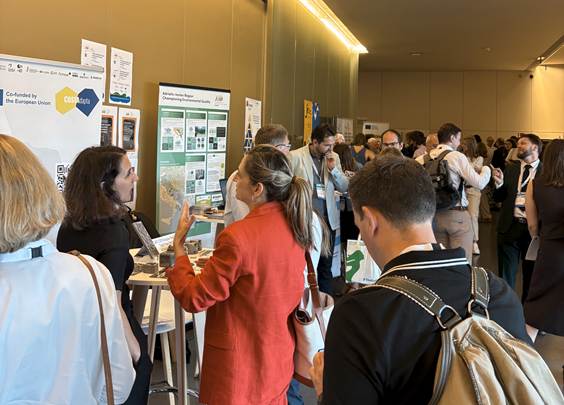
Attendees learn about the solutions developed by LIFE COSTAdapta at the Networking Village.
About LIFE COSTAdapta
LIFE COSTAdapta is a project with a budget of €3.4 million, co-financed by the European Union’s LIFE Programme, which develops an innovative solution inspired by the traditional intertidal pools of the Canary Islands to increase the resilience of coastal areas to climate change through nature-based solutions.
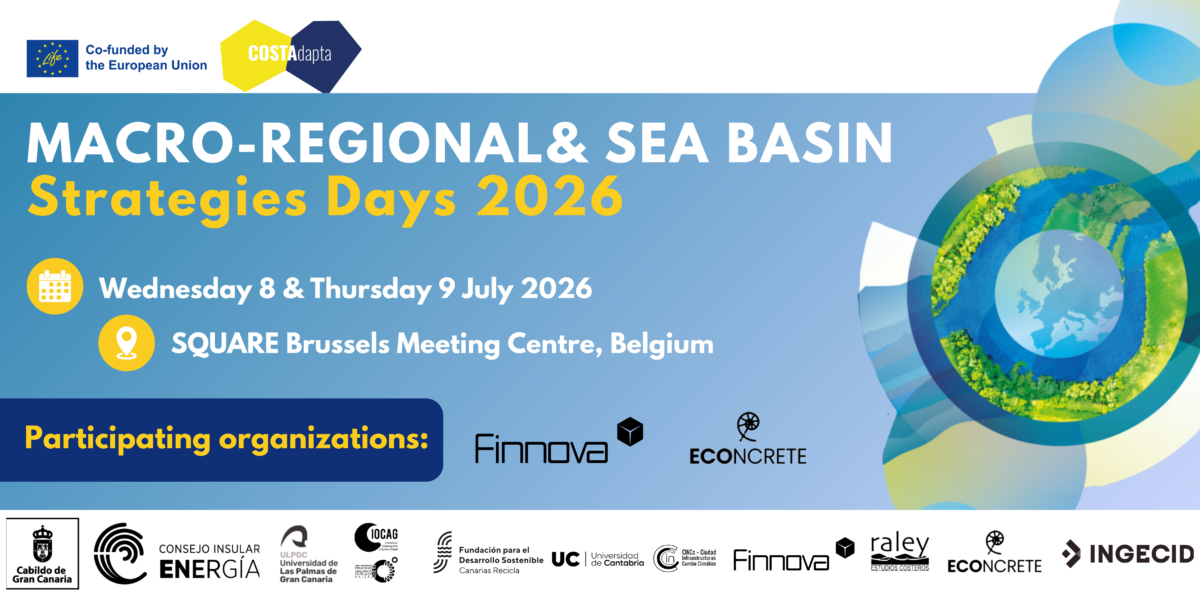
The event will take place on Wednesday 8 and Thursday 9 July 2026 at the SQUARE Brussels Meeting Centre, Brussels (Belgium).
Fundación Finnova and ECOncrete will participate with institutional and technical representation to showcase innovative climate adaptation solutions for coastal areas.
Monday 6 July, Brussels. The European project LIFE COSTAdapta will participate in the Macro-Regional & Sea Basin Strategies Days 2026, one of Europe’s leading forums on territorial cooperation, maritime governance and sustainability, to be held on Wednesday 8 and Thursday 9 July 2026. The project delegation will include Juan Manuel Revuelta, CEO of Fundación Finnova; Pilar Santamaría, Director of Communication and International Relations at Fundación Finnova; Laura Reig, law assistant; Claudia Tentor, Junior Communication Officer at Fundación Finnova; and Naomie Lecard, Marketing Manager at ECOncrete, a project partner. During the event, the delegation will showcase the innovative solutions developed by LIFE COSTAdapta to strengthen the resilience of coastal areas to climate change while fostering new collaboration opportunities with European stakeholders.
A strategic presence at the Networking Village
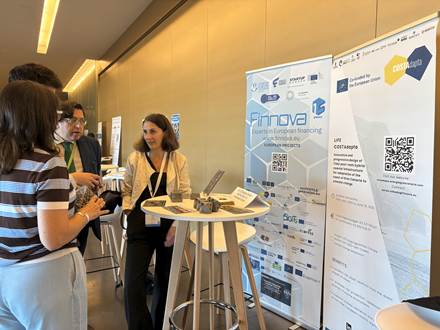
The Networking Village will feature 16 exhibition stands representing selected European projects and initiatives. Among them, LIFE COSTAdapta will host a stand in the Delvaux Foyer, reinforcing its position as a leading European initiative in climate change adaptation for coastal areas.
Shared with the Horizon Europe ONE-BLUE project, the stand will serve as a meeting point to present innovative solutions related to the sustainable blue economy, marine ecosystem protection and coastal resilience. It will also encourage knowledge exchange, collaboration between both initiatives and dialogue with professionals, institutions and organisations attending the event.
The stand will also feature communication materials and demonstration pieces provided by ECOncrete, offering visitors a practical insight into how nature-based solutions enhance biodiversity and strengthen the resilience of coastal infrastructure. All materials will be brought by Naomie Lecard, Marketing Manager at ECOncrete, and will include:
A mini tidal pool model, recreating one of the habitats designed to enhance marine biodiversity.
A mangrove-textured wall panel, demonstrating how bio-enhancing surfaces facilitate the colonisation of marine organisms.
A biologically colonised concrete sample, showcasing real examples of marine growth on ECOncrete’s solutions.
A sample of ECO-P, one of the materials used by the company to develop more sustainable marine infrastructure solutions.
These demonstration pieces will enhance the technical, educational and interactive nature of the stand, providing visitors with a practical understanding of how nature-based solutions contribute to climate adaptation, marine ecosystem restoration and greater resilience of coastal environments.
Institutional representation and European cooperation
Fundación Finnova’s participation will be led by Juan Manuel Revuelta, CEO of the foundation, and Pilar Santamaría, Director of Communication and International Relations, with the support of Laura Reig, law assistant and Claudia Tentor, Junior Communication Officers. The team will promote LIFE COSTAdapta’s European dimension through strategic meetings, institutional networking and project dissemination activities.
In addition, Naomie Lecard, Marketing Manager at ECOncrete, a partner of LIFE COSTAdapta responsible for developing the project’s eco-engineered concrete solutions, will contribute her technical expertise while presenting demonstration materials that showcase these innovative solutions for climate adaptation in coastal environments.
A key forum for maritime governance
The Macro-Regional & Sea Basin Strategies Days have become one of Europe’s leading platforms for dialogue on territorial cooperation, sustainability and maritime governance. Organised by the European Commission’s Directorate-General for Regional and Urban Policy (DG REGIO) and Directorate-General for Maritime Affairs and Fisheries (DG MARE), the event will bring together representatives from European institutions, national and regional administrations, experts and EU-funded projects to strengthen cooperation among Europe’s macro-regional and sea basin strategies.
The programme will feature high-level representatives from the European Commission and the presidencies of Europe’s main macro-regional and maritime strategies, including the Bulgarian Presidency of the Common Maritime Agenda for the Black Sea, the Bavarian Presidency of the EU Strategy for the Alpine Region, the Spanish Presidency of the Atlantic Strategy and Co-Presidency of the Western Mediterranean Initiative, and the Danish Presidency of the EU Strategy for the Baltic Sea Region. The closing session will also include a high-level discussion with representatives from DG REGIO and DG MARE on the future of territorial cooperation and the blue economy in Europe.
Throughout the two-day event, participants will take part in thematic workshops, plenary sessions and dedicated networking activities, including the Networking Village, working lunches, coffee breaks and an official dinner with live music, all designed to encourage knowledge exchange, partnership building and new international cooperation opportunities.
LIFE COSTAdapta’s participation in this forum reinforces its position as a leading European initiative in nature-based coastal adaptation and contributes to expanding its visibility and impact across Europe.
ECOncrete is a company specialising in nature-based marine and coastal infrastructure solutions, combining ecological design with innovative technology to enhance biodiversity, strengthen the resilience of coastal environments and reduce the environmental impact of maritime infrastructure.
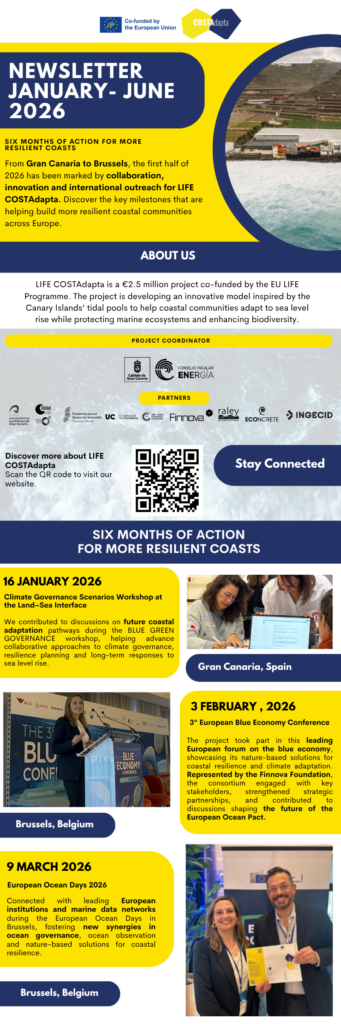
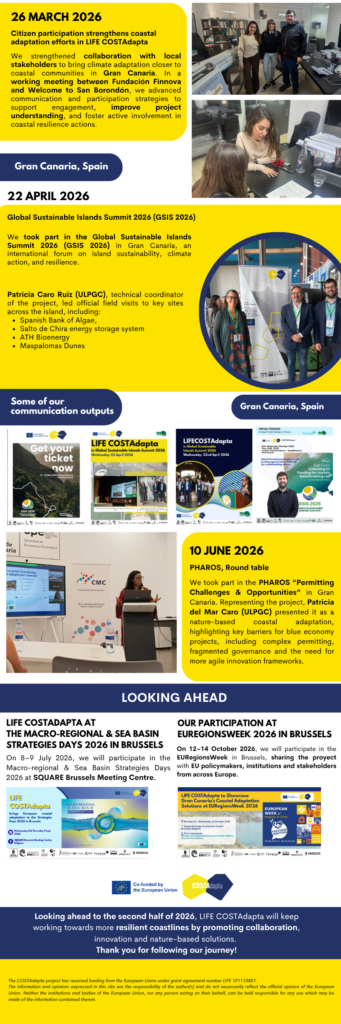
The new LIFE COSTAdapta Newsletter is out now. Take a look and follow our journey: https://www.linkedin.com/feed/update/urn:li:activity:7477990346623356928
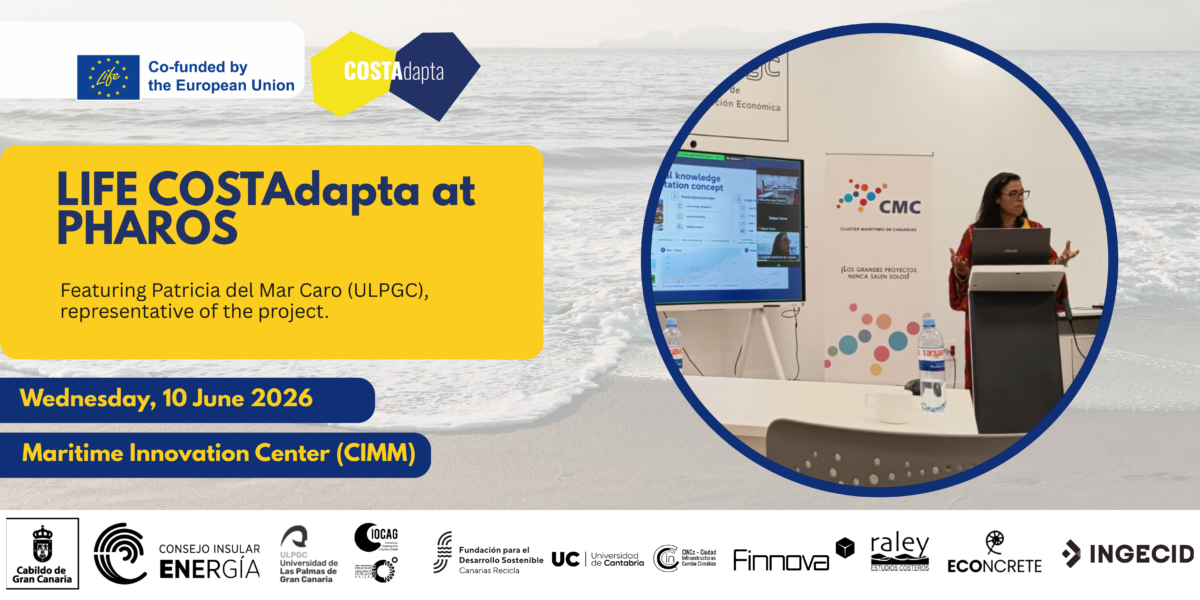
Researcher Patricia del Mar Caro (ULPGC) represented the consortium last Wednesday, June 10th, at the roundtable held at the CIMM
The meeting gathered experts to identify regulatory bottlenecks and propose legal frameworks that streamline coastal innovation
Monday, 22 June 2026, Gran Canaria.LIFE COSTAdapta participated in the second roundtable of the “Permitting Challenges & Opportunities” series organized by PHAROS, held on 10 June at the Centro de Innovación Marino Marítima (CIMM). The event provided a space for dialogue bringing together representatives of European blue economy projects to analyze the main regulatory and administrative barriers affecting the implementation of innovative initiatives in marine and coastal environments.
The session highlighted a shared reality among many European projects: difficulties arising from authorization processes, fragmented responsibilities across public administrations, and the complexity of procedures required to deploy innovative solutions.
During her intervention, Patricia del Mar Caro emphasized the role of LIFE COSTAdapta as a nature-based coastal adaptation demonstrator project. Its goal is to develop solutions inspired by traditional natural seawater pools in the Canary Islands to protect coastlines from climate change impacts, while also promoting environmental restoration and biodiversity conservation.
She also shared the project’s experience in implementing pilot actions in highly vulnerable coastal areas, stressing the importance of regulatory frameworks that allow faster validation and deployment of innovative solutions.
The conclusions of the meeting showed that many innovative projects are not primarily limited by technical or scientific constraints, but rather by the complexity of administrative procedures. Key recommendations included identifying required permits early in the process, improving coordination between responsible authorities, adapting regulatory requirements to pilot project scales, and promoting mechanisms that facilitate experimentation and innovation in the marine sector.
The outcomes of this session will contribute to a policy recommendations document led by PHAROS, aimed at providing public administrations with concrete proposals to improve authorization systems and accelerate the deployment of innovative solutions in the blue economy.
About the project
LIFE COSTAdapta has a budget of €3.4 million and is co-funded by the European Union’s LIFE Programme. The project consortium includes the Insular Energy Council of Gran Canaria, the Universidad de Las Palmas de Gran Canaria, the Universidad de Cantabria, Ingecid, RALEY, ECOncrete, the Canary Islands Sustainable Development Foundation Canarias Recicla, and the Finnova Foundation.
Its objective is to develop an innovative coastal adaptation solution inspired by traditional natural seawater pools in the Canary Islands, combining coastal protection, environmental restoration, and biodiversity conservation.
On World Oceans Day, the project highlights its commitment to the protection and adaptation of coastal areas.
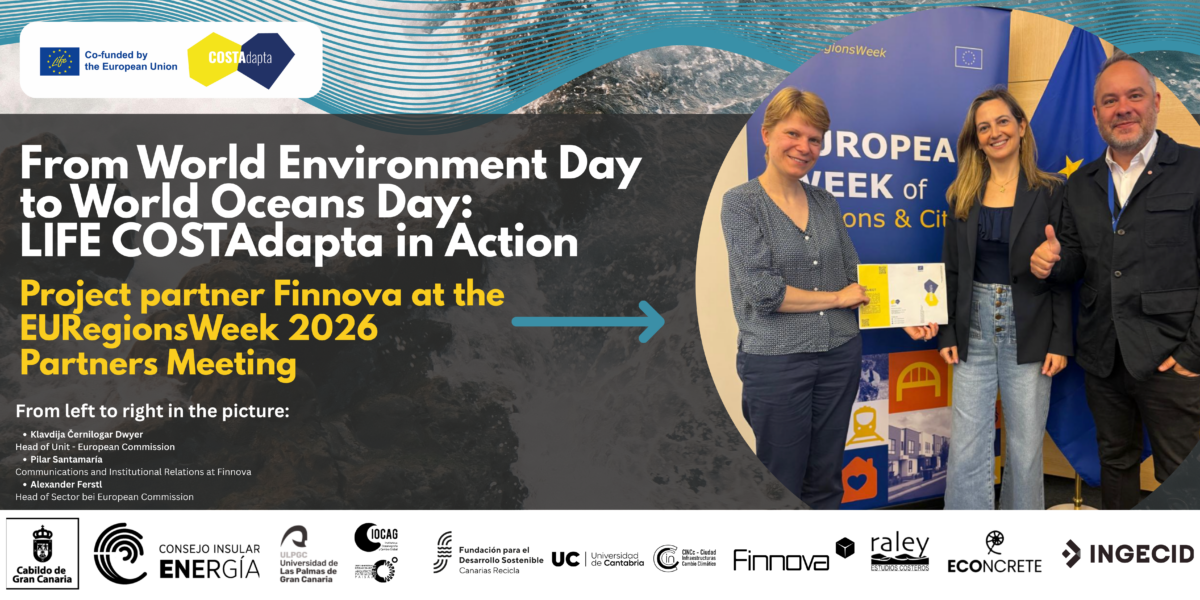
Pilar Santamaría represented the consortium at the preparatory meeting for the European Week of Regions and Cities 2026, coinciding with World Environment Day.
The attendance of Finnova’s representative, on behalf of the entire consortium, helped advance preparations for the project’s official participation in this major European event, which will take place next October. This important milestone comes during a significant institutional week marked by the coincidence of World Environment Day (5 June) and World Oceans Day (8 June). These two international observances underscore the importance of the actions promoted by LIFE COSTAdapta to improve coastal resilience through Nature-Based Solutions.
Coordinated by the Gran Canaria Island Energy Council (Consejo Insular de la Energía de Gran Canaria), LIFE COSTAdapta brings together scientific, technical, and communication partners committed to developing innovative solutions for adapting coastlines to sea-level rise.
Towards EURegionsWeek 2026
The European Week of Regions and Cities is one of the European Union’s leading forums dedicated to regional development and territorial cohesion. In this context, participation in the preparatory meeting provided an opportunity to contribute to the planning of the next edition of the event and to strengthen LIFE COSTAdapta’s visibility at the European level.
In addition, Pilar Santamaría, Head of Communications and Institutional Relations at Finnova Foundation, carried out networking activities on behalf of the consortium with EURegionsWeek organisers and representatives of the European Commission, including Alexander Ferstl and Klavdija Černilogar, Head of Unit at the European Commission. These meetings provided an opportunity to explore potential collaborations and present the project’s objectives and progress to key European stakeholders.
From the Environment to the Oceans: Protecting Coastlines to Protect the Future
The objectives of LIFE COSTAdapta are fully aligned with the global commitment promoted by the United Nations. The project works to develop solutions capable of reducing the impacts of climate change while simultaneously contributing to the conservation of marine ecosystems and the protection of the communities that depend on them.
On a day dedicated to recognising the fundamental role of the oceans in climate regulation, LIFE COSTAdapta highlights the urgent need to act in coastal areas, which are among the most vulnerable environments facing sea-level rise and extreme weather events. Through an innovative infrastructure inspired by the traditional Canary Islands tidal pools (“charcos de marea”), the project seeks to combine coastal protection, environmental regeneration, and climate adaptation, creating a hybrid model that can be replicated in other European territories.
About LIFE COSTAdapta
LIFE COSTAdapta is co-funded by the European Union’s LIFE Programme and has a total budget of €3,409,864. The project is coordinated by the Gran Canaria Island Energy Council and involves the participation of the University of Las Palmas de Gran Canaria, the University of Cantabria, INGECID, Raley Coastal Studies, ECOncrete AQUA, the Canary Islands Foundation for Recycling and Sustainable Development, and Finnova Foundation.
With a duration of seven years, the initiative is working to develop innovative nature-based coastal adaptation solutions that can be replicated across other European regions.
LIFE COSTAdapta will feature an official stand at the Networking Village of the 2026 Macro-regional & Sea Basin Strategies Days
Finnova will participate in Brussels with the European projects LIFE COSTAdapta and One Blue
Juanma Revuelta, CEO of Finnova, and Pilar Santamaría, Director of Communication and International Relations at Finnova, will attend the event on behalf of the project
Brussels, Monday 6 June 2026. The European project LIFE COSTAdapta will participate with an official stand at the Networking Village of the 2026 Macro-regional & Sea Basin Strategies Days, one of the leading European events focused on maritime cooperation, macro-regional strategies, territorial sustainability and governance, organised by the European Commission through the Directorate-General for Regional and Urban Policy (DG REGIO) and the Directorate-General for Maritime Affairs and Fisheries (DG MARE). The event will take place on Wednesday 8 and Thursday 9 July at the SQUARE Brussels Meeting Centre in Brussels.
The European Commission has officially confirmed the allocation of the exhibition space to LIFE COSTAdapta, which will be represented by Juanma Revuelta, CEO of the Finnova Foundation, and Pilar Santamaría, Director of Communication and International Relations at Finnova. The stand will be active during the Networking Village and the institutional activities scheduled between 17:00 and 22:00 on Wednesday 8 July, as part of a programme that will include working sessions, strategic meetings and an official dinner organised by the European Commission.
In addition, Finnova will share exhibition space with the European project One Blue, an initiative focused on protecting marine ecosystems and promoting a sustainable blue economy in Europe, thereby strengthening European synergies between climate innovation, coastal resilience and maritime sustainability.
Brussels brings together Europe’s leading maritime and macro-regional strategies
The Macro-regional & Sea Basin Strategies Days celebrate their third consecutive edition in 2026 as one of the main European forums dedicated to territorial, maritime and regional cooperation. Over the course of two days, representatives from the eight European macro-regional and maritime strategies — Alpine, Danube, Adriatic-Ionian, Baltic Sea, Atlantic, WestMED, Black Sea and Greater North Sea — will share projects, experiences and innovative solutions linked to sustainability, territorial cohesion and climate resilience.
The participation of LIFE COSTAdapta represents important European recognition of the work carried out by the project consortium in the field of nature-based adaptation and the protection of coastal areas against climate change. The exhibition space will provide an opportunity to showcase the solutions developed in Gran Canaria to institutional representatives, policymakers, experts, researchers and European organisations involved in climate action and coastal governance.
Finnova strengthens the project’s European dimension
The Finnova Foundation, the entity responsible for the communication and dissemination of LIFE COSTAdapta, will coordinate the institutional participation and networking activities planned during the event. The presence of Juanma Revuelta and Pilar Santamaría will reinforce the project’s European visibility, foster new opportunities for international cooperation and help build strategic alliances with key stakeholders from the European maritime, climate and territorial sectors.
In addition to the exhibition area, the event will feature high-level sessions on maritime cooperation, regional innovation, territorial sustainability and multilevel governance, consolidating its position as one of the leading European platforms for dialogue on maritime and macro-regional strategies.
The European project has been officially selected to host a stand at the 2026 European Week of Regions and Cities.
Finnova Director of Communications and Public Affairs Pilar Santamaría will attend the partner meeting organised by the European Commission on Friday, 5 June, in Brussels.
The meeting will provide information on the official timetable, next steps and requirements for preparing the exhibition space.
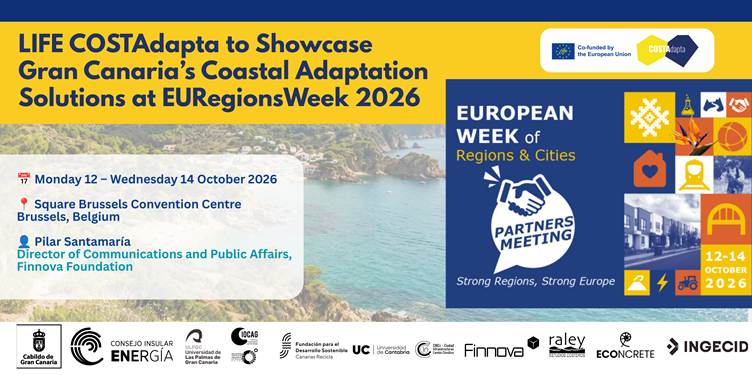
Brussels, Tuesday, 26 May 2026. The European project LIFE COSTAdapta has been officially selected to participate with a stand at the 2026 edition of the European Week of Regions and Cities (EURegionsWeek), Europe’s leading event dedicated to regional policy, territorial cohesion, sustainability and innovation, organised by the European Commission.
The confirmation was communicated by the EURegionsWeek Secretariat following the completion of the evaluation process, which this year attracted a large number of high-quality applications from across Europe. Thanks to this selection, LIFE COSTAdapta will have its own exhibition space to present its innovative climate adaptation and coastal resilience solutions to institutional representatives, policymakers, experts, researchers and organisations from across Europe on 12, 13 and 14 October 2026 in Brussels.
Preparations for the Official Participation Begin
As a first step in the organisational phase, the European Commission has invited all selected projects and organisations to an official preparatory meeting that will take place on Friday, 5 June 2026, at the Karel Van Miert Auditorium in Tour Madou, the European Commission’s premises in Brussels.
Representing the Finnova Foundation, the organisation responsible for the communication and dissemination activities of the LIFE COSTAdapta project, Pilar Santamaría, Director of Communications and Public Affairs, will attend the meeting.
During the session, EURegionsWeek organisers will officially present the results of the selection process, the event timetable, key organisational milestones, preparation deadlines and the guidelines required to ensure the successful delivery of all planned activities. A dedicated question-and-answer session will also be held to address participants’ queries and coordinate the logistical and communication aspects of the selected exhibition spaces.
European Recognition for Climate Adaptation Solutions
LIFE COSTAdapta’s participation in EURegionsWeek 2026 represents significant European recognition of the work carried out by the consortium in the field of nature-based coastal adaptation and resilience to the impacts of climate change.
Each year, the European Week of Regions and Cities brings together thousands of representatives from European institutions, regional and local authorities, universities, research centres, companies and international organisations to discuss Europe’s key territorial challenges and share innovative solutions for sustainable development.
Participation in the event will provide international visibility for the project’s achievements, strengthen cooperation with other European initiatives and create new opportunities for collaboration in the field of climate adaptation for coastal areas.
Finnova Strengthens the Project’s European Dimension
The Finnova Foundation will play a key role in coordinating LIFE COSTAdapta’s participation in EURegionsWeek 2026, both in the preparation of the stand and in the communication and dissemination activities planned throughout the event.
Pilar Santamaría’s attendance at the official meeting on 5 June will mark the beginning of the countdown to one of Europe’s leading forums on regional policy, sustainability and territorial innovation. In addition to coordinating organisational aspects, the meeting will help foster new strategic partnerships and networking opportunities for the project consortium.
The European project participated in the Global Sustainable Islands Summit 2026
Patricia Caro Ruiz (ULPGC) highlighted “soft systems” as a response to the climate risk already present along the coastline
Adrián Noheda (Finnova Foundation) fostered new connections in climate finance and international cooperation
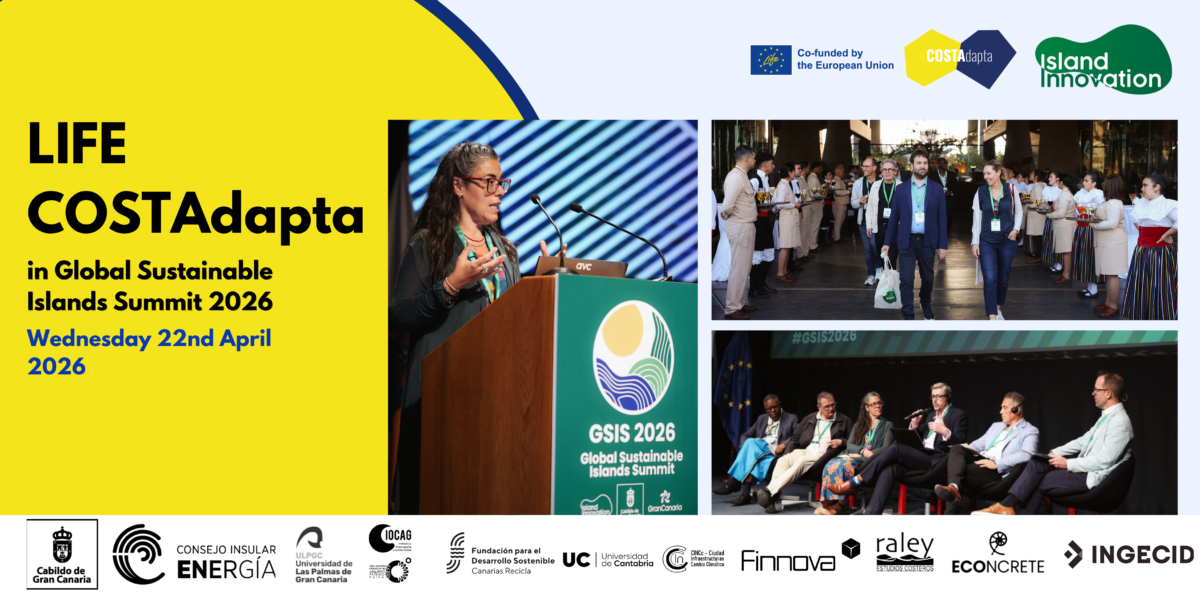
Brussels, Monday May 11th, 2026. The European project LIFE COSTAdapta, coordinated by the Island Energy Council of Gran Canaria (CIEGC), participated in the Global Sustainable Islands Summit (GSIS 2026), held on Wednesday, April 22 and Thursday, April 23, 2026, in Gran Canaria (Spain). The project presented its coastal resilience approach based on hybrid solutions inspired by nature.
The event featured contributions from Patricia Caro Ruiz, technical coordinator of the project and professor at the University of Las Palmas de Gran Canaria (ULPGC), and Adrián Noheda, project manager at the Finnova Foundation, the entity responsible for communication and strategic support of the project. This participation is part of LIFE COSTAdapta’s strategy to promote climate change adaptation in island territories through knowledge transfer, international cooperation, and the development of solutions applied to local contexts.
An international meeting for coastal adaptation in islands
GSIS 2026 brought together institutional representatives, scientists, and stakeholders from the blue economy sector to address sustainability challenges in island territories. With over 500delegates representing 67 countries worldwide, the summit provided a platform for exchanging ideas and best practices.
In this context, LIFE COSTAdapta shared its vision on the need to integrate climate adaptation into coastal planning, based on the premise that climate change-related risks are already present along the coastline.
During her intervention, Patricia Caro Ruiz (ULPGC) emphasized the importance of so-called “soft systems” for progressive coastal adaptation, based on the combination of natural processes and adaptive design as an alternative to traditional rigid infrastructures.
Nature-based solutions: the reef–tidal pool system
One of the key elements presented was the reef–tidal pool prototype, a hybrid solution that integrates natural pools, artificial reefs, and living structures. This system is designed to reduce wave energy, enhance sediment stability, and create marine habitats, thereby contributing to coastal protection and biodiversity.
International cooperation and climate finance
During the summit, Adrián Noheda (Finnova Foundation) carried out an agenda focused on identifying European funding opportunities and establishing new strategic partnerships for scaling up nature-based solutions. His participation helped strengthen the project’s connections with international stakeholders in climate innovation and coastal management.
About the project
The LIFE COSTAdapta project, coordinated by the Island Energy Council of Gran Canaria (CIEGC), has a budget of €3,337,563, co-funded at 60% by the European Union’s LIFE Programme. Its mission is to transform coastal adaptation through hybrid systems inspired by nature.
The multidisciplinary consortium is composed of: the University of Las Palmas de Gran Canaria (ULPGC), the University of Cantabria (UC), INGECID, Raley Coastal Studies, ECOncrete AQUA, the Canary Foundation for Recycling and Sustainable Development (FCR), and the Finnova Foundation.