COSTAdapta

Categories
News

LIFE COSTAdapta present at the youth training day in Brussels

  • The training meeting for young talents was held on 4 April in the European capital.
  • Finnova presented the main objectives and activities of the project.

Brussels, 5 April 2024. LIFE COSTAdapta has been present last 4th April at the training day for young people held in Brussels by the Finnova Foundation, partner of the project. During the event, attendees were able to learn about the main aspects of the European project and the activities that are being developed.

The presentation of LIFE COSTAdapta was very well received by the young people, who were able to see the importance of this project to alleviate the consequences of rising sea levels on the coasts. The day also served to raise awareness of a project that can be scaled up to other European territories and that will undoubtedly have enormous benefits for the coast of Gran Canaria.

About LIFECOSTAdapta

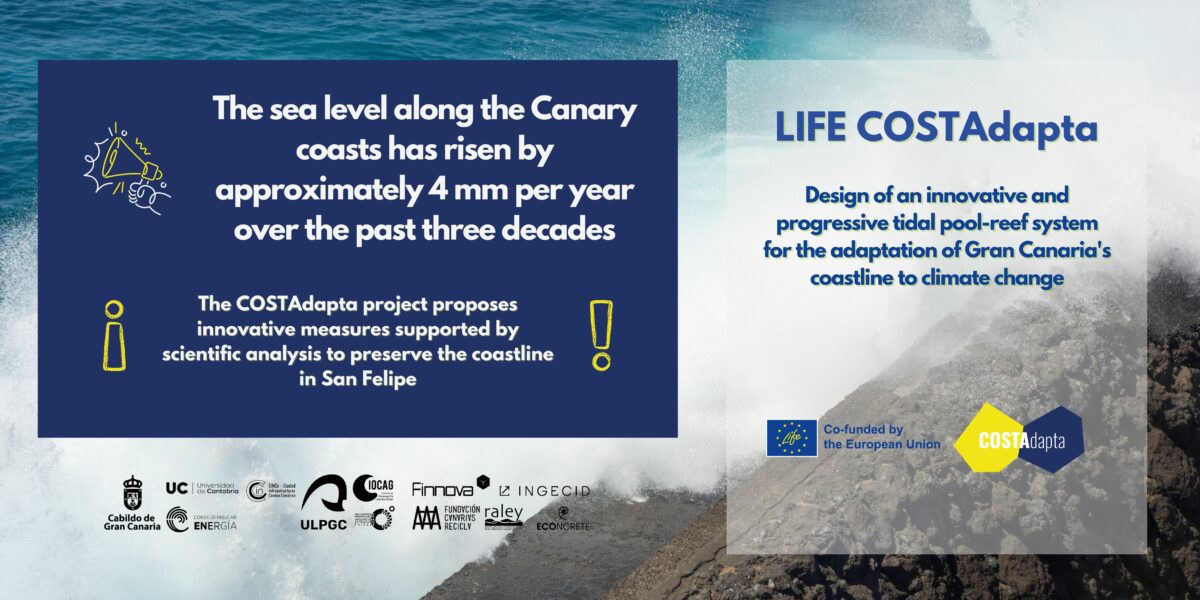
The main objective of the LIFE COSTAdapta project is to address the adaptation of the coast of Gran Canaria to sea level rise through an innovative methodology. To this end, a progressive tidal pool-reef system will be designed and tested, combining traditional tidal pool construction techniques with advanced solutions.

This will contribute to the progressive adaptation of the Gran Canaria coast to climate change, crucial given the high vulnerability of the Canary Islands to climate impacts, including sea level rise. In addition to strengthening the resilience of coastal areas, LIFE COSTAdapta aims to conserve habitats characteristic of these areas and protect the local tourism economy. The project will ensure economic sustainability by providing solutions to flooding and maintaining the region’s tourist attraction, which in turn will support coastal stability.

The project, with a duration of 7 years and a total budget of 3,409,864 EUR (2,045. 818 EUR subsidised by the European Union through the LIFE Programme), is coordinated by the Consejo Insular de Energía de Gran Canaria (CIEGC) of the Cabildo de Gran Canaria, with the support of its seven partners, among which are public entities, universities, foundations and private companies, such as the University of Las Palmas de Gran Canaria (ULPC), universities, foundations and private companies, such as the University of Las Palmas de Gran Canaria (ULPGC), the University of Cantabria (UC), INGECID, Raley Estudios Costeros, ECONCRETE, the Canary Islands Foundation for Recycling and Sustainable Development and the Finnova Foundation.

Categories
News

LIFE COSTAdapta celebrates World Climate Day

  • World Climate Day, declared by the United Nations (UN) Framework Convention, is celebrated on 26 March.
  • Since 1977, the average global temperature has been progressively exceeded every year.
  • The oceans are the planet’s largest heat sink.

Brussels, 26 March 2024. In recent decades there have been significant changes in the climate as a result of rapid industrial development and population growth, leading to consequences such as an increase in greenhouse gases and global warming, among others. This is why 26 March is World Climate Day, declared by the United Nations (UN) Framework Convention on Climate Change.

The objective of the celebration of this international day is focused on raising awareness and sensitising the population to the repercussions that all our actions and activities have on the climate. The 1992 United Nations Framework Convention on Climate Change was a turning point that changed the way people, governments and companies perceived the pollution of the planet until now.

Scientific studies show that every year since 1977 has exceeded the average temperature of the previous year, causing the earth’s temperature to rise steadily, reaching an increase of approximately 0.85ºC since the end of the 20th century. This situation of continuously rising temperatures is due, for the most part, to the burning of fossil fuels and their consequent emission of greenhouse gases.

To better understand this changing climate situation, we need to understand what climate really is. Climate is the result of the interaction between the atmosphere, oceans, and the earth’s surface, among other factors.  This relationship has been affected by human interaction and industrial production in recent years, coupled with increased emissions of greenhouse gases.   

Effects of climate change on the ocean

According to data published by the World Bank, the oceans are the planet’s largest heat sink, absorbing 90% of the excess heat caused by climate change. They are also a highly efficient carbon sink, absorbing 23% of human-generated CO2 emissions.

Climate change causes detrimental changes in the oceans, including temperature rise, sea level rise and acidification. In fact, the oceans are becoming more acidic as they continue to absorb CO2 into the atmosphere, causing oxygen levels to decrease. Another consequence is a significant change in ocean current patterns, affecting the health of the oceans and marine species. That is why from the LIFE COSTAdapta project we remind today the importance of becoming aware of the current situation regarding the effects of climate and its consequences.

The European LIFE COSTAdapta project is carrying out a series of initiatives to adapt to the needs of climate change and its consequences. The main objective of the LIFE COSTAdapta project is to address the adaptation of the coast of Gran Canaria to sea level rise through an innovative methodology. To this end, the objective is to design and test an innovative and progressive tidal pool-reef system, which uses, partially, the traditional technique of tidal pool construction, common elements in the Canary Islands and the rest of Macaronesia, for the coastal adaptation of Gran Canaria to climate change.

About LIFE COSTAdapta

The main objective of the LIFE COSTAdapta project is to address the adaptation of the coast of Gran Canaria to sea level rise through an innovative methodology. To this end, a progressive tidal pool-reef system will be designed and tested, which will combine traditional tidal pool construction techniques with advanced solutions.

This will contribute to the progressive adaptation of the coast of Gran Canaria to climate change, crucial given the high vulnerability of the Canary Islands to climate impacts, including sea level rise. In addition to strengthening the resilience of coastal areas, LIFE COSTAdapta aims to conserve habitats characteristic of these areas and protect the local tourism economy. The project will ensure economic sustainability by providing solutions to flooding and maintaining the region’s tourist attraction, which in turn will support coastal stability.

The project, with a duration of 7 years and a total budget of EUR 3,409,864 (EUR 2,045,818 subsidised by the European Union through the LIFE Programme), is coordinated by the Gran Canaria Island Energy Council (CIEGC) of the Cabildo de Gran Canaria, with the support of its seven partners.

Categories
News

LIFE COSTAdapta celebrates World Water Day 

  • On 22 March the UN General Assembly proclaimed it World Water Day.
  • 70% of the earth is covered with water; however, only 3% is fresh and most of it is frozen.

Brussels, 22 March 2024. There are different issues surrounding water, such as its difficult access for certain populations, pollution or the scarcity of this natural resource. On 22 March, the UN General Assembly proclaimed it World Water Day, a crucial occasion to reflect on the importance of this essential resource.  

The main objective of this day is to raise awareness of the global water crisis, as well as the situation faced by millions of people who do not have access to water. In addition, it is crucial to emphasise the relevance of protecting the planet’s natural resources from depletion. An objective that is very much in line with the LIFE COSTAdapta project that seeks to address the adaptation of the coast of Gran Canaria to sea level rise.  

Seventy per cent of the earth is covered with water, yet only 3 per cent of it is fresh and most of it is frozen. Water is considered an inexhaustible resource and therefore its value has been underestimated. In recent decades, the way water has been consumed has outpaced the rate at which it is consumed in excess of the resource’s capacity for renewal. The world’s available water reserves are threatened by polluting factors, according to various reports: at least 2 tons of waste are dumped daily into receiving water, including human discharges, agricultural waste and industrial waste.

Water is one of the fundamental rights for the preservation of life in all its forms. One of the central themes of the United Nations (UN) is the care and preservation of water worldwide. As part of sustainable development, this has been enshrined in the 2030 Agenda and is a priority of the Sustainable Development Goals (SDGs).

Water for Peace

This year’s theme, “Water for Peace”, gives food for thought about the importance of caring for and conserving peace. As the impacts of climate change increase and populations grow, there is an urgent need for countries to come together to protect and conserve one of our planet’s most precious resources. Public health, energy systems, economic productivity and environmental integrity depend on a well-functioning water cycle that can be managed equitably. When there is cooperation on water, it creates a positive effect by fostering harmony and building resilience to shared challenges. 

Water can create peace or provoke conflict. When water is scarce or polluted, or when people struggle to access it, tensions can rise. By cooperating on water, we can balance everyone’s water needs. As nations manage water cooperation, they foster harmony between communities and countries by uniting around fair and sustainable use.

That is why from the LIFE COSTAdapta project we remind today the importance of being aware of the current water situation and its relevant consequences. 

The European LIFE COSTAdapta project is carrying out a series of initiatives to adapt to the needs of climate change. The main objective of the LIFE COSTAdapta project is to address the adaptation of the coast of Gran Canaria to sea level rise through an innovative methodology. To this end, the aim is to design and test an innovative and progressive Tidal pool-reef system, partially using the traditional technique of tidal pool construction, common elements in the Canary Islands and the rest of Macaronesia, for the coastal adaptation of Gran Canaria to climate change. 

About LIFE COSTAdapta

The main objective of theLIFE COSTAdapta project is to address the adaptation of the coast of Gran Canaria to sea level rise by means of an innovative methodology. To this end, a progressive tidal pool-reef system will be designed and tested, combining traditional tidal pool construction techniques with advanced solutions.

This will contribute to the progressive adaptation of the Gran Canaria coast to climate change, crucial given the high vulnerability of the Canary Islands to climate impacts, including sea level rise. In addition to strengthening the resilience of coastal areas, LIFE COSTAdapta aims to conserve habitats characteristic of these areas and protect the local tourism economy. The project will ensure economic sustainability by providing solutions to flooding and maintaining the region’s tourist attraction, which in turn will support coastal stability.

The project, with a duration of 7 years and a total budget of 3,409,864 EUR (2,045,818 EUR subsidised by the European Union through the LIFE Programme), is coordinated by the Gran Canaria Island Energy Council (CIEGC) of the Cabildo de Gran Canaria, with the support of its seven partners.

Categories
News

LIFE COSTAdapta celebrates World Engineering Day for Sustainable Development

  • Today is World Engineering Day for Sustainable Development to highlight the role of professionals who, with their ingenuity and skills, build the future.
  • LIFE COSTAdapta advocates for engineering that contributes to sustainable development and adaptation to climate change.

Brussels, 4 March 2024. Today, Monday 4 March, the World Day of Engineering for Sustainable Development is celebrated to highlight the role of professionals who apply science and technology to solve global problems. This ephemeris is promoted by UNESCO with the purpose of presenting projects at the level of engineering and technology to achieve the goals set out in the Sustainable Development Plan proposed by the nations.

The aim is to ensure that future generations of engineers and scientists are able to devise solutions to local and global challenges in areas such as: food, water, energy, environment, sustainable cities, resilience to natural disasters, improvements in economic growth and even encourage gender equality within their professional field.

LIFE COSTAdapta has a fundamental role in the contribution of new measures for adaptation to climate change. In this sense, the main objective of the European project is to address the adaptation of the coast of Gran Canaria to sea level rise. To this end, it will design and test an innovative and progressive tidal pool-reef system. This prototype will help to minimise the effects of strong waves and rising sea levels, providing protection for the coast and favouring the proliferation of marine biodiversity.

The project, with a duration of 7 years and a total budget of 3,409,864 EUR (2,045,818 EUR subsidised by the European Union through the LIFE Programme), is coordinated by the Gran Canaria Island Energy Council (CIEGC) of the Cabildo de Gran Canaria, with the support of its seven partners.

Categories
News

LIFE COSTAdapta promotes coastal biodiversity on World Seagrass Day

  • Today is World Seagrass Day to raise awareness and promote action to conserve seagrasses in order to contribute to their health and development.
  • LIFE COSTAdapta advocates for the protection of seagrasses and their contribution to sustainable development and adaptation to climate change.

Brussels, 1 March 2024. Did you know that seagrasses are one of the most important coastal habitats for coping with the impacts of climate change? Today, 1 March, marks World Seagrass Day, an ecosystem that functions as a highly efficient carbon sink, storing up to 18% of the world’s ocean carbon, according to the United Nations. This action is fundamental in mitigating climate change and acidification of the oceans and seas, also contributing to the resilience of the most vulnerable ecosystems and species, such as coral reefs.

Seagrasses are found in shallow waters in many corners of the globe, from the tropics to the Arctic Circle. They form extensive seagrass meadows in which complex, highly productive and biologically rich habitats have developed. Despite covering barely 0.1% of the ocean floor, these seagrasses provide food and shelter for thousands of species of fish, seahorses and turtles, as well as improving water quality by filtering, recycling and storing nutrients and pollutants, and reducing seafood pollution. They also act as a first line of defence along coastlines by reducing wave energy, thereby protecting people from the increased risk of flooding and storms, one of the objectives promoted by the LIFE COSTAdapta project.

An endangered resource

Despite its important contribution to sustainable development and climate change mitigation and adaptation, this basic component of marine biodiversity is under threat, with only a quarter of all seagrass meadows found within marine protected areas.

Since the 1930s, seagrasses have been declining globally: 7% of this key marine habitat is being lost annually. The combination of different pressures from coastal development, pollution, climate change, dredging by ships, urban, industrial and agricultural run-off, and unregulated fishing and shipping activities are key drivers of the degradation of seagrasses and their ecosystems.

Seagrass management, conservation and restoration should be an essential component of sustainable blue economy strategies in the future. This is why the LIFE COSTAdapta project is taking the opportunity to reinforce our support for the protection of marine biodiversity, coastal adaptability to sea level rise and the environment in the face of climate change.

About LIFE COSTAdapta

The main objective of the LIFE COSTAdapta project is to address the adaptation of the coast of Gran Canaria to sea level rise by means of an innovative methodology. To this end, a progressive tidal pool-reef system will be designed and tested, combining traditional tidal pool construction techniques with advanced solutions.

This will contribute to the progressive adaptation of the Gran Canaria coast to climate change, crucial given the high vulnerability of the Canary Islands to climate impacts, including sea level rise. In addition to strengthening the resilience of coastal areas, LIFE COSTAdapta aims to conserve habitats characteristic of these areas and protect the local tourism economy. The project will ensure economic sustainability by providing solutions to flooding and maintaining the region’s tourist attraction, which in turn will support coastal stability.

The project, with a duration of 7 years and a total budget of EUR 3,409,864 (EUR 2,045,818 subsidised by the European Union through the LIFE Programme), is coordinated by the Gran Canaria Island Energy Council (CIEGC) of the Cabildo de Gran Canaria, with the support of its seven partners.

Categories
News

LIFE COSTAdapta arrives at the 5th Mediterranean Water Forum in Tunisia

  • The Forum is a platform open to all stakeholders interested in efficient and sustainable water management in the Mediterranean region.
  • LIFE COSTAdapta participates in the forum together with the Finnova Foundation, project partner

Brussels, 9 February 2024. LIFE COSTAdapta has been present these days 5, 6 and 7 February at the V Mediterranean Water Forum held in Tunisia by the Finnova Foundation, partner of the project. The Forum represents a unique opportunity to meet professionals from different countries who share their knowledge, experiences and ideas to find innovative solutions to water-related challenges. 

LIFE COSTAdapta, which aims to address the adaptation of the coast of Gran Canaria to sea level rise, has been present in the session “WEFE Nexus: Water/Energy/Food/Environment”. The CEO of the Finnova Foundation, Juanma Revuelta, and the director of European Funds, Juan Viesca, explained the main aspects of the project, which can be scaled up through other European programmes to other regions with the same problem on their coasts.

The Tunis Days is a platform open to all stakeholders in water management in the Mediterranean region, which has brought together a variety of solutions for efficient and sustainable water management by providing innovative solutions. Participants have established important contacts with water management professionals and have presented projects, technologies and innovative practices developed in the Mare Nostrum. The conclusions of this conference will be taken to the 10th World Water Forum (WWF) to be held in Bali (Indonesia) in May 2024.

About LIFE COSTAdapta

The main objective of the LIFE COSTAdapta project is to address the adaptation of the coast of Gran Canaria to sea level rise by means of an innovative methodology. To this end, a progressive tidal pool-reef system will be designed and tested, combining traditional tidal pool construction techniques with advanced solutions.

This will contribute to the progressive adaptation of the Gran Canaria coast to climate change, crucial given the high vulnerability of the Canary Islands to climate impacts, including sea level rise. In addition to strengthening the resilience of coastal areas, LIFE COSTAdapta aims to conserve habitats characteristic of these areas and protect the local tourism economy. The project will ensure economic sustainability by providing solutions to flooding and maintaining the region’s tourist attraction, which in turn will support coastal stability.

The project, with a duration of 7 years and a total budget of 3,409,864 EUR (2,045. 818 EUR subsidised by the European Union through the LIFE Programme), is coordinated by the Consejo Insular de Energía de Gran Canaria (CIEGC) of the Cabildo de Gran Canaria, with the support of its seven partners, among which are public entities, universities, foundations and private companies, such as the University of Las Palmas de Gran Canaria (ULPC), universities, foundations and private companies, such as the University of Las Palmas de Gran Canaria (ULPGC), the University of Cantabria (UC), INGECID, Raley Estudios Costeros, ECONCRETE, the Canary Islands Foundation for Recycling and Sustainable Development and the Finnova Foundation.

Categories
News

LIFE COSTAdapta project presented by the Energy Council of Gran Canaria at the National Conference of the Covenant of Mayors 2024

  • The Consejo Insular de la Energía de Gran Canaria (CIEGC) of the Cabildo de Gran Canaria, lead partner of the project, has been in charge of presenting it at the National Conference of the Covenant of Mayors 2024.
  • LIFE COSTAdapta, which addresses the adaptation of the coast of Gran Canaria to sea level rise, aims to become a benchmark and be replicated in those coastal areas suffering the consequences of climate change.

Brussels, 31 January 2024. The European LIFE Costadapta project, which aims to address the adaptation of the coast of Gran Canaria to sea level rise, is present these days (30 and 31 January) at the National Conference of the Covenant of Mayors 2024 in Gran Canaria and Tenerife, with the project’s lead partner, the Gran Canaria Island Energy Council of the Cabildo de Gran Canaria. This project aims to become a benchmark and be replicated in coastal areas that suffer the impact of strong waves.

The conference, organised by the Island Councils of Gran Canaria and Tenerife and in collaboration with the Canary Islands Federation of Municipalities, focuses on relevant issues for municipalities such as adaptation to climate change, energy poverty, energy communities, collaboration between municipalities and companies and the analysis of successes and obstacles in the implementation of climate measures at local level.

The Canary Islands are in a position of high vulnerability to the impacts of climate change, as pointed out by the Intergovernmental Panel on Climate Change (IPCC), showing a significant increase in sea levels affecting its coasts. In response to this problem, the main objective of the LIFE COSTAdapta project is to address the adaptation of the coast of Gran Canaria to rising sea levels by means of an innovative methodology. To this end, a progressive tidal pool-reef system will be designed.

In addition to strengthening the resilience of coastal areas, LIFE COSTAdapta aims to conserve habitats characteristic of these areas and protect the local tourist economy. The project will ensure economic sustainability by providing solutions to flooding and maintaining the region’s tourist attraction, which in turn will support coastal stability.

With a duration of 7 years and a total budget of EUR 3,409,864 (EUR 2,045. 2,045,818 EUR subsidised by the EU through the LIFE Programme), COSTAdapta is a project coordinated by the Gran Canaria Island Energy Council (CIEGC) of the Cabildo de Gran Canaria with the support of 7 partners: University of Las Palmas de Gran Canaria (ULPGC), University of Cantabria (UC), INGECID, Raley Estudios Costeros, ECONCRETE, the Canarian Foundation for Recycling and Sustainable Development and the Finnova Foundation.

Categories
News

2023 closes with record-breaking temperatures that are affecting sea level rise

  • 2023 looks set to be the hottest year in recorded history
  • Sea level rise is a direct consequence of global temperature increase
  • The European LIFE COSTAdapta project aims to adapt the coast of Gran Canaria to climate change by building a progressive system of tidal reefs-tide shelves

In just one week’s time, 2023 will come to a close, a year in which several temperature records have been broken as a result of climate change. This rise in global temperature is causing sea levels to rise, threatening seabed biodiversity, erosion and coastal encroachment, among other adverse effects. The European LIFE COSTAdapta project aims to address the problems caused by rising sea levels on the coast of Gran Canaria by building a progressive system of tidal reefs-tidal pools.

This year has seen sustained record-breaking temperatures. Up to October, the global average temperature in 2023 was the highest since measurements began, approaching the planetary safety limit of 1.5 degrees above pre-industrial levels set as a target by the international community in the historic Paris Agreement. The perfect storm unleashed by the combination of climate change and the “El Niño” phenomenon, which is often the cause of rising temperatures in recent years, is behind data that already places this year as the warmest, pending confirmation by the end of 2023.

Moreover, once the hottest months in the northern hemisphere, July and August, were over, the lull in the thermometers was relatively short-lived and the counter-attack of the heat was violent. Global temperatures in September and October were more anomalous than in any other year, according to Copernicus data. In fact, in Europe, this September was the hottest September by far: 1.1°C behind the previous top-ranked September, which was in 2020.

Multiple records have also been broken with respect to sea temperature. During this summer, both the Mediterranean and the Atlantic have broken their maximum temperature records, reaching average values of 28.71ºC and 24.9ºC, respectively. Both seas are living, on average, with water temperatures well above the historical average and the highest range ever detected.

When sea levels are rising as fast as they are, even the smallest rise can have terrible consequences for people living on the coast. As seawater moves inland, it can lead to soil erosion, flooding of wetlands, contamination of agricultural land and aquifers, and thus loss of habitat for fish, birds and plants. On the other hand, sea level rise coincides with the occurrence of more extreme weather conditions and more dangerous weather phenomena.

About LIFE COSTAdapta

The main objective of the LIFE COSTAdapta project is to address the adaptation of the coast of Gran Canaria to sea level rise by means of an innovative methodology. To this end, a progressive tidal pool-reef system will be designed and tested, combining traditional tidal pool construction techniques with advanced solutions.

This will contribute to the progressive adaptation of the Gran Canaria coast to climate change, crucial given the high vulnerability of the Canary Islands to climate impacts, including sea level rise. In addition to strengthening the resilience of coastal areas, LIFE COSTAdapta aims to conserve habitats characteristic of these areas and protect the local tourism economy. The project will ensure economic sustainability by providing solutions to flooding and maintaining the region’s tourist attraction, which in turn will support coastal stability.

The project, with a duration of 7 years and a total budget of 3,409,864 EUR (2,045. 818 EUR subsidised by the European Union through the LIFE Programme), is coordinated by the Consejo Insular de Energía de Gran Canaria (CIEGC) of the Cabildo de Gran Canaria, with the support of its seven partners, among which are public entities, universities, foundations and private companies, such as the University of Las Palmas de Gran Canaria (ULPC), universities, foundations and private companies, such as the University of Las Palmas de Gran Canaria (ULPGC), the University of Cantabria (UC), INGECID, Raley Estudios Costeros, ECONCRETE, the Canary Islands Foundation for Recycling and Sustainable Development and the Finnova Foundation.

Categories
News

Rising sea levels at the heart of the COP 28 debate

  • The most vulnerable territories have insisted on the need to keep global temperature rise below 1.5 degrees Celsius
  • LIFE COSTAdapta is a project that aims to protect coasts from rising sea levels

Brussels, 15 December 2023. The United Nations Conference on Climate Change held in Dubai (also known as COP 28), closed last Tuesday, December 12, with a warning message from the countries most vulnerable to climate change about its eventual disappearance. The constant rise in sea level is the main threat to island territories such as Tuvalu, Kiribati or the Fiji Islands, states that have hardly any altitude and for which the fight against climate change is at the top of the agenda. A problem that the European project LIFE COSTAdapta aims to tackle by addressing the adaptation of the coast of Gran Canaria to sea level rise.

The Alliance of Small Island States (AOSIS) has exposed once again at this last COP the imperative need to keep the rise in global average temperature below 1.5 degrees. This body, which brings together 39 territories particularly vulnerable to climate change, warns that they are already suffering with the current level of warming, and that losses and damages will increase with each increase in temperature.  “For our islands, there can be no alternative. This is our red line,” they point out.

In addition, AOSIS also issued a statement criticizing some aspects of the final agreement of this COP 28. The organization regrets that no commitment was made to reach peak emissions in 2025. AOSIS refers to the lack of attention being given to scientific rigor in this aspect, by not taking the relevant measures in order to act in line with what science says should be done.

The LIFE COSTAdapta project, which was present at COP 28, aims to show the problems that sea level rise can cause if we do not act in time in this regard. Precisely, it is in line with the main objective of the LIFE COSTAdapta project, to address the adaptation of the coast of Gran Canaria to sea level rise. 

About LIFE COSTAdapta

The main objective of the LIFE COSTAdapta project is to address the adaptation of the coast of Gran Canaria to sea level rise through an innovative methodology. To this end, a progressive tidal pool-reef system will be designed and tested, combining traditional tidal pool construction techniques with advanced solutions.

This will contribute to the progressive adaptation of the coast of Gran Canaria to climate change, which is crucial given the high vulnerability of the Canary Islands to climate impacts, including sea level rise. In addition to strengthening the resilience of coastal areas, LIFE COSTAdapta seeks to conserve habitats characteristic of these areas and protect the local tourism economy. The project will ensure economic sustainability by providing solutions to flooding and maintaining the region’s tourist attraction, which in turn will support coastal stability.

The project, with a duration of 7 years and a total budget of EUR 3,409,864 (EUR 2,045,818 subsidized by the European Union through the LIFE Program), is coordinated by the Gran Canaria Island Energy Council (CIEGC) of the Cabildo de Gran Canaria, with the support of its seven partners.