COSTAdapta

Categories
News

LIFE COSTAdapta welcomes the approval of the provisional agreement on a new EU Environmental Crime Directive

  • The European Union has become the first international body to criminalise wide-scale environmental damage «comparable to ecocide»
  • The European LIFE COSTAdapta project supports the new European Directive against eco-crimes.

Brussels, 30 November 2023. The Council presidency and European Parliament negotiators reached on last Thursday November 16 a preliminary agreement on a proposed EU law that would improve the investigation and prosecution of environmental crime offences. The European COSTAdapta project, which advocates the progressive adaptation of the coast of Gran Canaria to climate change, values very positively this measure that will help to preserve the environment.

The directive defines environmental crime more precisely and adds new types of environmental criminal offences, replacing the previous 2008 directive, which has become obsolete in the face of developments in EU environmental law. It also harmonises the level of penalties for natural persons and, for the first time, for legal persons across all EU member states.

The Council and European Parliament agreed to increase the number of offences that currently exist under EU criminal law from 9 to 18. This broadens and clarifies the type of conduct that is prohibited because it harms the environment. The new offences include timber trafficking, which is a major cause of deforestation in some parts of the world, the illegal recycling of polluting components of ships and serious breaches of legislation on chemicals.

In addition, member states will have to ensure that training is provided for those working to detect, investigate and prosecute environmental crime, such as judges, prosecutors and police authorities. EU countries will also need to make sure that these authorities have adequate resources – for instance in terms of the number of qualified staff and the financial resources to carry out their functions under the directive. The directive also contains provisions on support and assistance to persons reporting environmental crime, environmental defenders and persons affected by these crimes.

The agreement still needs to be confirmed by both institutions before going through the formal adoption procedure.

The LIFE COSTAdapta project, aligns with environmental protection

LIFE COSTAdapta, as a project committed to sustainable development by adapting the coast of Gran Canaria to rising sea levels due to climate change through an innovative and progressive tidal pool-reef system, is aligned with environmental protection.

About LIFE COSTAdapta

LIFE COSTAdapta project aims to address the adaptation of the coast of Gran Canaria to sea-level rise through an innovative methodology. To achieve this, a progressive system of Tidal pool-reefs will be designed and tested, combining traditional tidal pool construction techniques with advanced solutions.

This will contribute to the gradual adaptation of the Gran Canaria coast to climate change, which is crucial given the high vulnerability of the Canary Islands to climate impacts, including sea-level rise. In addition to strengthening the resilience of coastal areas, LIFE COSTAdapta seeks to preserve the characteristic habitats of these areas and protect the local tourist economy. The project will ensure economic sustainability by providing solutions against flooding and maintaining the region’s tourist appeal, which in turn will favor coastal stability.

The project, with a duration of 7 years and a total budget of 3,409,864 EUR (2,045,818 EUR subsidized by the European Union through the LIFE Program), is coordinated by Consejo Insular de Energía de Gran Canaria (CIEGC) by the Cabildo de Gran Canaria, with the support of its seven partners.
Categories
News

Ways in which LIFE COSTAdapta will strengthen the biosphere reserves on the coast of Gran Canaria

Brussels, November 3rd, 2023. Did you know that in 2005, UNESCO’s Man and the Biosphere Programme (MAB) granted the seal of Biosphere Reserve to the island of Gran Canaria?

This recognition highlights the island’s environmental quality and diversity, as nearly half of Gran Canaria’s geographic space (around 43%) was included under this seal.

Areas that comprise the Gran Canaria Biosphere Reserve. Source: Web oficial de Turismo de Gran Canaria

The island’s continual effort to maintain a balance between environmental preservation and economic and social progress, promoting sustainable measures and harmonious integration between the population and nature, stands as an example of good practices aligned with the 2030 Agenda and the European Green Deal.

Biosphere reserves represent one of the main pillars of UNESCO’s mission as a United Nations agency dedicated to science. Each biosphere reserve fosters innovative local solutions aimed at conserving biodiversity, protecting ecosystems, addressing climate change, while simultaneously seeking to improve the livelihoods of the population and engaging them in raising awareness.

In this regard, the European project LIFE COSTAdapta fully aligns with these goals, as through its Tidal pool-reefs system, it presents a sustainable solution that will strengthen coastal resilience against climate change, favoring marine diversity and reinforcing coastal geodiversity.

Furthermore, this initiative seeks to promote sustainable tourism, attracting visitors interested in biodiversity and raising local awareness about environmental conservation.

As part of the European Union’s LIFE programme, our project aims to drive research and innovation, collaborating with partners and experts to transfer this methodology to other coastal regions facing similar challenges.

Today, on the International Day for Biosphere Reserves, we reaffirm our commitment to benefit the protection of marine biosphere reserves and their surroundings.

About LIFE COSTAdapta

LIFE COSTAdapta project aims to address the adaptation of the coast of Gran Canaria to sea-level rise through an innovative methodology. To achieve this, a progressive system of Tidal pool-reefs will be designed and tested, combining traditional tidal pool construction techniques with advanced solutions.

This will contribute to the gradual adaptation of the Gran Canaria coast to climate change, which is crucial given the high vulnerability of the Canary Islands to climate impacts, including sea-level rise. In addition to strengthening the resilience of coastal areas, LIFE COSTAdapta seeks to preserve the characteristic habitats of these areas and protect the local tourist economy. The project will ensure economic sustainability by providing solutions against flooding and maintaining the region’s tourist appeal, which in turn will favor coastal stability.

The project, with a duration of 7 years and a total budget of 3,409,864 EUR (2,045,818 EUR subsidized by the European Union through the LIFE Program), is coordinated by Consejo Insular de Energía de Gran Canaria (CIEGC) by the Cabildo de Gran Canaria, with the support of its seven partners.
Categories
News

LIFE COSTAdapta promotes ecological practices on coasts

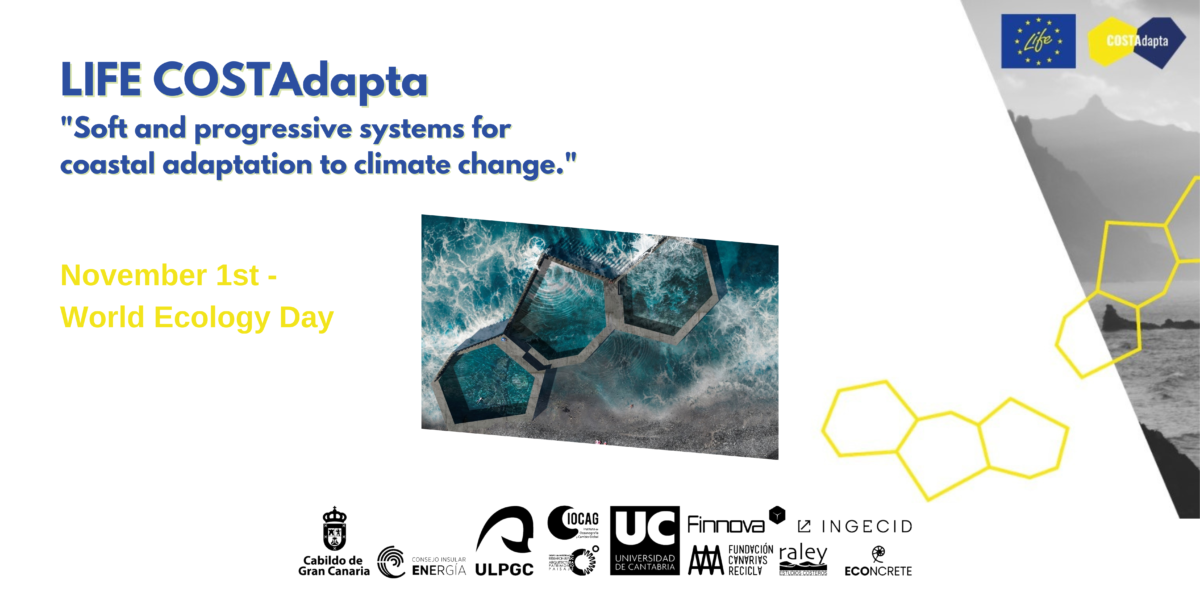
Brussels, November 1st, 2023. Today, Wednesday, November 1st, from the European project LIFE COSTAdapta, we join the global community in commemorating World Ecology Day. This significant occasion aims to raise awareness and sensitize people to the necessity of preserving the environment and promoting ecological actions that contribute to the health of our planet. Through the celebration of this day, we pay tribute to ecology as a scientific discipline and acknowledge the work of ecological professionals.

What is the role of ecology?

Ecology studies the relationships between living beings and the environment that surrounds them, although its focus is not exclusively limited to the study of green areas. It carries out activities and actions that contribute to the sustainability of the environment and the planet, with the goal of improving the quality of life for both humans and their surroundings.

Through ecology, the importance of carrying out actions in harmony with the environment to favor the planet’s biodiversity is promoted. Some examples of these actions include optimizing production, consumption, and services based on ecological criteria, managing generated waste, and conserving water, among other practices.

The pioneering LIFE COSTAdapta system provides advantages to coastal ecosystems

The LIFE COSTAdapta project proposes an integrated ecological solution to strengthen coastal resilience against climate change by creating Tidal pool-reefs. These reefs will not only protect against coastal erosion by quieting waves and currents but also promote ecotourism by attracting visitors interested in sustainability, coastal nature, and the unique local biodiversity of Gran Canarias.

Moreover, the project aims to raise awareness among the community and visitors about the significance of conservation, adding value to local ecological understanding. Furthermore, it focuses on encouraging innovation and research to establish collaborations that can replicate this solution in other coastal regions facing similar challenges, thereby promoting the continuous improvement of this approach through partnerships with experts and public-private collaborations.

About LIFE COSTAdapta

LIFE COSTAdapta project aims to address the adaptation of the coast of Gran Canaria to sea-level rise through an innovative methodology. To achieve this, a progressive system of Tidal pool-reefs will be designed and tested, combining traditional tidal pool construction techniques with advanced solutions.

This will contribute to the gradual adaptation of the Gran Canaria coast to climate change, which is crucial given the high vulnerability of the Canary Islands to climate impacts, including sea-level rise. In addition to strengthening the resilience of coastal areas, LIFE COSTAdapta seeks to preserve the characteristic habitats of these areas and protect the local tourist economy. The project will ensure economic sustainability by providing solutions against flooding and maintaining the region’s tourist appeal, which in turn will favor coastal stability.

The project, with a duration of 7 years and a total budget of 3,409,864 EUR (2,045,818 EUR subsidized by the European Union through the LIFE Program), is coordinated by Consejo Insular de Energía de Gran Canaria (CIEGC) by the Cabildo de Gran Canaria, with the support of its seven partners.