COSTAdapta

Categories
News

LIFE COSTAdapta focuses on coastal adaptation during World Water Week

Ocean warming reinforces the need to prepare coastal areas for the impacts of climate change

Brussels, 25 August 2026. The celebration of World Water Week 2026, taking place from 23 to 27 August under the theme Water for People and Progress, once again places water at the centre of the international debate on sustainability, resilience and climate change.

The international event, held annually in Stockholm, brings together experts, institutions, organisations and other stakeholders involved in water management to address some of the main challenges related to this resource. The 2026 edition pays particular attention to water governance, climate resilience and sustainable development.

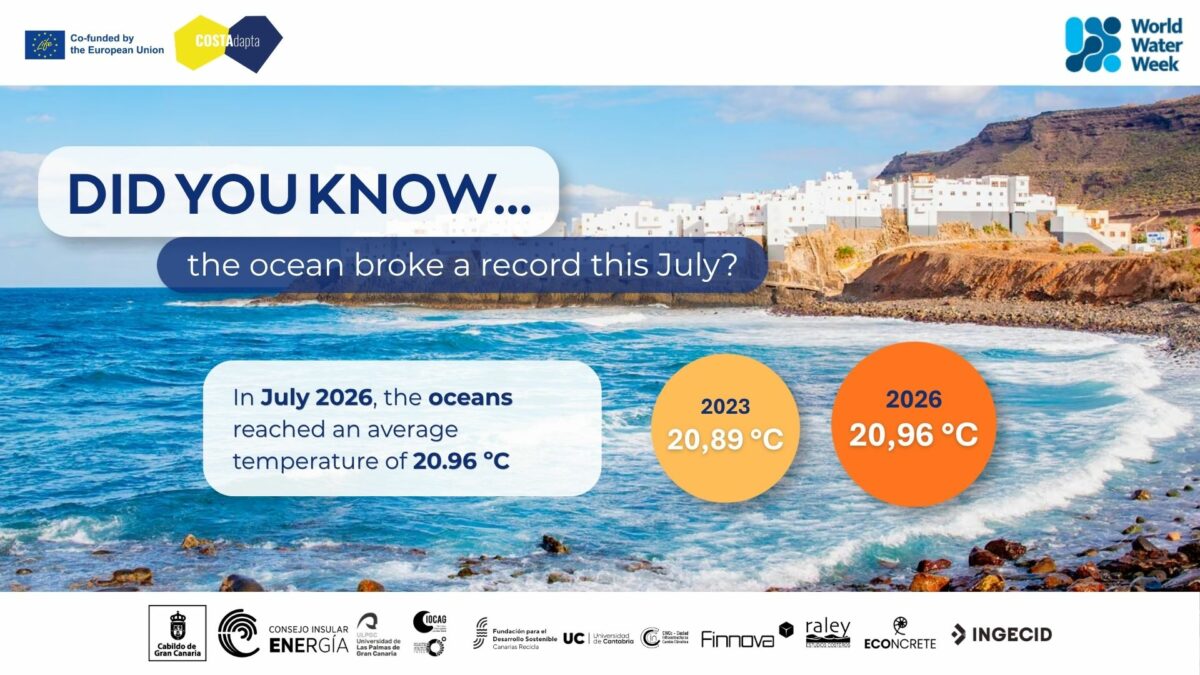
In this context, changes in ocean temperatures are one of the indicators showing the scale of the climate challenge. Copernicus data have confirmed exceptionally high sea surface temperatures throughout 2026. In June, the average temperature over the extratropical ocean reached 20.86 °C, the highest value ever recorded for this month.

These figures show how global warming is altering marine conditions and creating new challenges for coastal territories.

From ocean warming to coastal adaptation

Rising ocean temperatures are part of a changing climate scenario that also affects the dynamics of coastal areas. Sea-level rise, increased exposure to certain extreme events and pressure on marine ecosystems make it necessary to advance adaptation strategies capable of responding to these changes.

LIFE COSTAdapta works precisely in this field.

The European project is developing an innovative methodology to improve the adaptation of Gran Canaria’s coastline to climate change, with particular attention to sea-level rise and wave action.

One of the main solutions proposed is the Tidal Pool-Reef system, inspired by the traditional tidal pools found in the Canary Islands.

The proposal aims to reduce the exposure of certain coastal areas to wave action while creating favourable conditions for marine biodiversity. The approach combines climate adaptation, nature-based solutions and the restoration of coastal ecosystems.

Preparing for a scenario that is already changing

Changes in ocean temperatures highlight the need to move from observation towards adaptation.

LIFE COSTAdapta proposes a response based on knowledge of the territory and the development of solutions capable of integrating coastal protection with ecosystem conservation.

Climate change cannot be stopped by a single project, but territories can be better prepared to face its consequences.

In this regard, World Water Week provides an opportunity to highlight that talking about the future of water also means talking about the future of oceans, coastlines and the communities that depend on them.

About LIFE COSTAdapta

LIFE COSTAdapta has a total budget of €3,337,563 and is 60% co-financed by the European Union’s LIFE Programme.

The project is coordinated by the Gran Canaria Island Energy Council and involves the University of Las Palmas de Gran Canaria, University of Cantabria, INGECID, RALEY Estudios Costeros, ECOncrete, Fundación para el Desarrollo Sostenible Canarias Recicla and Fundación Finnova.

Its objective is to develop and demonstrate innovative solutions to improve the resilience of Gran Canaria’s coastal areas to the impacts of climate change, combining innovation, adaptation, environmental restoration and biodiversity conservation.

More information:
 https://costadapta.energiagrancanaria.com/
Categories
News

LIFE COSTAdapta to present its coastal adaptation solutions at the Atlantic–WestMED Stakeholder Conference 2026

The European project will have a space in the exhibition area of the event, which will bring together stakeholders from the Atlantic and Western Mediterranean in Las Palmas de Gran Canaria

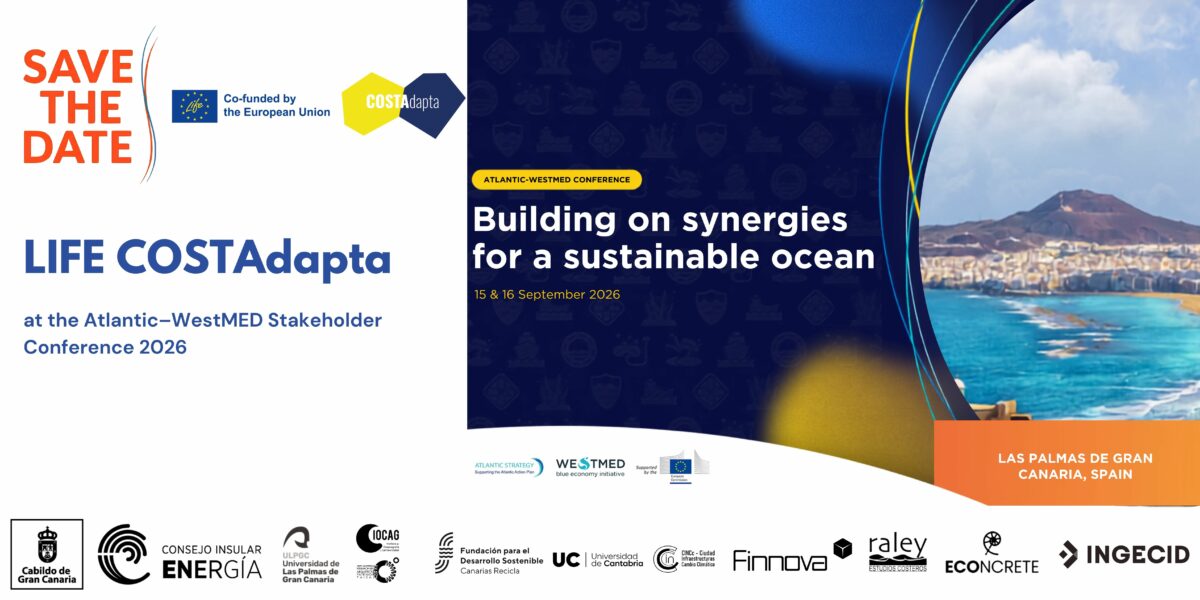
Brussels, 19 August 2026. LIFE COSTAdapta will participate in the Atlantic–WestMED Stakeholder Conference 2026, which will take place on Tuesday 15 and Wednesday 16 September in Las Palmas de Gran Canaria.

The event will bring together policymakers, public authorities, researchers, companies, entrepreneurs, investors, organizations, and European projects from the Atlantic and Western Mediterranean basins. The conference aims to strengthen cooperation, share experiences, and create new opportunities in the field of the blue economy.

LIFE COSTAdapta will have a space in the exhibition area

LIFE COSTAdapta has been invited to participate in the conference’s Exhibition Area, a space for projects and organizations to present their initiatives, solutions and results to participants.

The project will share an exhibition space with ONE-BLUE, a European initiative focused on studying emerging pollutants and their effects on aquatic ecosystems and marine biodiversity.

This participation will provide an opportunity to introduce LIFE COSTAdapta to new European stakeholders and showcase its contribution to adapting coastal areas to climate change.

Nature-inspired solutions

LIFE COSTAdapta is developing an innovative methodology to adapt the coast of Gran Canaria to rising sea levels.

The project proposes the design and testing of a progressive Tidal Pool-Reef system, inspired by the traditional tidal pools found in the Canary Islands. This solution combines traditional techniques with advanced solutions to strengthen coastal resilience and support the conservation of marine habitats.

The initiative also incorporates a participatory approach aimed at integrating the needs of the territory and coastal communities into the adaptation process.

A meeting to strengthen cooperation between basins

The Atlantic–WestMED Stakeholder Conference 2026 represents the first major joint conference of the Atlantic and WestMED maritime strategies. The program includes plenary sessions, thematic meetings, project presentations, and networking activities.

Topics addressed at the event will include coastal resilience, climate adaptation, sustainable tourism, decarbonization, and skills related to the blue economy. The conference will also feature a hackathon aimed at developing new ideas for cooperation and exploring future funding opportunities.

LIFE COSTAdapta’s presence will help strengthen the project’s European visibility and establish new contacts with initiatives and organizations working in marine ecosystem protection, climate adaptation, and the blue economy.

About LIFE COSTAdapta

LIFE COSTAdapta is coordinated by the Gran Canaria Island Energy Council (CIEGC), with the support of seven partner organizations, including the University of Las Palmas de Gran Canaria, the University of Cantabria, INGECID, Raley Estudios Costeros, ECOncrete AQUA, the Canary Foundation for Recycling and Sustainable Development, and Finnova Foundation. The project has a seven-year duration and is funded by the European Union’s LIFE Program.

Categories
News

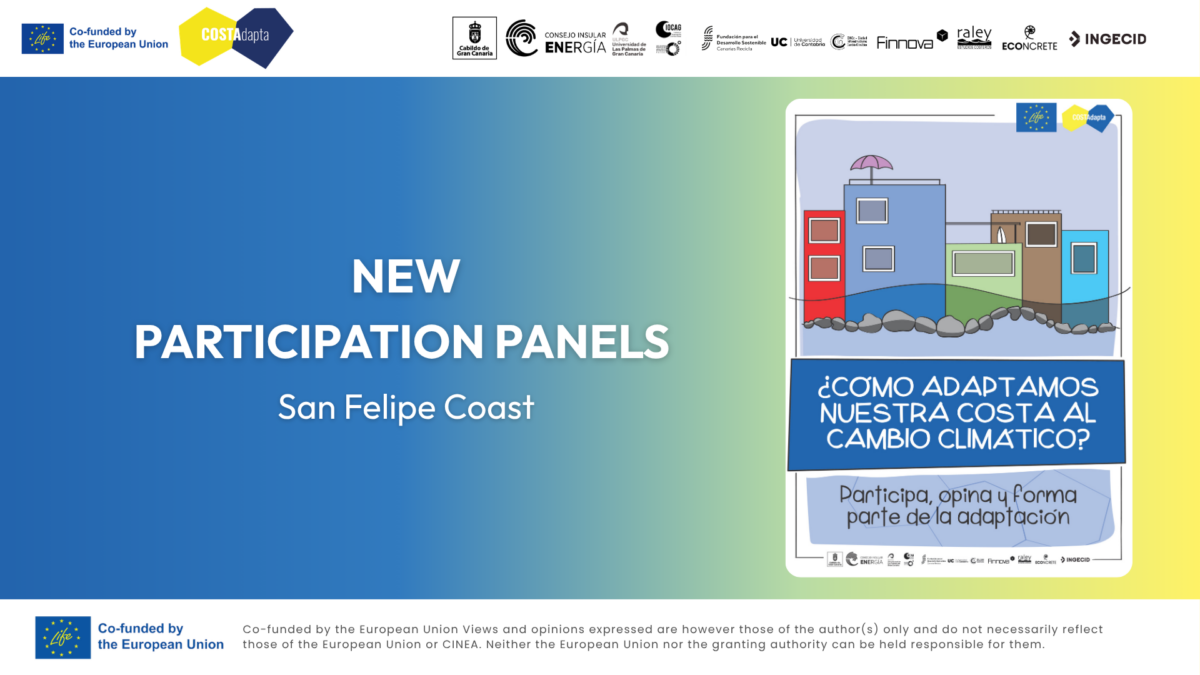
LIFE COSTAdapta makes its coastal adaptation participation panels available online

The materials present the San Felipe coastline diagnosis, its main risks and the proposed solutions to strengthen climate change adaptation

Gran Canaria, 14 August 2026. The European LIFE COSTAdapta project has made the information panels used during its participation activities in San Felipe available to the public. The materials can now be consulted on the project’s official website.

The panels provide a visual and accessible overview of the situation along the San Felipe coastline. Their content covers historical, urban, environmental, social and climate-related aspects of the area.

The materials also present the main risks facing the coastline, including coastal erosion, biodiversity loss and sea level rise.

Information on coastal adaptation solutions

The panels explain the different adaptation measures studied by LIFE COSTAdapta. These include the Tidal Pool-Reef system.

This solution draws inspiration from the traditional tidal pools of the Canary Islands. The project seeks to combine coastal protection with the conservation of the coastline’s biodiversity and environmental and social values.

The materials also explain the project’s working approach. This model combines coastal risk analysis, the design of adaptation solutions, collaboration with local stakeholders and the implementation of measures on the ground.

Citizen participation as part of the project

LIFE COSTAdapta has developed different activities to understand the views of residents and coastal users in San Felipe.

The participation sessions have collected concerns, suggestions and needs related to coastal adaptation. These contributions complement the technical studies carried out by the project partners.

Making the panels available online expands access to this information and keeps the content used during the participation activities available to the public.

Through this approach, LIFE COSTAdapta reinforces its commitment to a coastal adaptation process based on scientific knowledge, innovation and community participation.

A European project for a more resilient coastline

LIFE COSTAdapta is coordinated by the Consejo Insular de la Energía de Gran Canaria (CIEGC) and includes the Universidad de Las Palmas de Gran Canaria, the Universidad de Cantabria, INGECID, Raley Estudios Costeros, ECOncrete AQUA, Fundación Canaria para el Reciclaje y Desarrollo Sostenible and Fundación Finnova.

The project has a total budget of €3,409,864 and receives 60% co-financing from the European Union’s LIFE Programme. Its planned duration is 84 months.

The panels are available on the official LIFE COSTAdapta website:

Categories
News

San Felipe and El Circo take the floor: residents and surfers co-design the protection of Gran Canaria’s coastline through LIFE COSTAdapta

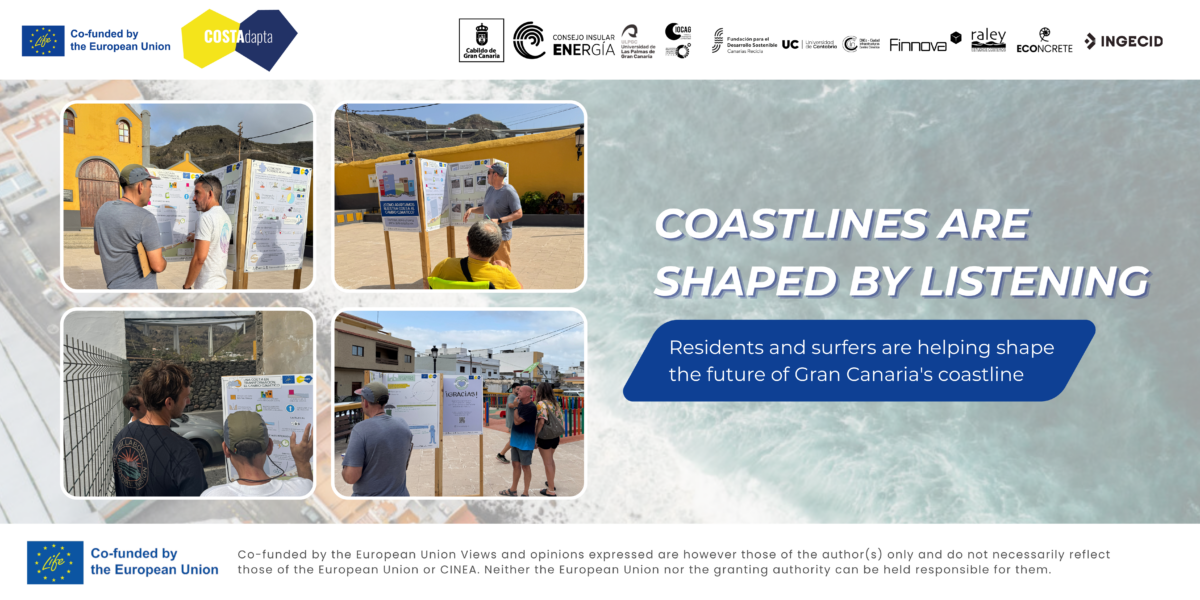
Throughout July, a mobile community engagement initiative collected first-hand proposals from local residents and coastal users on the innovative Tidal Pool-Reef system.

The contributions, questions and suggestions gathered during this active listening campaign will now be analysed to provide direct feedback to the local community.

Brussels, 3 August 2026 – The European project LIFE COSTAdapta has concluded its community engagement campaign carried out throughout July in northern Gran Canaria. Through a mobile outreach initiative, the project team met directly with residents and coastal users to explain the project’s technical progress in an accessible way and, above all, to listen to the community’s views first-hand.

The initiative focused on two key locations along the coastline of Santa María de Guía: the neighbourhood of San Felipe and the El Circo surf break, one of the main gathering points for the local surfing community. Through information panels installed on-site, visitors were able to learn about the design of the innovative Tidal Pool-Reef system. Inspired by the traditional intertidal tidal pools of the Canary Islands, this nature-based solution aims to protect the coastline against sea level rise while combining coastal defence with the ecological restoration of marine flora and fauna.

Community participation and active listening

Beyond providing information, the main objective of the mobile outreach initiative was to give the local community a voice through a fully inclusive participation process. The campaign gathered questions, suggestions and feedback from residents, surfers and visitors who regularly use this stretch of coastline.

All the information, concerns and proposals collected during the campaign are currently being analysed by the LIFE COSTAdapta technical team. The results will be used to prepare detailed responses, which will soon be shared directly with the local community. The project consortium emphasises that co-designing adaptation measures with local stakeholders is essential to ensuring that coastal adaptation solutions are both sustainable and respectful of the area’s traditional coastal uses.

About the project

LIFE COSTAdapta has a total budget of €3,337,563, of which €2,002,538 is co-funded by the European Union’s LIFE Programme. The project has a duration of seven years and is coordinated by the Gran Canaria Island Energy Council (Consejo Insular de la Energía de Gran Canaria – CIEGC), part of the Cabildo de Gran Canaria.

The project consortium brings together a multidisciplinary team comprising CIEGC, the University of Las Palmas de Gran Canaria (ULPGC), the University of Cantabria (UC), INGECID, RALEY Estudios Costeros S.C.P., ECOncrete AQUA, the Canary Islands Foundation for Recycling and Sustainable Development (Canarias Recicla – FCR), and the Finnova Foundation. For more information, visit: https://costadapta.energiagrancanaria.com/