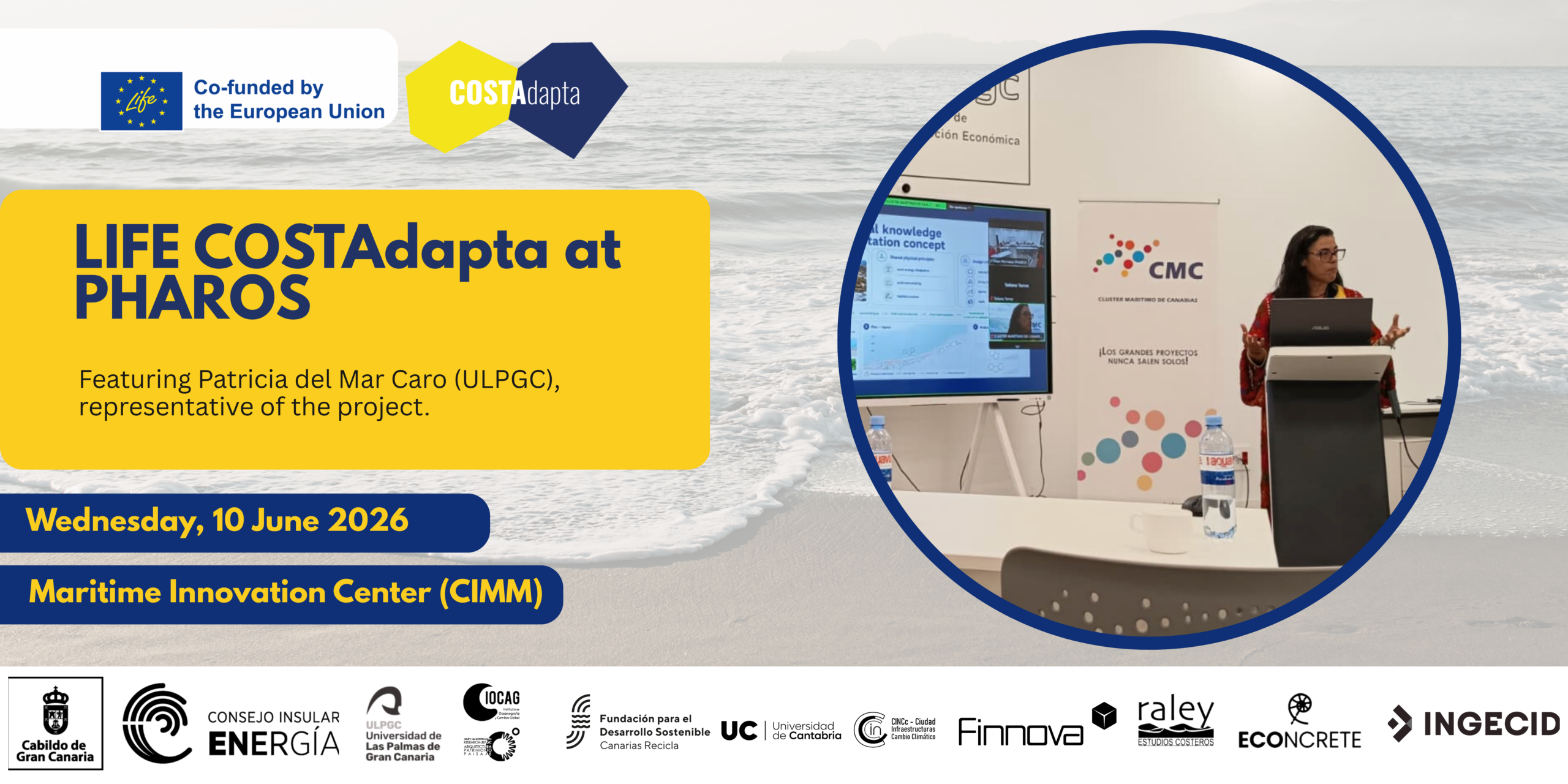
- Researcher Patricia del Mar Caro (ULPGC) represented the consortium last Wednesday, June 10th, at the roundtable held at the CIMM
- The meeting gathered experts to identify regulatory bottlenecks and propose legal frameworks that streamline coastal innovation
Monday, 22 June 2026, Gran Canaria. LIFE COSTAdapta participated in the second roundtable of the “Permitting Challenges & Opportunities” series organized by PHAROS, held on 10 June at the Centro de Innovación Marino Marítima (CIMM). The event provided a space for dialogue bringing together representatives of European blue economy projects to analyze the main regulatory and administrative barriers affecting the implementation of innovative initiatives in marine and coastal environments.
Representing the project, Patricia del Mar Caro, climate adaptation specialist at the Universidad de Las Palmas de Gran Canaria (ULPGC), presented the work developed by LIFE COSTAdapta to improve the resilience of island coastlines against sea level rise and coastal erosion.
Coastal adaptation facing administrative challenges
The session highlighted a shared reality among many European projects: difficulties arising from authorization processes, fragmented responsibilities across public administrations, and the complexity of procedures required to deploy innovative solutions.
During her intervention, Patricia del Mar Caro emphasized the role of LIFE COSTAdapta as a nature-based coastal adaptation demonstrator project. Its goal is to develop solutions inspired by traditional natural seawater pools in the Canary Islands to protect coastlines from climate change impacts, while also promoting environmental restoration and biodiversity conservation.
She also shared the project’s experience in implementing pilot actions in highly vulnerable coastal areas, stressing the importance of regulatory frameworks that allow faster validation and deployment of innovative solutions.
A European debate to boost blue innovation
The roundtable also included contributions from DesaLIFE (Ocean Oasis), Ocean Gardens (MacroCarbon), and the Instituto Tecnológico de Canarias (ITC), each offering different perspectives on marine innovation, water management, sustainability, and the blue economy.
The conclusions of the meeting showed that many innovative projects are not primarily limited by technical or scientific constraints, but rather by the complexity of administrative procedures. Key recommendations included identifying required permits early in the process, improving coordination between responsible authorities, adapting regulatory requirements to pilot project scales, and promoting mechanisms that facilitate experimentation and innovation in the marine sector.
The outcomes of this session will contribute to a policy recommendations document led by PHAROS, aimed at providing public administrations with concrete proposals to improve authorization systems and accelerate the deployment of innovative solutions in the blue economy.
About the project
LIFE COSTAdapta has a budget of €3.4 million and is co-funded by the European Union’s LIFE Programme. The project consortium includes the Insular Energy Council of Gran Canaria, the Universidad de Las Palmas de Gran Canaria, the Universidad de Cantabria, Ingecid, RALEY, ECOncrete, the Canary Islands Sustainable Development Foundation Canarias Recicla, and the Finnova Foundation.
Its objective is to develop an innovative coastal adaptation solution inspired by traditional natural seawater pools in the Canary Islands, combining coastal protection, environmental restoration, and biodiversity conservation.
More information: https://lifecostadapta.com/