The European project stresses the importance of understanding climate change to strengthen the adaptation of Gran Canaria’s coastline
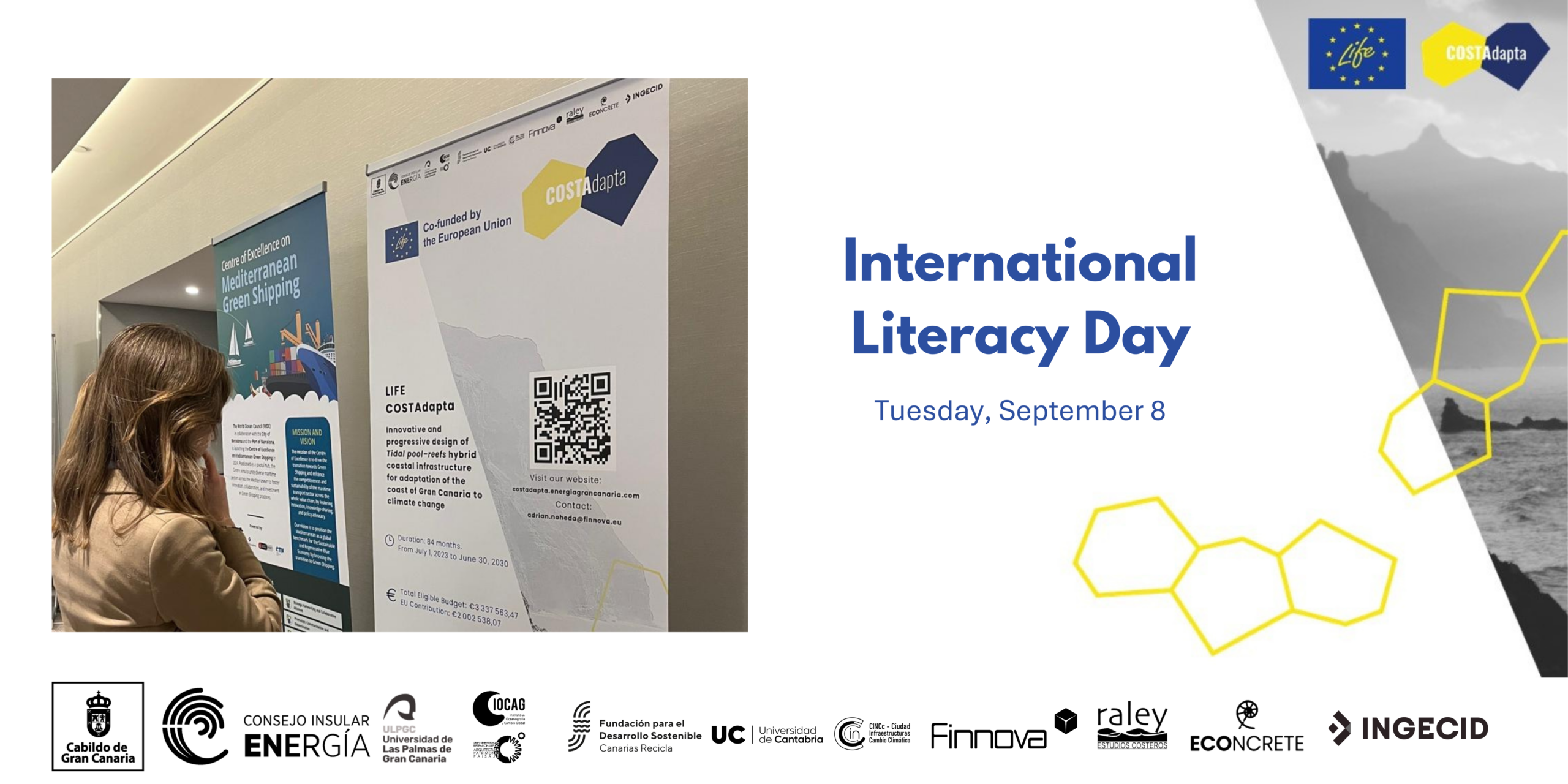
Gran Canaria, 8 September 2026. The celebration of International Literacy Day highlights the importance of access to knowledge as a tool for addressing major social and environmental challenges. In this context, the European project LIFE COSTAdapta highlights the role of environmental literacy in understanding the impacts of climate change and advancing towards a more resilient coastline in Gran Canaria.
Understanding how the coastline is changing, what consequences sea level rise may have and what adaptation options are available allows citizens to participate more actively and knowledgeably in the protection of their environment.
Environmental literacy is particularly relevant in island territories such as the Canary Islands, where coastal areas concentrate a significant part of economic, social and recreational activity. For LIFE COSTAdapta, climate change adaptation must go hand in hand with knowledge and awareness among the people who live in and enjoy these spaces.
A coastline prepared for the future
LIFE COSTAdapta addresses the adaptation of Gran Canaria’s coastline to sea level rise through an innovative methodology based on the design and testing of a progressive Tidal pool-reef system.
The proposal combines traditional tidal pool construction techniques, characteristic of the Canary Islands and Macaronesia, with advanced solutions. The aim is to progressively strengthen natural coastal protection, support the creation and conservation of habitats and help reduce vulnerability to the effects of climate change.
The project is based on a principle of particular relevance to local communities: coastal adaptation must allow these spaces to remain part of everyday life for local communities.
LIFE COSTAdapta therefore seeks to increase coastal resilience without affecting local use. Protecting coastal areas also contributes to safeguarding economic activities linked to the coastline, including tourism, without proposing a transformation of beaches aimed at replacing their use by local residents.
Knowledge for shared adaptation
Awareness is essential to ensure that adaptation solutions are understood and valued by society. Environmental literacy helps translate concepts such as sea level rise, coastal erosion and climate resilience into the everyday reality of people living close to the sea.
In this context, LIFE COSTAdapta approaches adaptation as a process that requires knowledge, innovation and collaboration between public authorities, the scientific community, businesses and citizens.
The project is coordinated by the Gran Canaria Island Energy Council (CIEGC), part of the Cabildo de Gran Canaria, and brings together seven partners: University of Las Palmas de Gran Canaria (ULPGC), University of Cantabria (UC), INGECID, Investigación y Desarrollo de Proyectos, Raley Estudios Costeros S.C.P., ECOncrete AQUA, Fundación Canaria para el Reciclaje y Desarrollo Sostenible (FCR) and Fundación Finnova.
With a duration of 84 months, LIFE COSTAdapta has a total budget of €3,337,563, of which €2,002,53 is co-financed by the European Union through the LIFE Programme.
The initiative contributes to European climate adaptation objectives and reinforces the need to prepare coastal areas for an environmental scenario undergoing significant transformation.
More information:
Press contact:
Fundación Finnova