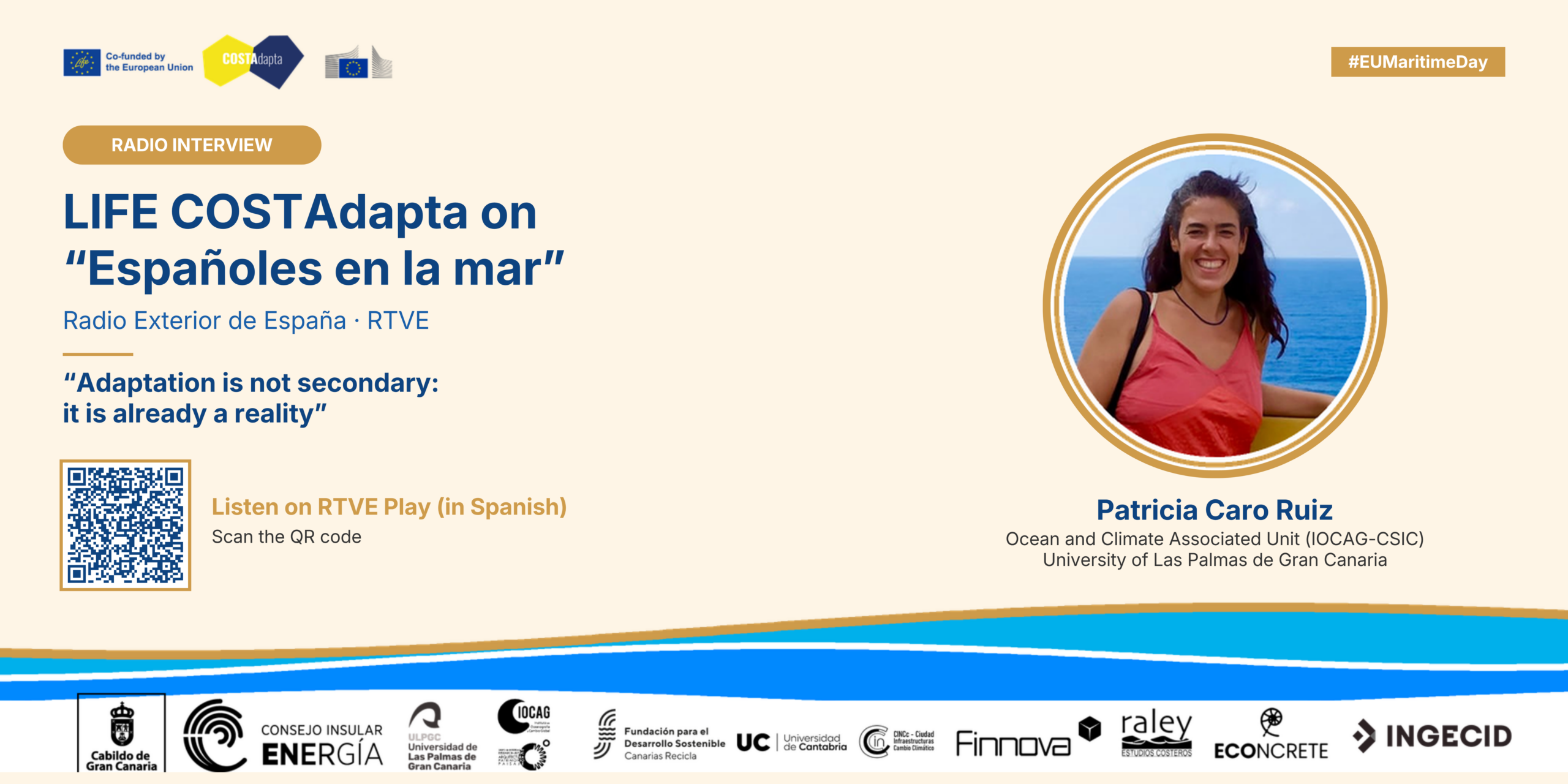
Patricia Caro Ruiz (IOCAG-CSIC, ULPGC) explains on Radio Exterior de España how tidal pools can reduce coastal risk in Gran Canaria and reviews the project’s webinar on the EU Outermost Regions
Las Palmas de Gran Canaria, Wednesday 4 November 2026. The LIFE COSTAdapta project was featured on “Españoles en la mar”, the Radio Exterior de España (RTVE) programme about the sea. Patricia Caro Ruiz, project manager at the Ocean and Climate Associated Unit (IOCAG-CSIC) of the University of Las Palmas de Gran Canaria, talked about the project and the conclusions of the webinar held the day before, in an interview recorded on Thursday 29 October.
Tidal pools against climate change
On the Canary Islands’ rocky, wave-battered coasts, with few sandy beaches, tidal pools are a familiar feature. ULPGC researchers began studying their adaptation role: these structures break waves and reduce the energy reaching the shore. They are also part of local culture and have a far smaller landscape impact than conventional coastal works.
“The beach itself should provide the protection, with small interventions that help it stabilise,” Patricia Caro explained. The project moves away from “hard” engineering, using an innovative concrete that helps larvae colonise the structure and creates new marine habitats.
The prototype will be built in a coastal neighbourhood of Santa María de Guía, within one of the seven high-risk areas identified in Gran Canaria by PIMAC Costas Canarias. The construction design is ready, after modelling to optimise location, orientation, materials and building method.
Exposed islands, tailored solutions
Patricia Caro noted that on islands, people and essential services — such as desalination and power plants — are concentrated on the coast, highly exposed to sea-level rise, erosion and extreme events. “There is no single solution for the whole coast, but a range of solutions” to be designed for each stretch.
Looking back at the webinar of Wednesday 28 October, held for European Maritime Day In My Country 2026 with the Canary Islands, the Azores and Madeira, she highlighted that the Outermost Regions share common problems and a common path: understanding coastal risk in detail, planning the coastline, strengthening early warning and taking action. “Adaptation is not secondary; it is already a reality,” she concluded.
LIFE COSTAdapta is coordinated by the Island Energy Council of Gran Canaria (Cabildo de Gran Canaria), with the University of Las Palmas de Gran Canaria, the University of Cantabria, INGECID, Raley Estudios Costeros, ECOncrete, Fundación Finnova and Fundación Canarias Recicla as partners.
🎧 Listen to the interview (in Spanish) on RTVE Play: https://www.rtve.es/play/audios/espanoles-en-la-mar/microorganismos-clave-para-entender-evolucion/17288749/
About LIFE COSTAdapta
LIFE COSTAdapta is a seven-year project with a total budget of €3,337,563, of which €2,002,538 is provided by the EU LIFE programme. It is coordinated by the Island Energy Council of Gran Canaria (CIEGC), Cabildo de Gran Canaria, together with seven partners.
LIFE COSTAdapta project, co-funded by the European Union LIFE programme. Funded by the European Union. Views and opinions expressed are however those of the author(s) only and do not necessarily reflect those of the European Union or the European Climate, Infrastructure and Environment Executive Agency (CINEA). Neither the European Union nor the granting authority can be held responsible for them.