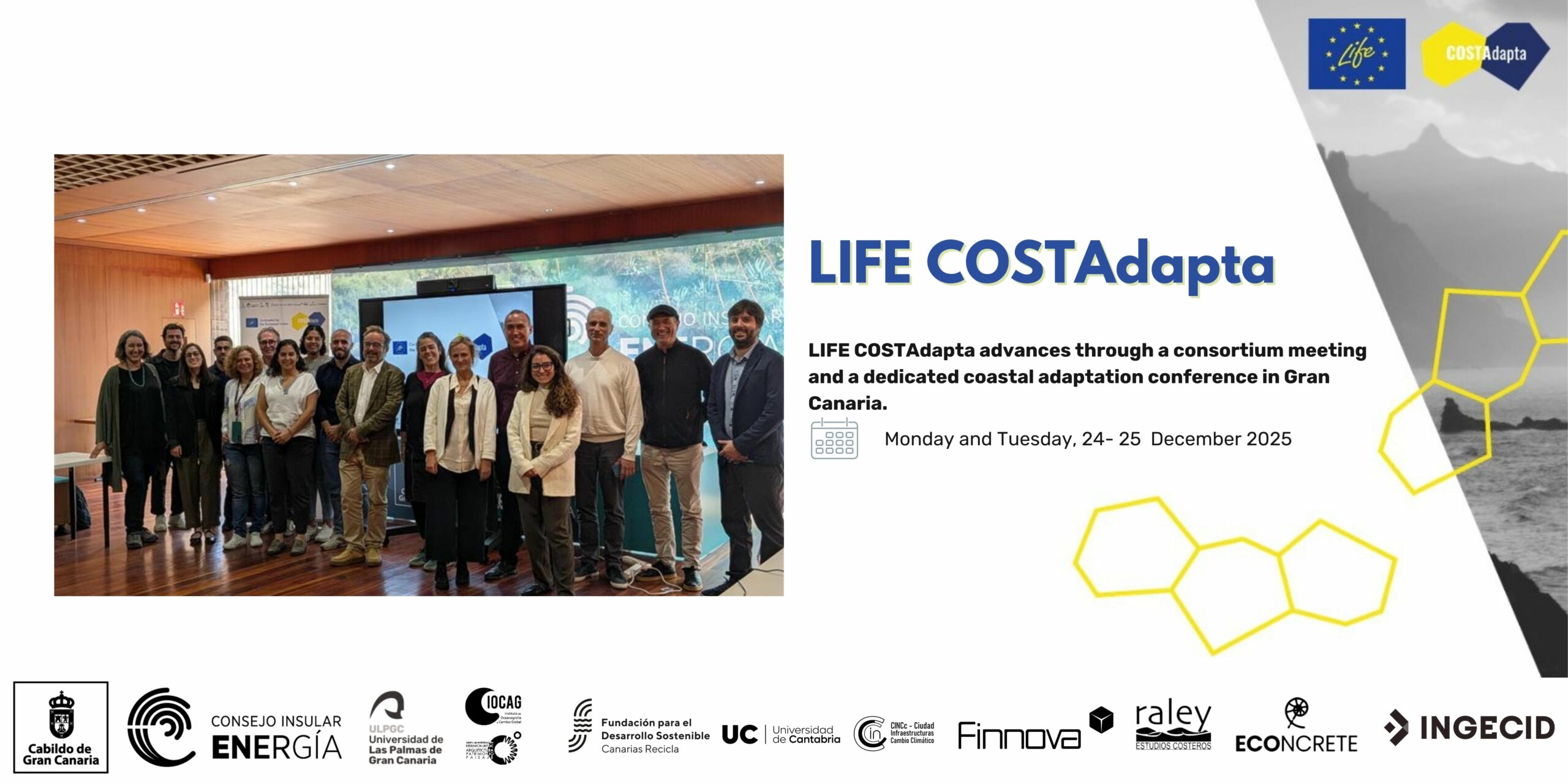
The island hosted a consortium meeting, a field visit to San Felipe and the First Conference on Coastal Adaptation to Climate Change in Island Regions on 24 and 25 November
Las Palmas de Gran Canaria, 8 December 2025 — The European project LIFE COSTAdapta held two days of intensive work on 24 and 25 November in Gran Canaria, combining technical coordination, a visit to the pilot area and an institutional event included in the EURegionsWeek close to you programme. The activities brought together the project consortium, the ELMEN mechanism monitor from CINEA and institutional and academic representatives committed to coastal adaptation to climate change.
The first day took place at the headquarters of the Island Energy Council of Gran Canaria (CIEGC), where the second in-person consortium meeting was held with the participation of Sara Barceló, monitor of the ELMEN mechanism from CINEA. During the session, the consortium reviewed the status of the project, ongoing deliverables and upcoming technical and administrative milestones. The meeting strengthened internal planning for the development phase of the tidal pool–reef system, an innovative solution inspired by the traditional tidal pools of the archipelago.
In the afternoon, part of the delegation travelled to the pilot area in San Felipe to observe the location where the coastal adaptation solution will be implemented. The visit made it possible to better understand the dynamics of the shoreline and the interaction between the sea and nearby inhabited areas, including a home affected by coastal retreat. This experience highlighted the urgency of advancing solutions that combine scientific knowledge, territorial governance and respect for the traditional use of the Canary Islands’ coastline.
The second day was dedicated to the First Conference on Coastal Adaptation to Climate Change in Island Regions, organised by CIEGC and the Finnova Foundation under the EURegionsWeek close to you programme. The institutional opening featured the participation of Raúl García Brink, Councillor for Environment, Climate, Energy and Knowledge of the Island Council of Gran Canaria; the presence of Lluís Serra Majem, Rector of the University of Las Palmas de Gran Canaria; and the participation of Adrián Noheda, project manager and expert in European funding at Finnova. The conference included thematic sessions involving projects and entities working on coastal adaptation in vulnerable territories, such as NATALIE, IMPLACOST, Blue Green Governance and MasDunas, together with experts from the Government of the Canary Islands and the University of Las Palmas de Gran Canaria.
Discussions focused on multilevel climate governance, funding challenges and the need for replicable models that allow island regions to strengthen their resilience. The event generated notable media interest and was covered by outlets such as Radio Televisión Canaria, which highlighted Gran Canaria’s growing role as a reference point in coastal adaptation at the European level.
In the afternoon, the consortium held a follow-up technical session focusing on communication, replicability, sustainability and the exploitation of results. The session aimed to ensure that the methodologies and knowledge generated by the project can be transferred to other European territories affected by sea level rise.
LIFE COSTAdapta aims to design and test an innovative tidal pool–reef system that strengthens the adaptive capacity of Gran Canaria’s coastline in response to sea level rise, while preserving local coastal uses, enhancing biodiversity and contributing to the tourism economy. The project has a total budget of €3,337,563, of which €2,002,538 is co-funded by the European Union through the LIFE Programme. The initiative runs for seven years and is coordinated by CIEGC, with the participation of the University of Las Palmas de Gran Canaria, University of Cantabria, INGECID, Raley Coastal Studies, ECOncrete AQUA, the Canary Foundation for Recycling and Sustainable Development, and the Finnova Foundation.
Media coverage of the event can be accessed through the report published by Radio Televisión Canaria:
https://rtvc.es/gran-canaria-se-convierte-en-referencia-europea-en-adaptacion-costera-26-noviembre-2025/
For more information on the project: https://costadapta.energiagrancanaria.com/