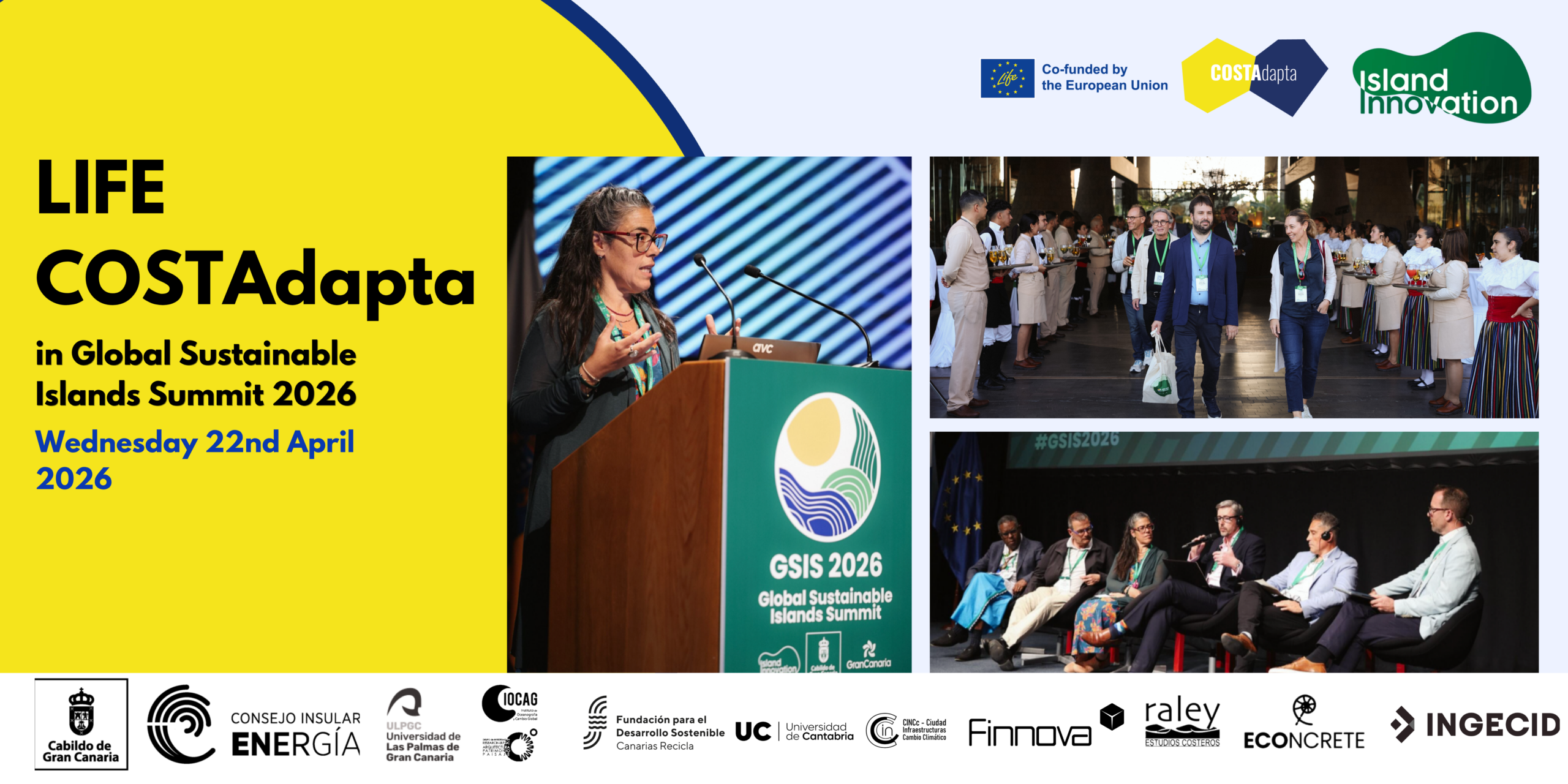
- The European project participated in the Global Sustainable Islands Summit 2026
- Patricia Caro Ruiz (ULPGC) highlighted “soft systems” as a response to the climate risk already present along the coastline
- Adrián Noheda (Finnova Foundation) fostered new connections in climate finance and international cooperation
Brussels, Monday May 11th, 2026. The European project LIFE COSTAdapta, coordinated by the Island Energy Council of Gran Canaria (CIEGC), participated in the Global Sustainable Islands Summit (GSIS 2026), held on Wednesday, April 22 and Thursday, April 23, 2026, in Gran Canaria (Spain). The project presented its coastal resilience approach based on hybrid solutions inspired by nature.
The event featured contributions from Patricia Caro Ruiz, technical coordinator of the project and professor at the University of Las Palmas de Gran Canaria (ULPGC), and Adrián Noheda, project manager at the Finnova Foundation, the entity responsible for communication and strategic support of the project. This participation is part of LIFE COSTAdapta’s strategy to promote climate change adaptation in island territories through knowledge transfer, international cooperation, and the development of solutions applied to local contexts.
An international meeting for coastal adaptation in islands
GSIS 2026 brought together institutional representatives, scientists, and stakeholders from the blue economy sector to address sustainability challenges in island territories. With over 500 delegates representing 67 countries worldwide, the summit provided a platform for exchanging ideas and best practices.
In this context, LIFE COSTAdapta shared its vision on the need to integrate climate adaptation into coastal planning, based on the premise that climate change-related risks are already present along the coastline.
During her intervention, Patricia Caro Ruiz (ULPGC) emphasized the importance of so-called “soft systems” for progressive coastal adaptation, based on the combination of natural processes and adaptive design as an alternative to traditional rigid infrastructures.
Nature-based solutions: the reef–tidal pool system
One of the key elements presented was the reef–tidal pool prototype, a hybrid solution that integrates natural pools, artificial reefs, and living structures. This system is designed to reduce wave energy, enhance sediment stability, and create marine habitats, thereby contributing to coastal protection and biodiversity.
International cooperation and climate finance
During the summit, Adrián Noheda (Finnova Foundation) carried out an agenda focused on identifying European funding opportunities and establishing new strategic partnerships for scaling up nature-based solutions. His participation helped strengthen the project’s connections with international stakeholders in climate innovation and coastal management.
About the project
The LIFE COSTAdapta project, coordinated by the Island Energy Council of Gran Canaria (CIEGC), has a budget of €3,337,563, co-funded at 60% by the European Union’s LIFE Programme. Its mission is to transform coastal adaptation through hybrid systems inspired by nature.
The multidisciplinary consortium is composed of: the University of Las Palmas de Gran Canaria (ULPGC), the University of Cantabria (UC), INGECID, Raley Coastal Studies, ECOncrete AQUA, the Canary Foundation for Recycling and Sustainable Development (FCR), and the Finnova Foundation.
For more information:
https://costadapta.energiagrancanaria.com/