Ocean warming reinforces the need to prepare coastal areas for the impacts of climate change
Brussels, 25 August 2026. The celebration of World Water Week 2026, taking place from 23 to 27 August under the theme Water for People and Progress, once again places water at the centre of the international debate on sustainability, resilience and climate change.
The international event, held annually in Stockholm, brings together experts, institutions, organisations and other stakeholders involved in water management to address some of the main challenges related to this resource. The 2026 edition pays particular attention to water governance, climate resilience and sustainable development.
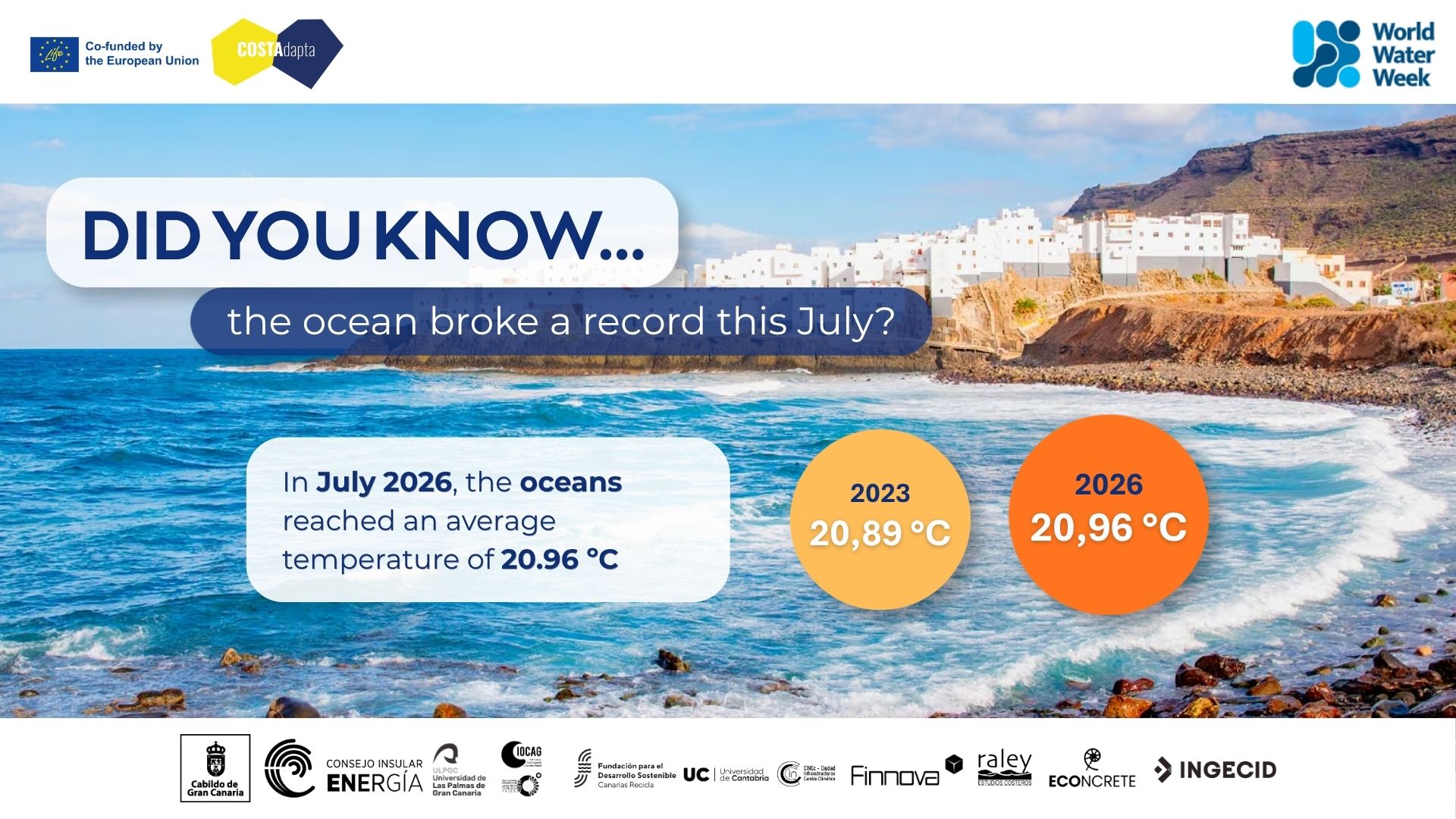
In this context, changes in ocean temperatures are one of the indicators showing the scale of the climate challenge. Copernicus data have confirmed exceptionally high sea surface temperatures throughout 2026. In June, the average temperature over the extratropical ocean reached 20.86 °C, the highest value ever recorded for this month.
These figures show how global warming is altering marine conditions and creating new challenges for coastal territories.
From ocean warming to coastal adaptation
Rising ocean temperatures are part of a changing climate scenario that also affects the dynamics of coastal areas. Sea-level rise, increased exposure to certain extreme events and pressure on marine ecosystems make it necessary to advance adaptation strategies capable of responding to these changes.
LIFE COSTAdapta works precisely in this field.
The European project is developing an innovative methodology to improve the adaptation of Gran Canaria’s coastline to climate change, with particular attention to sea-level rise and wave action.
One of the main solutions proposed is the Tidal Pool-Reef system, inspired by the traditional tidal pools found in the Canary Islands.
The proposal aims to reduce the exposure of certain coastal areas to wave action while creating favourable conditions for marine biodiversity. The approach combines climate adaptation, nature-based solutions and the restoration of coastal ecosystems.
Preparing for a scenario that is already changing
Changes in ocean temperatures highlight the need to move from observation towards adaptation.
LIFE COSTAdapta proposes a response based on knowledge of the territory and the development of solutions capable of integrating coastal protection with ecosystem conservation.
Climate change cannot be stopped by a single project, but territories can be better prepared to face its consequences.
In this regard, World Water Week provides an opportunity to highlight that talking about the future of water also means talking about the future of oceans, coastlines and the communities that depend on them.
About LIFE COSTAdapta
LIFE COSTAdapta has a total budget of €3,337,563 and is 60% co-financed by the European Union’s LIFE Programme.
The project is coordinated by the Gran Canaria Island Energy Council and involves the University of Las Palmas de Gran Canaria, University of Cantabria, INGECID, RALEY Estudios Costeros, ECOncrete, Fundación para el Desarrollo Sostenible Canarias Recicla and Fundación Finnova.
Its objective is to develop and demonstrate innovative solutions to improve the resilience of Gran Canaria’s coastal areas to the impacts of climate change, combining innovation, adaptation, environmental restoration and biodiversity conservation.
More information:
https://costadapta.energiagrancanaria.com/