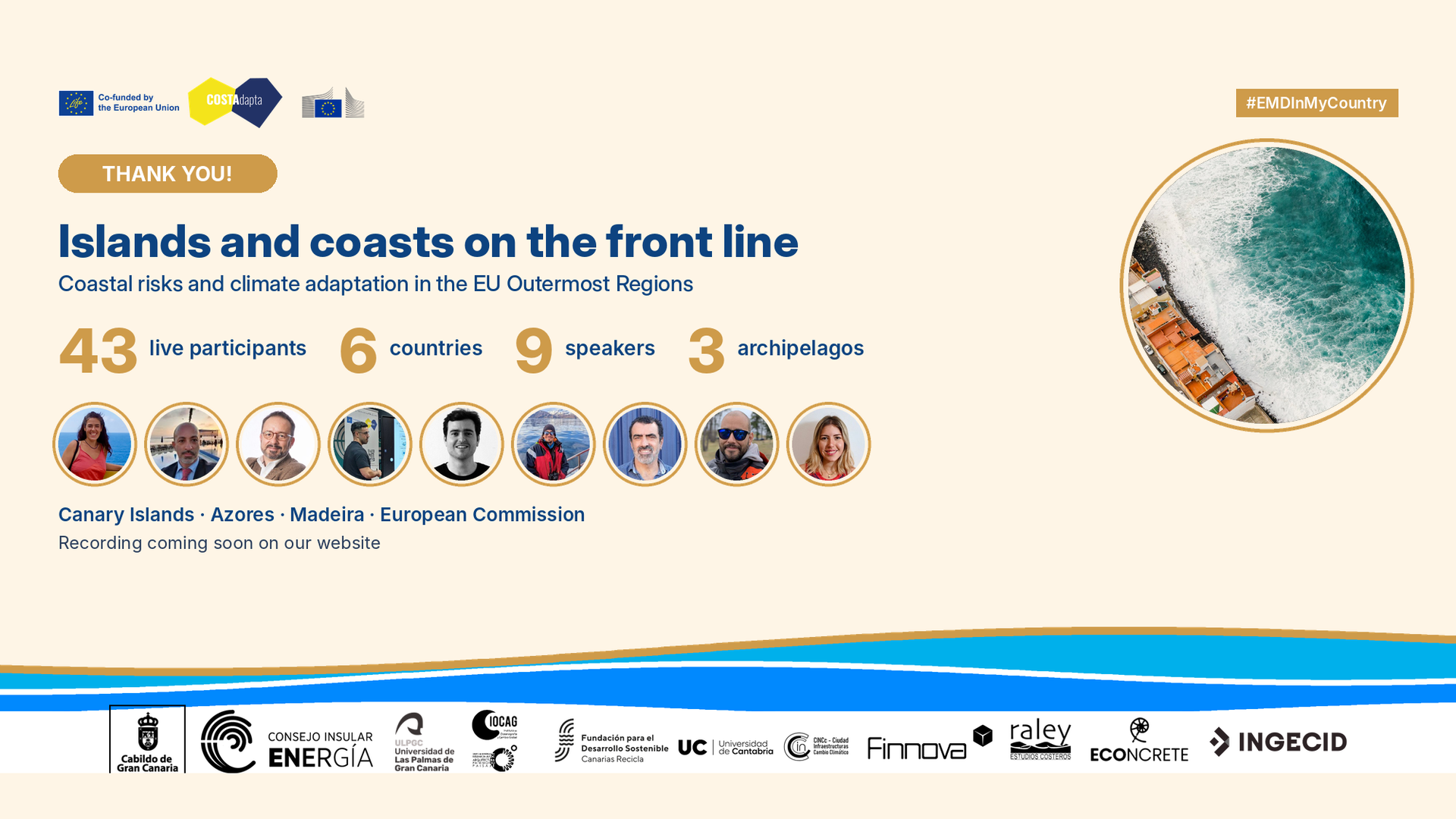
The Canary Islands, the Azores and Madeira, together with the European Commission, discussed their coastal risks, the solutions they are already testing and how to fund climate adaptation.
Las Palmas de Gran Canaria, 28 October 2026. The LIFE COSTAdapta project today held the webinar “Islands and coasts on the front line: coastal risks and climate adaptation in the EU Outermost Regions”, organised by project partner Fundación Finnova as part of European Maritime Day In My Country 2026. 43 people from six countries (Spain, Portugal, Belgium, France, Italy and Saudi Arabia) followed the event live, with more than 50 registrations. Participants included representatives of the European Commission; the governments of the Canary Islands, the Azores and Madeira; universities and research centres such as ULPGC, the University of Cantabria, the French Geological Survey (BRGM) and the University of Pisa; and blue economy companies and organisations.
The European perspective
Dario Vaschetto, Policy Officer at the European Commission’s Directorate-General for Maritime Affairs and Fisheries (DG MARE), presented the new European strategy for coastal communities, adopted in June alongside the strategy for islands, and the new strategic vision for the Outermost Regions published in September. The strategy is built on three pillars (prosperity, resilience and liveability) and includes 13 flagship actions, among them mapping the investment needed for climate adaptation in coastal areas.
Canary Islands: from risk to action
Raúl Salvador García Brink, Councillor for the Environment, Climate, Energy and Knowledge of the Gran Canaria Island Council, stressed that coastal risks already affect the island’s safety, economy and heritage: around 940 metres of Las Canteras beach show medium or high coastal risk, and 55 of the 343 protected heritage sites assessed in the Canary Islands could be affected by sea-level rise. He called for moving “from pilot projects to large-scale implementation”, with stable funding and stronger coordination between administrations.
Nareme Herrera, from the University of Cantabria, presented the risk analysis of San Felipe (Santa María de Guía), a high cumulative coastal risk area where the shoreline retreated by an average of 7.6 metres between 1955 and 2020.
A hybrid solution in San Felipe
Iñaki Pérez Anzola, architect and researcher at ULPGC, explained the LIFE COSTAdapta tidal pool–reef system. Inspired by traditional Canarian tidal pools, it combines three functions: dissipating wave energy, stabilising sediments and providing surfaces that support colonisation by marine organisms. It is a much-needed response: under one of the most demanding climate scenarios for 2100, more than 80 % of San Felipe’s dwellings could be affected by coastal flooding.
Three archipelagos, one challenge
In the round table moderated by Patricia Caro Ruiz (IOCAG – ULPGC), Asier Furundarena Hernández (Gesplan) presented the IMPLACOST project, which is developing coastal prediction systems for Macaronesia: between 1980 and 2025, 158 extreme marine events and more than 539 impacts were recorded in the Canary Islands. Renato Sérgio Verdadeiro Marques (Government of the Azores) explained the archipelago’s flood risk management plan and a new camera-based early-warning system inspired by Madeira’s experience. Nuno Marques (LIFE DUNAS, Government of Madeira) showed how the Porto Santo dune is being rebuilt with nature-based solutions.
Participants agreed on the key: sharing data and solutions between regions. “We need to speak more, louder and faster,” said Asier Furundarena.
A fund for each step
Paulina Menem, European Union Project Manager at Fundación Finnova, explained that “there is not a single fund for everything, but a fund for each step”: LIFE and Horizon Europe to understand risk and test solutions, Interreg to replicate them in other regions, and the ERDF to scale them up. She highlighted the upcoming 2027 calls, such as those under the Horizon Europe missions on oceans and on climate adaptation.
Conclusions
Patricia Caro Ruiz closed the session with four ideas: understanding risk is the first step to adaptation; hybrid and nature-based solutions can protect the coast while supporting biodiversity; the Outermost Regions move faster by sharing experience; and European funding turns plans into real projects.
The recording of the webinar will be available on the LIFE COSTAdapta website and its social media.
LIFE COSTAdapta (LIFE22-CCA-ES-LIFE-COSTAdapta) is co-funded by the European Union through the LIFE programme, with a total budget of €3,337,563, of which €2,002,538 is the European Union contribution.
Co-funded by the European Union. Views and opinions expressed are however those of the author(s) only and do not necessarily reflect those of the European Union or CINEA. Neither the European Union nor the granting authority can be held responsible for them.